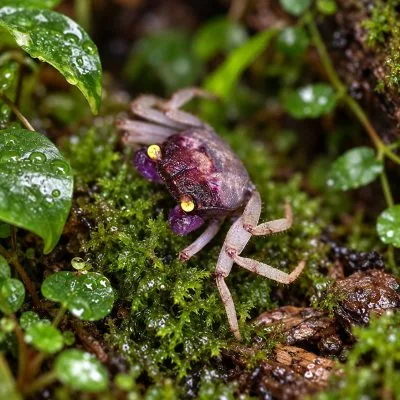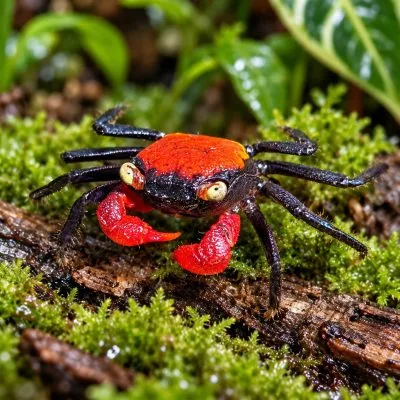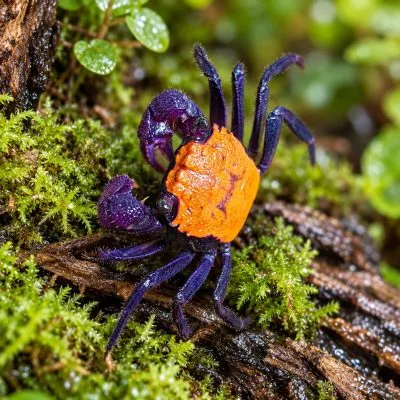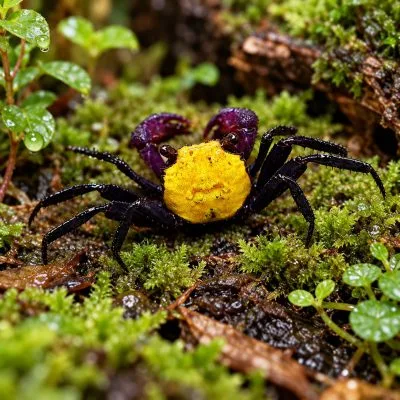
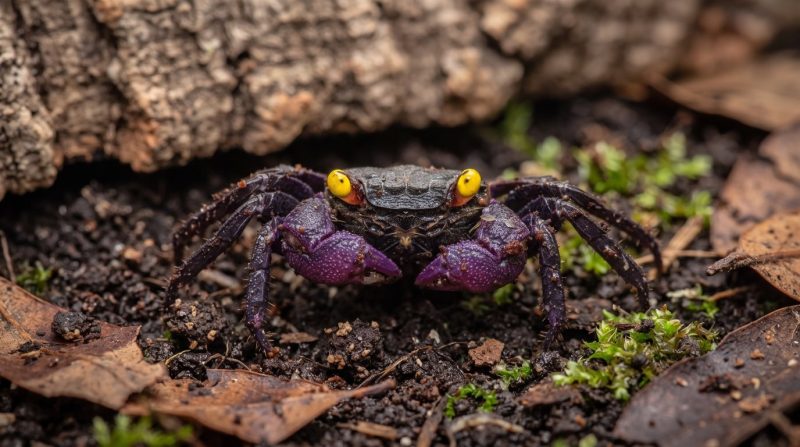
Vampire crabs have small broods: one clutch produces up to about 40 crablets, tiny crabs about 2 to 3 mm across that hatch with no larval stage. How many of those you end up raising is a different number, because adult vampire crabs eat the crablets they catch.
Why do vampire crabs have so few babies?
Because each egg is big and has to build a whole crab on its own. The vampire crabs sold in the hobby skip the larval stage. Their large eggs hatch straight into tiny crabs in fresh water, so ordinary vampire crab care needs no brackish or salt water for the young.
That’s the pattern across the genus. Most vampire crab species develop directly, their large eggs hatching as juvenile crabs or as very advanced larvae that don’t feed,1 and their eggs average about 1.2-1.8 mm across.2 An adult female’s shell is only about 10-15 mm (0.4-0.6 inch) wide, and we think the arithmetic is simple: she can’t fit many eggs that size under her flap.
A related land crab from the same family shows the same trade-off. In Sesarma jarvisi, a small Jamaican crab that isn’t a vampire crab, the eggs are about 1.3 mm across and a female carries 3 to 24 of them.3 Big eggs give a vampire crab young that can walk off on day one; the price is numbers.
Not every vampire crab species works this way, though. A few species from Taiwan and the Philippines have small eggs and larvae that feed in the plankton.2 So the big-egg rule holds for most species, not all. For your tank the point is simpler: a brood grows up in the same humid, lidded paludarium as its parents.
Why you may count fewer vampire crablets than actually hatched
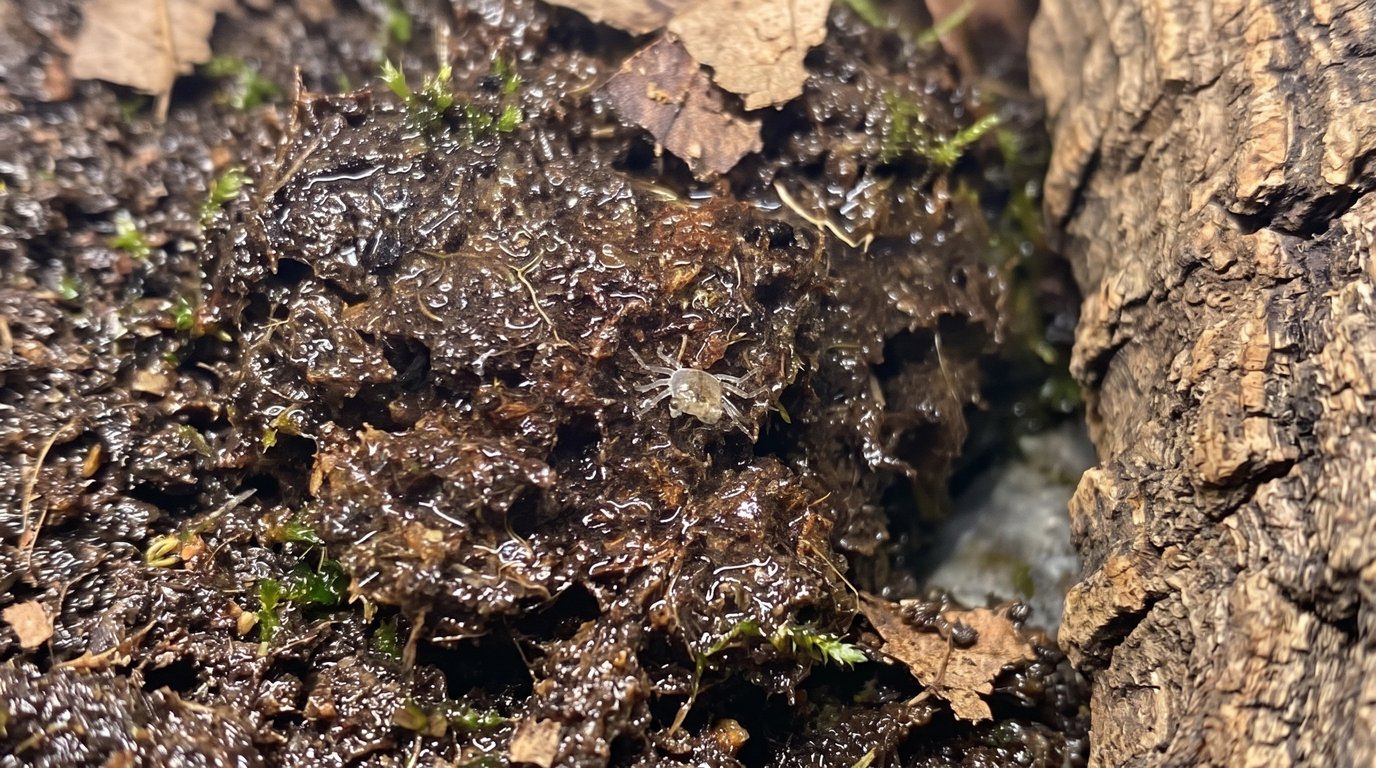
Because the young are tiny and good at hiding, your first count can be well short of the real brood. Crablets measure about 2 to 3 mm (about a tenth of an inch) across when first seen, a small fraction of how big vampire crabs get as adults. They start out clear, brown or dark, so they blend into the substrate. Newly hatched crablets also stay on or under their mother for a short time before they go off on their own.
The mother is hard to find too. A berried female spends most of the brooding time hidden, often dug in or in a burrow, and is rarely seen until the crablets appear. So a female who drops out of sight for weeks may simply be carrying eggs. Keep that in mind before you hunt for a missing vampire crab by digging up the land.
Want a better count? Look under cork bark, in moss and along the water’s edge over several days, and put each hide back the way you found it. Lifting everything at once disturbs a female who may still be carrying eggs.
How many vampire crablets survive with the adults?
Fewer than if you move them. Adult vampire crabs eat the crablets they catch, so moving the crablets, or the adults, to another tank raises the most young. Tank size won’t make up the difference, because vampire crabs don’t breed more in a smaller tank; the clutch stays the same, and only cover and separation change how many survive.
How big is the gap? One keeper who raised broods both ways got 2 to 5 crablets to adult size with the adults, and about 20 in separate boxes. In a large, densely planted paludarium some crablets do grow up alongside the adults, so leaving them in isn’t a total loss. You’ll just raise fewer.
The brood itself isn’t the danger. Crablets from one brood mostly live together without hurting each other. They sit in groups and squabble over food, but young of a similar size aren’t seen eating each other. You can keep them together until they reach about 1 cm or start to color up.
If you want to raise as many as you can, have the container for vampire crab breeding ready before the female goes into hiding. A small lidded box is enough: damp humus or soil, moss for cover, and water no deeper than about 1 cm or a dish the crablets can walk out of. Feed them crushed fish food, and let springtails living in the moss add to it.
Fish are a second risk in the water section. Keep to small, peaceful vampire crab tank mates, because large, aggressive or bottom-hunting fish can eat crabs. A crablet a tenth of an inch across is a far smaller mouthful than an adult.
How often can a female vampire crab have babies?
Plan for broods to keep coming: a breeding group can keep producing them, and each one is carried for about three to seven weeks before the crablets appear. Keepers count from different starting points, some from when they first see eggs and others from when the female goes into hiding.
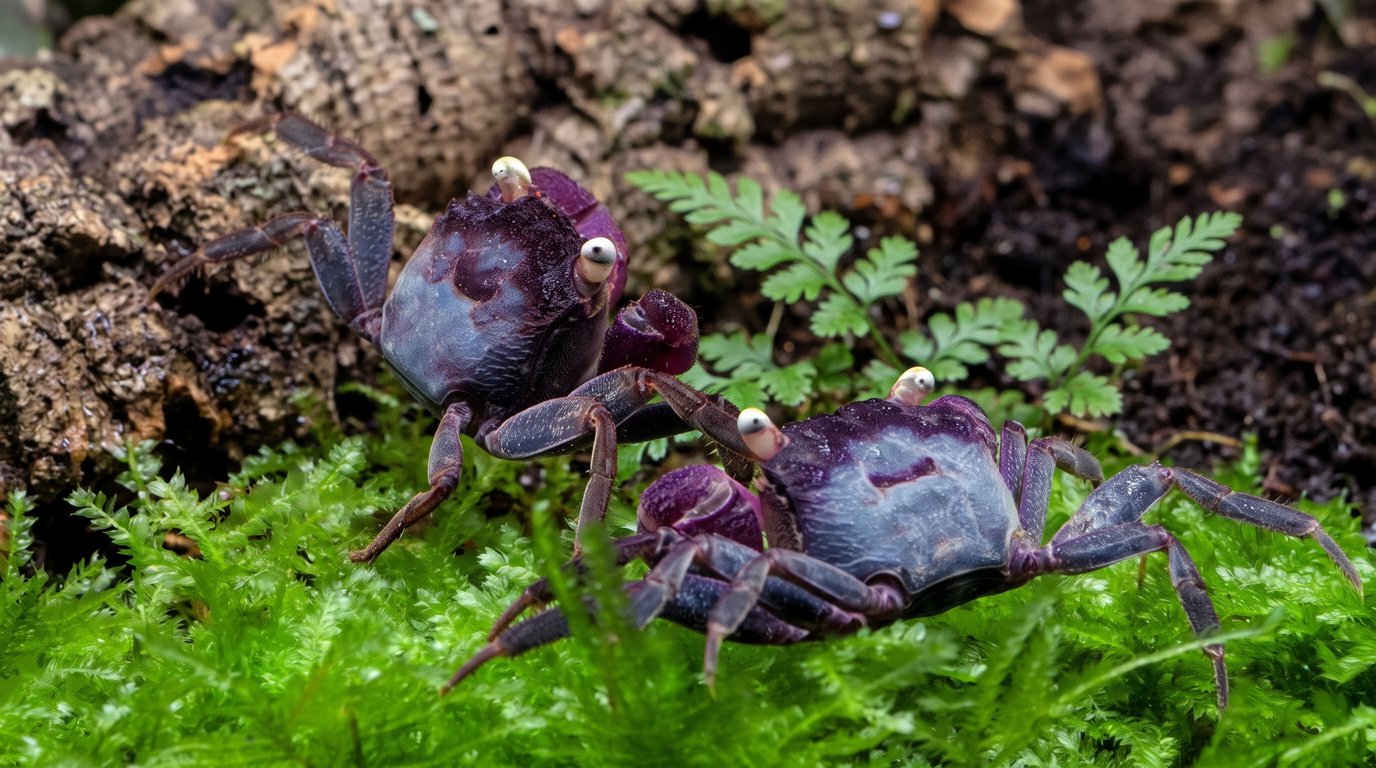
How soon one female can carry again hasn’t been measured, in a study or by enough keepers to give a figure. What a whole group can do is clearer. One large paludarium that started with 12 crabs, with no young moved out, held at least 48 less than a year later.
So decide early whether you want broods at all. Keep males and females together if you do, and keep a single sex if you don’t, because a group with only one sex has no one to mate with. You choose Male or Female for each crab on the product page for our tank-bred vampire crabs. Everything in our catalog is bred or propagated in our own tanks rather than collected from the wild.
What to do when you have more vampire crab babies than you can house
Rehome the extras and split the adults by sex. Ask other keepers, a local aquarium club or a shop that takes invertebrates. We think young crabs that have colored up are easier to place. Never let surplus crabs go outdoors.
Splitting the sexes doesn’t stop the brood that’s already on its way. A female who was carrying eggs when you split the group can still release her crablets weeks later, so keep checking the hides in her tank.
If you’ve already got too many vampire crab babies, move the ones you’ll keep into a grow-out box first and hold the rest until they color up.
When you sort them, check the flap underneath each crab. It’s the reliable way to tell vampire crab male vs female, and a sorting mistake can put a pair back together and start the next brood.
References
3 Sources
- Ng and Wowor, The vampire crabs of Java, with descriptions of five new species from Mount Halimun Salak National Park, West Java, Indonesia (Crustacea: Brachyura: Sesarmidae: Geosesarma), Raffles Bulletin of Zoology 67: 217-246, 2019.
- Shy and Ng, Geosesarma mirum, a new species of semi-terrestrial sesarmid crab (Crustacea, Decapoda, Brachyura) from central Taiwan, ZooKeys 858: 1-10, 2019.
- Diesel and Horst, Breeding in a snail shell: ecology and biology of the Jamaican montane crab Sesarma jarvisi (Decapoda: Grapsidae), Journal of Crustacean Biology 15(1), 1995.
Ready to get started?
Shop our Vampire Crab collection
8 products available · Live Arrival Guarantee