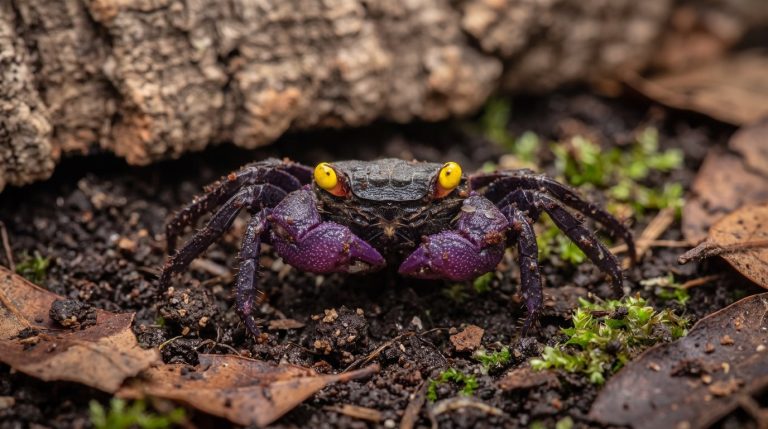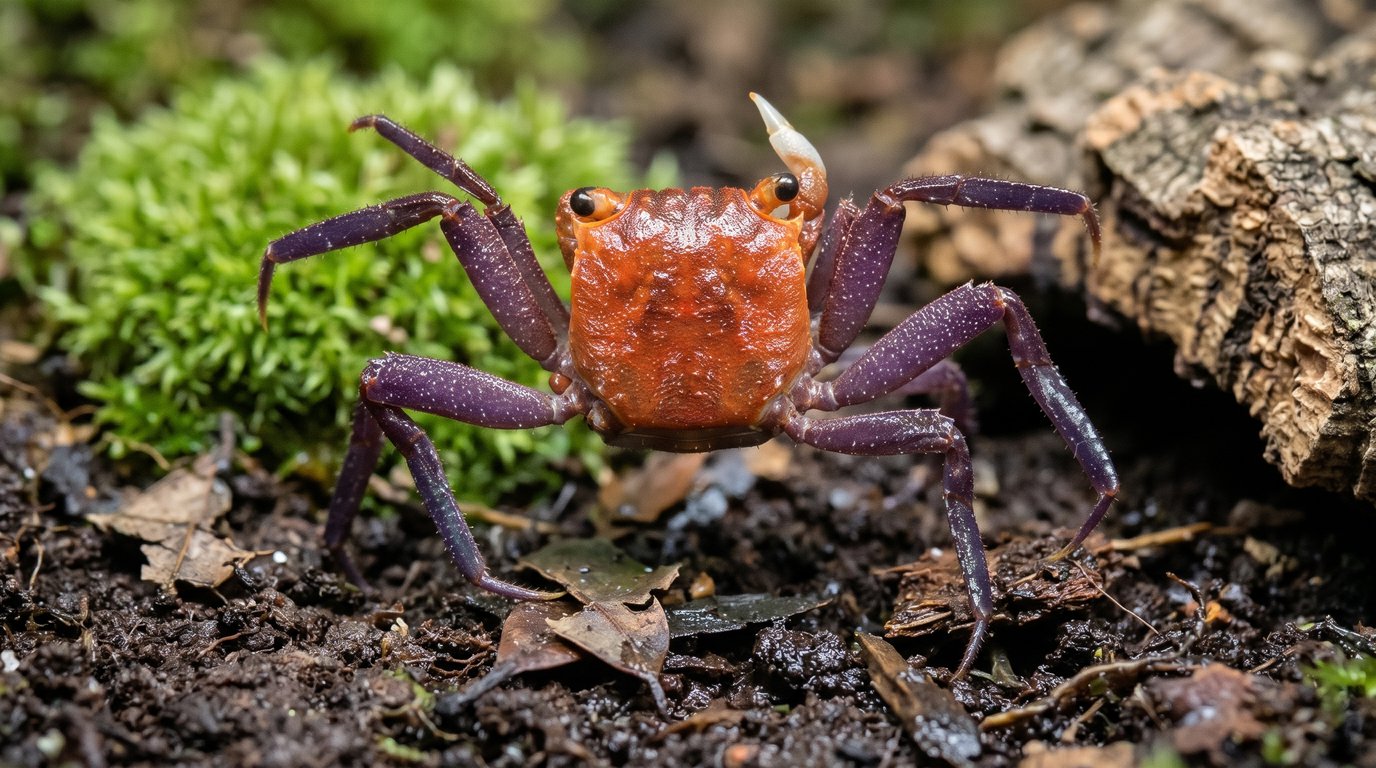
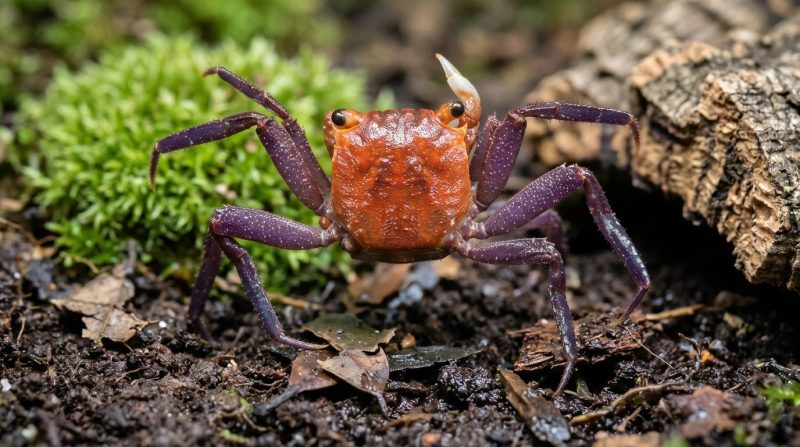
Yes, vampire crabs lay eggs, but the female doesn’t leave them in the soil or the water. She keeps the clutch stuck under the flap on her underside and carries it for about three to seven weeks, until the eggs hatch straight into tiny crabs.
Where does a female vampire crab keep her eggs?
Under her own body. Like other true crabs, a female vampire crab carries her eggs stuck to the small paired limbs under her abdomen, the pleopods, and the abdomen itself is broad in females for exactly that job. It lies flat against her underside, over the clutch.1
That’s why breeding can look like live birth. You don’t find a pile of eggs in a burrow. One day there are simply crablets under the bark. The eggs were there all along, out of sight beneath her. It also means a paludarium set up for ordinary vampire crab care can produce young without you doing anything special.
If you’d like to see a clutch one day, stock both males and females. Our vampire crab lines are sold as Male or Female, so you choose the sex on the product page. Everything in our catalog is bred or propagated in our own tanks rather than collected from the wild.
What vampire crab eggs look like under the flap
Expect a small clump of eggs packed under the female’s flap. Across the genus the eggs are large for such a small crab, averaging about 1.2-1.8 mm across.2 That’s big next to her shell, which is only about 10-15 mm (0.4-0.6 inch) wide.
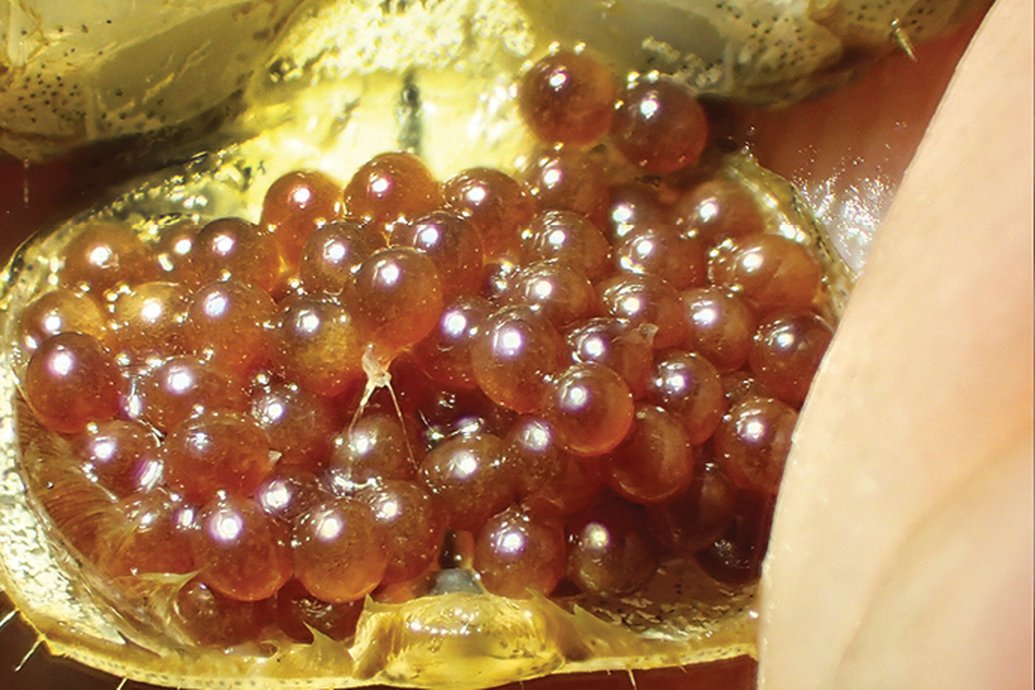
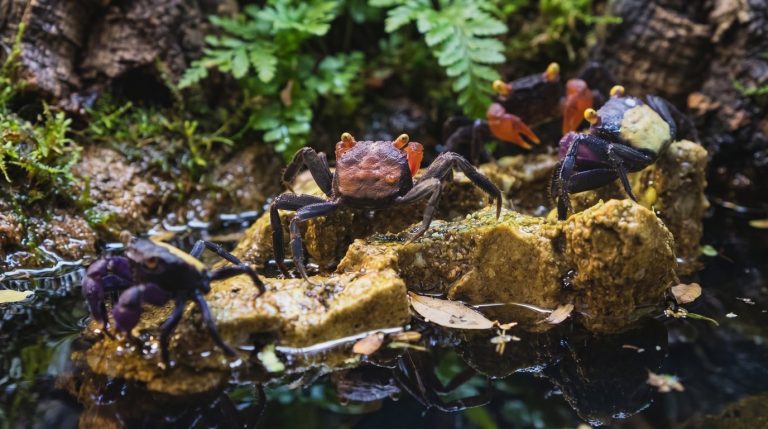
We often see females in our paludariums carrying a clutch of eggs under the flap. The eggs we’ve seen on our females are orange to red, or brown to black.
You’ll only see them from below, and most of the time you won’t see her at all. A female carrying eggs spends most of the brooding time hidden, often dug in or in a burrow, and you’ll rarely see her until the crablets appear. So a female you used to see every day going missing can be the first clue.
Not sure which crab to watch? Look at the flap first. It’s the reliable way to tell vampire crab male vs female, and only females have the wide flap that carries eggs. Don’t pick her up and turn her over to check, though. Handling her tells you nothing the crablets won’t tell you a few weeks later.
How long do vampire crab eggs take to hatch?
About three to seven weeks. The spread comes partly from where keepers start counting: some count from the day they first see eggs, others from the day the female goes into hiding.
So start your count from whichever you notice, and keep checking under the hides from then on. Don’t write the clutch off because the count has run out. Crablets under bark or in the moss are the sign you’re waiting for, and the steps after that are part of vampire crab breeding at home.
If you’ve read a single figure somewhere, such as a month, it may count from a different starting point. We’d treat any one number as a rough guide, not a date to plan around.
What hatches from vampire crab eggs?
Tiny crabs, not larvae. The vampire crabs sold in the hobby skip the free-swimming larval stage, so the eggs hatch into complete crabs, about 2 to 3 mm across when you first see them, in the same fresh water as their parents. Nothing in the tank needs to change, and vampire crabs don’t need salt water at any stage.
The big eggs explain it. Over 90 percent of vampire crab species whose egg size had been recorded by 2019 have large eggs and develop directly.2 In most species those eggs hatch as young crabs, or as very advanced larvae that don’t feed.3 A few species are the exception, among them two from Taiwan and the Philippines, with small eggs and larvae that live in the plankton.2 Females of one of those two, Geosesarma hednon, have to migrate to the sea to release their larvae.4 The crabs in the hobby don’t: their young hatch right in the tank.
How many come out of one clutch? Up to about 40 crablets, and how many babies vampire crabs have left to raise depends on whether the adults reach them first. Newly hatched crablets stay on or under their mother for a short time before they go off on their own.
What to do when your vampire crab is carrying eggs
Mostly, leave her alone. Keep the land damp, keep the lid on and feed the tank as usual, so she can stay out of sight for the weeks she needs.
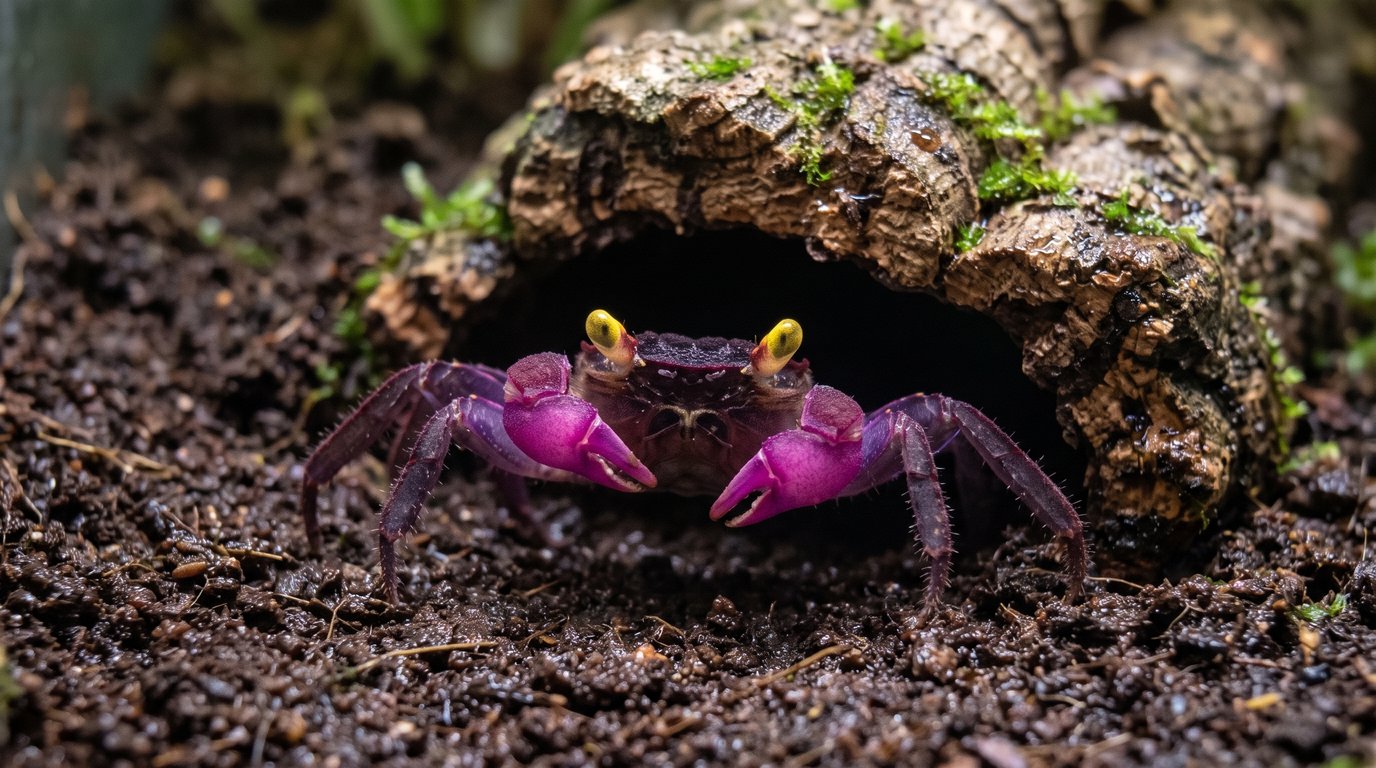
Give her somewhere to dig. A berried female often goes underground, so damp soil a pregnant vampire crab can burrow into serves her better than bare gravel. Don’t dig up the land section to find her. Lifting every hide disturbs a female who may still be carrying.
Plan for the crablets before they arrive. Adult vampire crabs eat the crablets they catch, so moving the crablets, or the adults, to another tank raises the most young. Have a small lidded box with damp soil and moss ready. Whether to separate a pregnant vampire crab before she hatches her eggs is a separate call. It turns on how big and how densely planted your tank is, and on whether a male keeps chasing the females.
References
4 Sources
- Ng, Guinot and Davie, Systema Brachyurorum: Part I. An annotated checklist of extant brachyuran crabs of the world, Raffles Bulletin of Zoology Supplement 17: 1-286, 2008.
- Shy and Ng, Geosesarma mirum, a new species of semi-terrestrial sesarmid crab (Crustacea, Decapoda, Brachyura) from central Taiwan, ZooKeys 858: 1-10, 2019.
- Ng and Wowor, The vampire crabs of Java, with descriptions of five new species from Mount Halimun Salak National Park, West Java, Indonesia (Crustacea: Brachyura: Sesarmidae: Geosesarma), Raffles Bulletin of Zoology 67: 217-246, 2019.
- Ng, Liu and Schubart, Geosesarma hednon, a new species of terrestrial crab (Crustacea: Decapoda: Brachyura: Sesarmidae) from Taiwan and the Philippines, Raffles Bulletin of Zoology 52(1): 239-249, 2004.
Ready to get started?
Shop our Vampire Crab collection
8 products available · Live Arrival Guarantee