
Your missing vampire crab (Geosesarma) is most likely still in the tank and hiding, because these crabs often go days without being seen and some stay out of sight for weeks. A crab around a molt, a female carrying eggs and a crab that’s new to your tank all hide more than usual. The other crab is a real suspect only when the missing one was a crablet, when it had just molted, or when you find remains, so check those before you take the tank apart.
How long can a vampire crab hide before you should worry?
Days are normal, and so are weeks for some crabs. By day, vampire crabs sit in burrows and tunnels they’ve dug, in caves and crevices, under stones, cork or leaves, or deep in dense plants. You can go days without seeing one, and some crabs aren’t seen for weeks or months while they’re alive and well. In other tanks one or two crabs are out most days, so judge “missing” against what your own crabs usually do.
Look at the right time of day. Vampire crabs are mostly out in the evening, at night and in the early morning, and most of them spend the day hidden. They also eat mostly in the evening and at night, so you’ll rarely see one feed. Leave a little food where the missing crab used to sit, just before lights-out, and check in the morning whether any of it has gone. Because vampire crabs are mostly nocturnal, an evening check tells you more than a daytime search.
Has the crab only just arrived? Newly bought crabs usually stay hidden at first and show themselves more once they’ve settled, anywhere from about two weeks to half a year, and some stay shy. New crabs also often die between arrival and about two weeks later, even in a tank where others are doing well. If a new crab vanishes in that window and you notice a bad smell, go through the checks for why vampire crabs keep dying.
Is your missing vampire crab molting?
It may well be, so leave the hides alone for now. In crabs generally, a crab that has just molted is soft and nearly helpless, its attackers are often its own kind, and it stays in a secluded spot until the new shell hardens.1 Digging up a burrow or lifting cork can expose a crab at exactly that moment.
In our paludariums, a molting crab stays down in the water for a few hours, and our crabs eat their old shell afterward. So look into the water section first, from outside the glass, and don’t take a missing shed as proof that your crab didn’t molt. If you find something that looks like a dead crab, check it against the signs in vampire crab molting before you lift it out.
Could a missing female vampire crab be carrying eggs?
Yes, and if she is, you may not see her for weeks. A berried female spends most of the brooding time hidden, often dug in or in a burrow, and is rarely seen until the crablets appear. She carries her eggs for about three to seven weeks before they do.
So if the crab you can’t find is a female, give her time before you start searching. The first tiny crabs turning up will tell you where she’s been. If you do spot her, leave her hide alone and weigh whether to separate a pregnant vampire crab at all.
Check the lid before you search the room for an escaped vampire crab
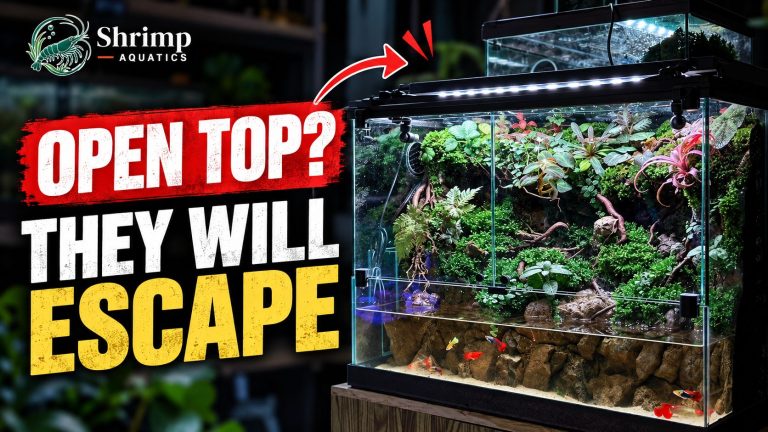
Look for a way out first, because a crab can only leave a closed tank through a gap. Check where cables and tubing pass through the lid, the corners and hinges, and whether the lid was left open after feeding. Find a gap? Search the floor around the stand and behind the tank the same day, then close it the way vampire crab tank setup describes before the next crab finds it.
What tells you the other vampire crab killed it?
Remains, or a missing crab that was already at risk. Without one of the signs below, treat your crab as hiding and keep watching.
- It was a crablet. Adult vampire crabs eat crablets they catch, which is why moving the crablets, or the adults, to another tank raises the most young.
- It had just molted. A soft, freshly molted crab is the one at risk, and in crabs generally its attackers are often its own kind.1
- You’ve seen fighting, or found loose legs and claws. Vampire crabs in a group often lose legs and claws in fights, most often when a dominant male chases or attacks the others, and a crab can lose anything from one leg to both claws and several legs this way.
- You’ve found a body, not a shed. A dead crab still has its eyes, is full inside and soon smells. A shed looks like a whole crab, but its eyes are empty, see-through shells and it’s hollow.
- Something smells. A dead crab soon smells, so a bad smell from one corner of the land is your cue to look there, gently.
Even a body doesn’t tell you the other crab did it. It tells you the crab died, and newly bought vampire crabs often die in their first two weeks even where the rest of the group is fine. If you can’t find the crab and none of these signs fit, we’d keep the lights, feeding and hides exactly as they are and give it another week of evening checks.
Make the tank safer so the next vampire crab isn’t lost
Give every crab its own cover. Put in enough hides that every crab can get out of sight at once, so a crab that’s being chased, or is soft after a molt, always has somewhere to go. A hide for every crab is basic vampire crab care, not an extra.
Watch for one crab, often a dominant male, that keeps chasing the others out of cover, because that’s when legs start going missing. If it keeps happening, add more hides or split the group. Move crablets out as soon as you see them, or move the adults, and keep the lid closed every time you feed. If your tank has no lid at all, start there, because vampire crabs can escape an open-top enclosure.
Adding a crab to the group? When you buy our tank-bred vampire crabs, you choose Male or Female for each crab on the product page, so you can plan how many males go in. Everything in our catalog is bred or propagated in our own tanks rather than collected from the wild.
References
1 Source
- Edible Crabs of the United States (Fishery Leaflet 550), George H. Rees, U.S. Fish and Wildlife Service, Bureau of Commercial Fisheries, December 1963.
Ready to get started?
Shop our Vampire Crab collection
8 products available · Live Arrival Guarantee