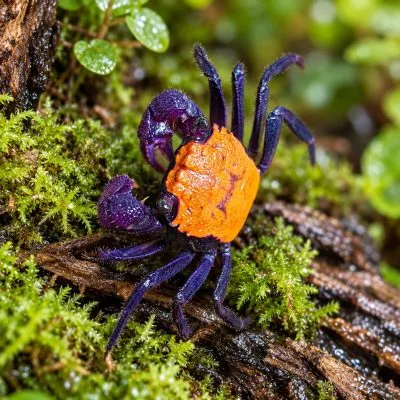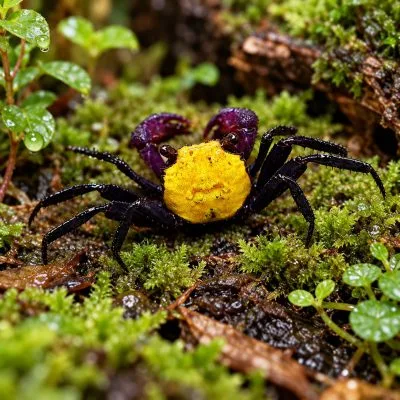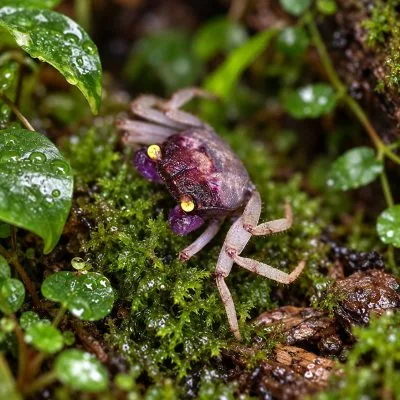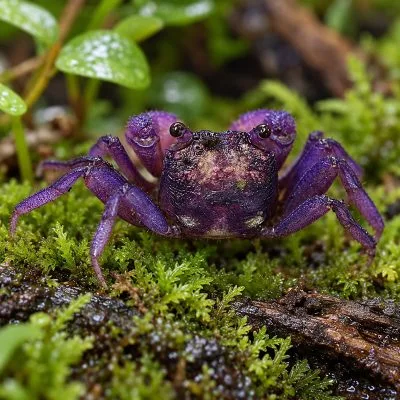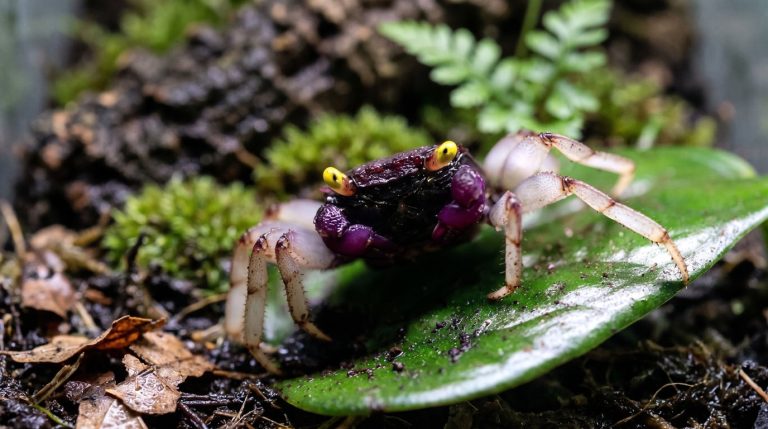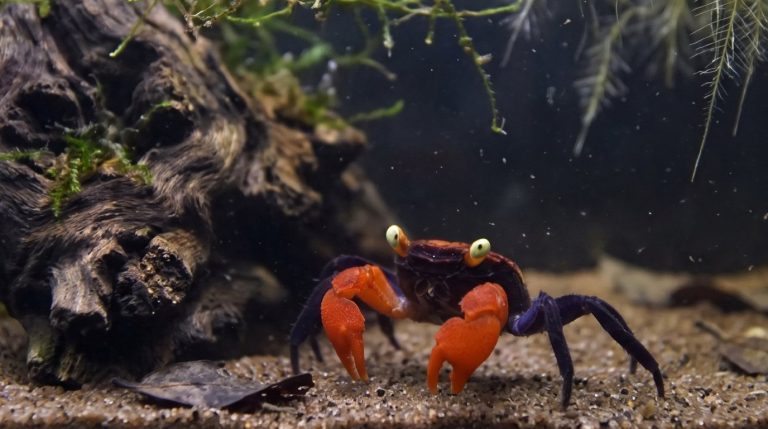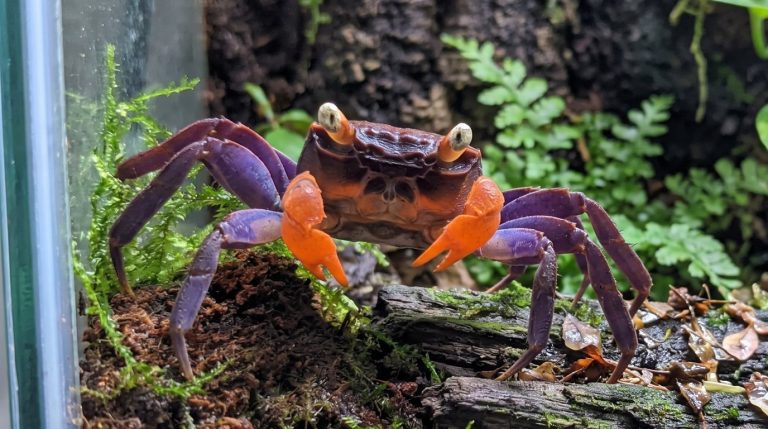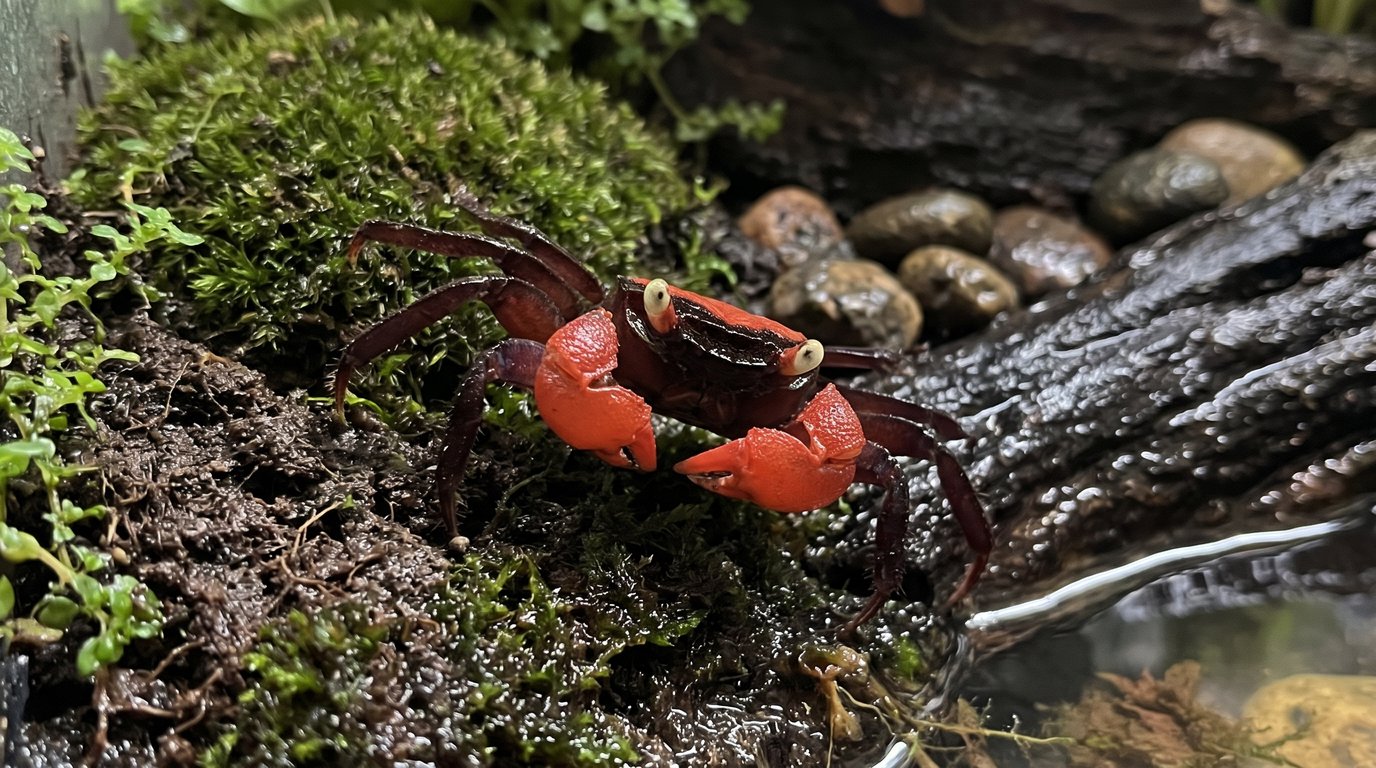
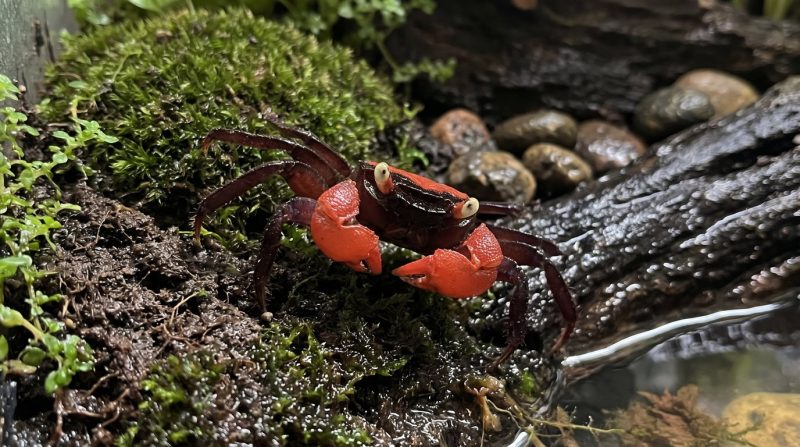
To heat a vampire crab paludarium, put a small submersible heater in the water section. If that won’t fit, stick a heat mat to the outside of the side glass and run it on a thermostat. Aim for a thermometer at crab level that reads about 78°F (26°C), within 72-85°F (22-29°C). If your room already holds that range day and night, you don’t need a heater at all. Skip the heat lamp. It warms the air without adding water.
Do you need a heater for a vampire crab paludarium?
You need a heater for a vampire crab paludarium only if your room drops below about 72°F (22°C). The vampire crab temperature that suits them is about 78°F (26°C), within 72-85°F (22-29°C), and plenty of keepers run them at ordinary room temperature with no heater at all. So the room decides, not the crab.
Before you buy a heater or any vampire crabs, put a thermometer where the tank will stand. Read it early in the morning and again in the warmest part of the afternoon for a few days.
Our vampire crab paludariums in Vietnam don’t have a heater of any kind. They run at room temperature. That’s a tropical room, though, so if your home runs cooler, go by your own thermometer, not by our tanks.
If the reading only dips below 72°F (22°C) on winter nights, a heater on a thermostat fills that gap without pushing the warm afternoons any higher. If the room never gets there at all, you’ll want the heater running most of the time, and it’s worth taking more care over where it goes. Steady heat is only one part of good vampire crab care, but it’s the part that’s easiest to get right before the crabs arrive.
Which heat source fits a vampire crab tank best?
Start with a small submersible heater in the water section, use a heat mat on the side glass if you can’t, and leave the heat lamp for last. Keepers who heat a vampire crab tank mostly use one of the first two. That’s a small aquarium heater in the water, set to about 77°F (25°C), or a small heat mat on the side or back glass.
| Heat source | Where it goes | What to watch |
|---|---|---|
| Submersible aquarium heater | In the water section, covered to the line its manual sets | Evaporation lowering the water below that line; the land may stay cooler than the water |
| Heat mat | Outside of the side or back glass, above the soil line | It needs a thermostat, and it must never sit under a wet floor |
| Heat lamp or ceramic emitter | Above the lid | It dries the air, so you’ll mist more to hold the humidity |
A heater warms the pool your crabs climb into, but the warmth doesn’t always reach the land. One keeper found that a nano heater set to 77°F (25°C) made no difference to the air in the tank. That’s why the thermometer on the land matters more than the dial on the heater. A heat mat warms the land and the air directly, but it can struggle on a big tank. In one tank about 31 inches long, a side mat gave off barely any warmth.
Why does a lamp dry the tank out? With the same moisture in it, warmer air reads as less humid.1 A lamp over the lid adds heat but no water. A few keepers do add a low-wattage bulb over the land. If you go that way, keep the lid closed and plan on misting more often to keep a vampire crab tank humid.
Fit a submersible heater to a shallow vampire crab pool
Pick a heater whose manual allows the position your water depth forces. Then keep it covered to its line all the time. Manuals don’t agree on this, so read yours before you build the pool around it. Zoo Med’s paludarium heater must be fully under water and switches off if it’s exposed to air.2 It mounts on the side or back wall. An EHEIM thermocontrol heater must be immersed at least to its minimum mark and installed upright.3 It must never run dry. Aqueon’s Pro heaters can lie flat, but only if they’re fully under water at all times.4 For a shallow pool, that’s the kind to look for.
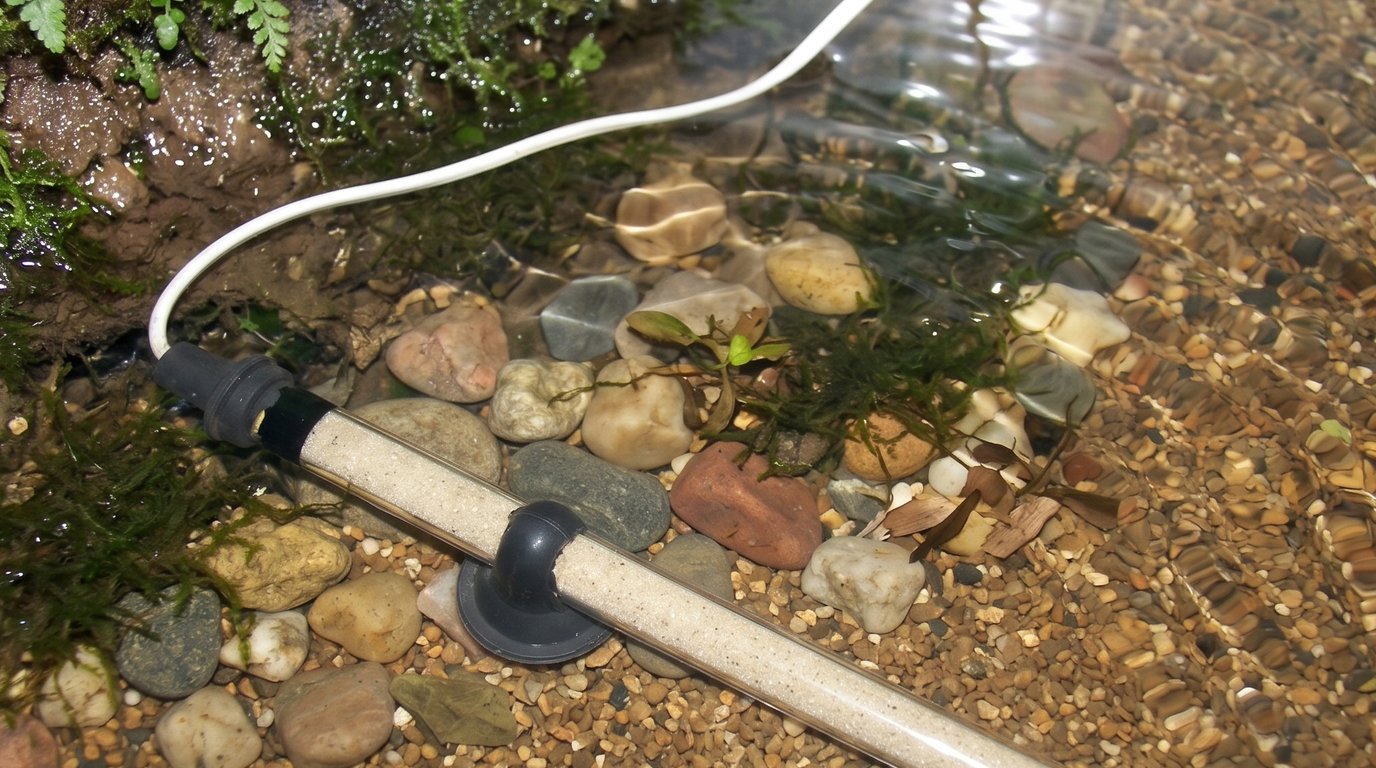
That’s the catch in a vampire crab tank. The pool is shallow, and an upright heater with a high minimum mark won’t fit in it. Plan the depth around the heater while you’re working out your vampire crab tank setup, not after the land is in.
- Find the minimum water line and the allowed positions in the heater’s manual, and make the deepest part of the pool deep enough for them.
- Mount the heater in that deepest spot with its suction cups, away from the slope the crabs use to walk in and out.
- Run the cord out through the lid so it leaves no gap a crab can squeeze through.
- Top up evaporated water before it drops below the heater’s line. Aqueon’s own troubleshooting names evaporation as a reason a heater ends up uncovered.4 Check the suction cups when you top up.
- To take the heater out, unplug it and leave it in the water for about 30 minutes to cool first.3
A dry-run cutoff protects the heater. It won’t keep the tank warm: if the water drops, the heat stops, and a cold night follows. Watch the cord too. A crab can climb it, so a loose exit through the lid works like a small open top. The reasons vampire crabs escape from an open-top enclosure apply to that gap as well.
Put a heat mat on the side glass, away from the water section
Stick the mat to the outside of the side or back glass, above the soil line. Keep it well away from the water section. Exo Terra makes its heat mats for the outside of glass tanks only, and they aren’t waterproof.5 Water must never reach them. Zoo Med’s under-tank heater says it isn’t designed for use with water, and it names paludariums.6 Take that at its word. Its maker prefers side mounting when you’re unsure about the bottom.6 The same sheet says the heater runs much warmer than your target.6 Put it on a thermostat.
Keep the mat high and to one side, so a crab that digs down moves into cooler soil, not warmer. Exo Terra also says to keep the water bowl on the side away from the mat.5 That stops the water overheating. For reptiles, vets advise an under-tank heater cover no more than 30% of the floor.7 That leaves the animal a way out of the heat. Your crabs need the same thing: a cooler side of the tank they can walk to.
Where should the thermostat probe and thermometers go in a vampire crab tank?
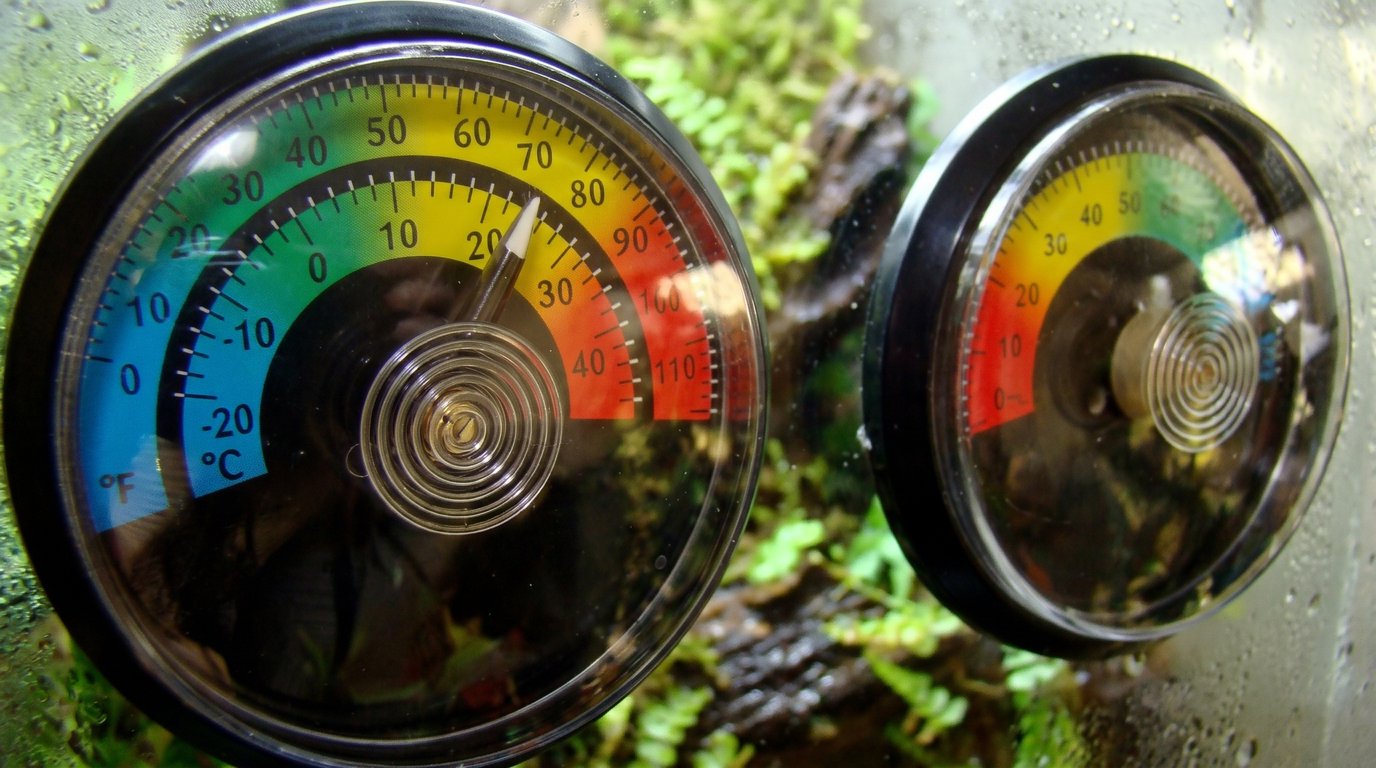
Put the thermostat probe where you want the temperature held. For a heat mat, that means on the land at crab level, not stuck to the mat or buried in the soil. Exo Terra’s thermostat manual says to place the sensor on top of the substrate when it runs a heat mat.8 That’s where the set temperature counts. Its sensor is waterproof and made for damp tanks.8 An on/off thermostat turns the heat on a set amount below your target. It turns it off again at the target.9 Set its high and low alarms too, if it has them.9 They warn you when something sticks.
Check the heater’s manual before you plug it into a thermostat. Inkbird’s controller only works with a heater whose own dial doesn’t get in its way.9 EHEIM goes further: that thermocontrol model may not run through an extra timer or control system.3 Leave it on its own dial.
- One thermometer sits on the land at crab level, away from the heat source.
- A second one reads the water section.
- Both read inside 72-85°F (22-29°C) in the early morning and in the warmest part of the afternoon.
- If Neocaridina share the pool, the water stays inside their 72-77°F (22-25°C) as well.
- Bee or Crystal shrimp are kept at 60-72°F (15.5-22°C), which meets the crab range only at 72°F (22°C). Don’t warm their water for the crabs.
Vets advise reading the temperature just above the substrate where a reptile actually sits.7 The same goes for your crabs. For them that’s the moss and soil on the land, where they spend most of their time.
What to do when a vampire crab tank gets too hot
Switch off the heat and cool the room once crab level passes 85°F (29°C). Keepers who lost vampire crabs in hot weather found their tanks at about 86°F (30°C) or more. A heater left running through a heat wave only adds to it. Zoo Med says to put its under-tank heater on a thermostat, or unplug it, if your house can get above 80°F.6 Act on the thermometer, not on how the crabs look.
Move the tank away from a sunny window and off anything that runs warm, and check the thermometer in the afternoon, not just in the morning. On hot days we cool the room that holds the crab tanks with air conditioning. Leaving the lid off for long isn’t a fix, because an open top can’t hold the humid air the crabs need.
Ordering vampire crabs once the tank holds its temperature
Order your crabs once both thermometers hold 72-85°F (22-29°C) for several days. Check them morning and afternoon, with the heater or mat already on its thermostat. You choose Male or Female for each crab on the product page when you buy tank-bred vampire crabs. Everything in our catalog is bred or propagated in our own tanks rather than collected from the wild.
References
9 Sources
- A Discussion of Water Vapor, Humidity, and Dewpoint, and Relationship to Precipitation, National Weather Service, Louisville, KY (NOAA), undated.
- Programmable Paludarium Heater Instructions, PH-25 and PH-50, Zoo Med Laboratories, manufacturer instructions, undated.
- thermocontrol operating manual, types 3631-3640, EHEIM GmbH & Co. KG, manufacturer manual, undated.
- Aqueon Pro Heaters Instruction Manual, Aqueon (Central Garden & Pet), manufacturer manual, August 2020.
- Heat Mat operating instructions, PT2015-PT2018, Exo Terra (Rolf C. Hagen Inc.), manufacturer instructions, undated.
- ReptiTherm U.T.H. Under Tank Heater instructions, Zoo Med Laboratories, manufacturer instructions, undated.
- Divers, Providing a Home for a Reptile, Merck Veterinary Manual (pet owner version), last updated June 2026.
- Thermostat 100W Electronic ON/OFF Operating Instructions, PT2456, Exo Terra (Rolf C. Hagen Inc.), manufacturer instructions, undated.
- ITC-308-WIFI user manual, Shenzhen Inkbird Technology, manufacturer manual, version V10.0, undated.