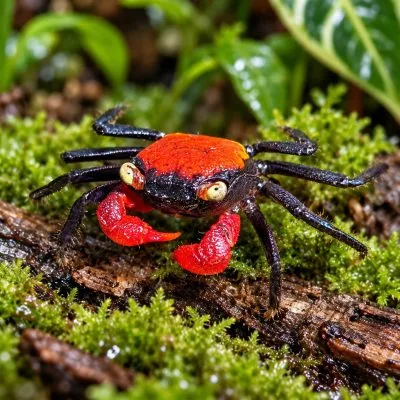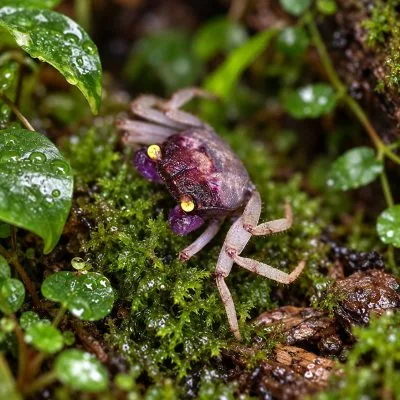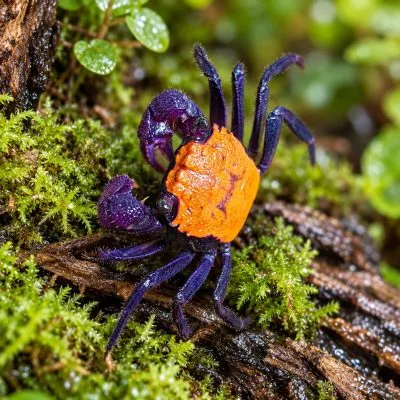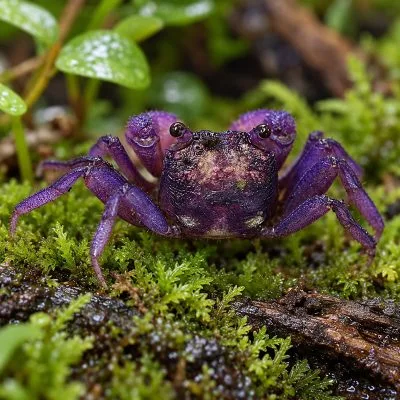
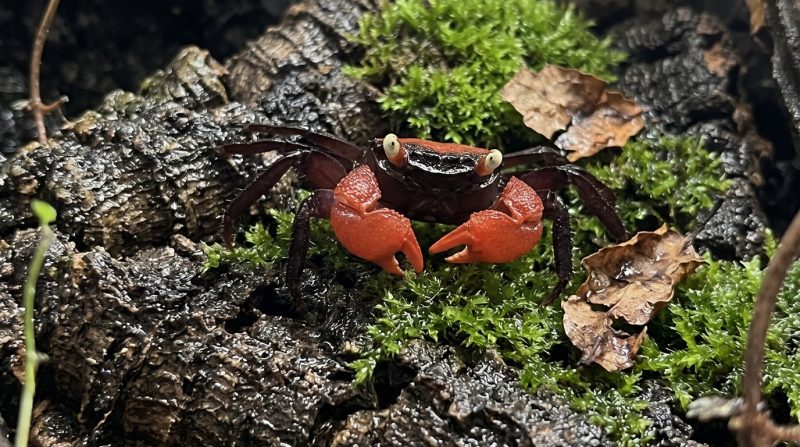
Keep vampire crabs at about 78°F (26°C), anywhere within 72-85°F (22-29°C), and read that number on the land where the crabs sit. The warm end is where the trouble starts. Keepers who lost crabs in hot weather found their tanks at about 86°F (30°C) or more. If your room holds the range day and night, you don’t need a heater at all.
What temperature range keeps vampire crabs healthy?
About 78°F (26°C) is the number to aim for, and anywhere from 72°F to 85°F (22-29°C) works. That’s the band keepers hold their vampire crabs in, and holding it is one of the easier parts of vampire crab care. That band is close to how researchers housed them as well. A team at Stanford and Harvard kept red devil vampire crabs (Geosesarma hagen) for at least two months in a room averaging about 79°F (26°C) before testing them.1 Their study is a preprint, not yet peer reviewed.
| Aim for | About 78°F (26°C) |
|---|---|
| Range that works | 72-85°F (22-29°C) |
| Where keepers lost crabs | About 86°F (30°C) and up, in hot weather |
| Water section | The same range, and inside the range of any shrimp or fish living in it |
| Where to measure | On the land at crab level, with a second thermometer in the water |
Why not just run the tank at the top of the range? Warmer water made small crabs breathe faster in that same study.1 More to the point, a tank parked at 85°F (29°C) has nothing left in reserve for a hot afternoon. Sitting in the middle gives you a few degrees of room either way.
How hot is too hot for a vampire crab tank?
Treat anything past 85°F (29°C) at crab level as too hot, and start cooling the room. The tanks where keepers lost crabs in a hot spell were only a degree or so past that, at about 86°F (30°C) or more, so the margin at the warm end is thin.
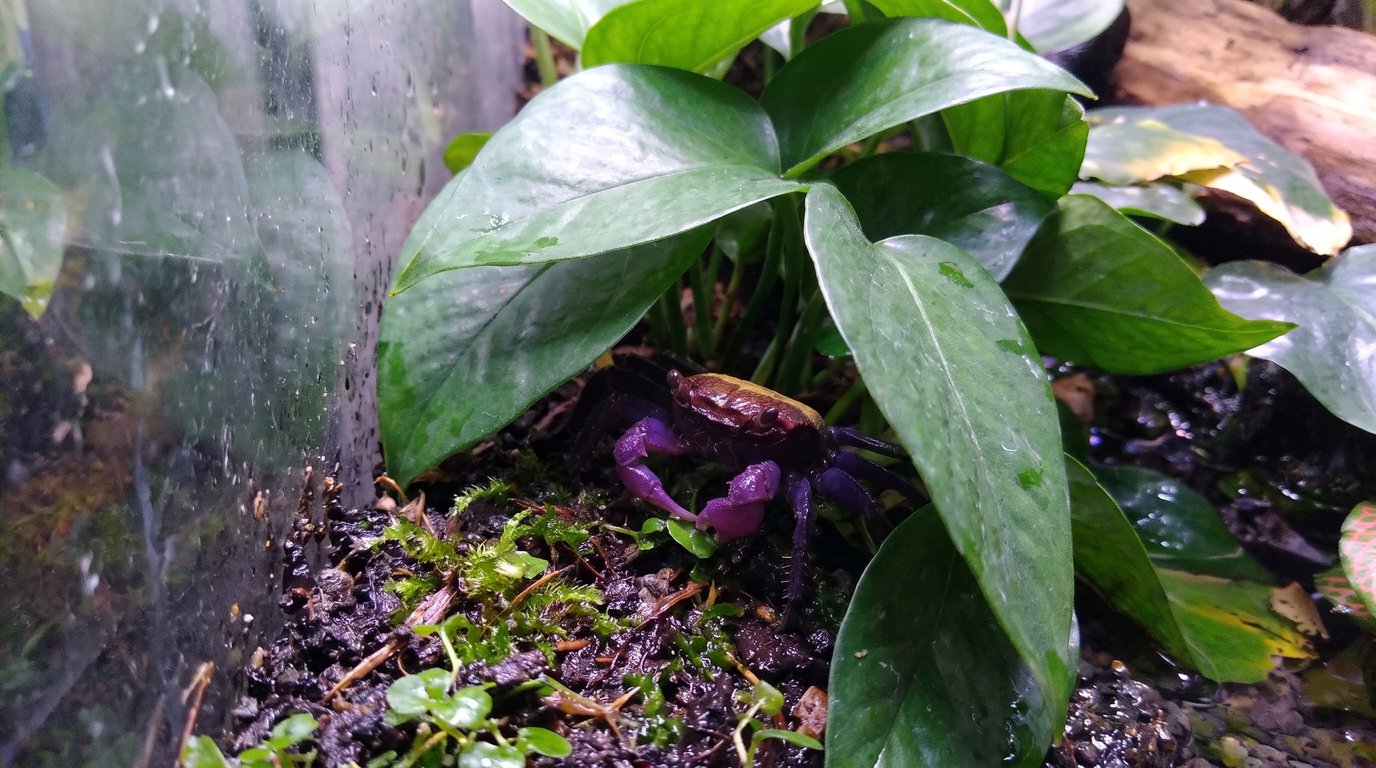
Our crab paludariums usually sit at about 81-86°F (27-30°C), which is just the room temperature in Ho Chi Minh City. We switch the air conditioning on only when the weather gets really hot. When the room that holds our crab tanks has got too hot, our crabs turned sluggish and stopped eating, and we lost some of them.
So if your tank already runs near the top, a heat wave has very little room to work with. Go by the thermometer before you go by the crabs. A crab that’s sluggish and off its food could also be new, about to molt or cold, and a vampire crab not eating has several causes besides heat. The reading is what tells you which one you’re dealing with.
Once crab level passes 85°F (29°C), work through these in order:
- Switch off any heater or heat mat on the tank.
- Move the tank out of direct sun and away from anything that runs warm, such as a lamp, a fridge or a sunny wall.
- Cool the room itself, because the tank can’t get much cooler than the air around it.
- Keep the lid on. An open top lets out the humid air the crabs need, and it’s how a crab gets out.
- Read the thermometer again in the warmest part of the afternoon, not only in the morning.
Is room temperature warm enough for vampire crabs?
Yes, as long as your room stays between 72°F and 85°F (22-29°C) day and night. Plenty of keepers run vampire crabs with no heater at ordinary room temperature, and their crabs did fine. You won’t know until you measure, though. Before you buy vampire crabs, stand a thermometer where the tank will go and read it first thing in the morning and again late in the afternoon for a few days.
If the early-morning reading falls below 72°F (22°C), a small heater on a thermostat closes that gap. Where it goes matters, because the way you heat a vampire crab paludarium decides whether the land dries out. A tank a few degrees cooler at night than by day is normal without a heater, and that’s fine while both readings stay in the range.
Cold matters too. One keeper whose tank sat at 60-70°F (16-21°C) while they tried and failed to warm it lost many of their crabs over that time. A dip under 72°F on a cool night isn’t an emergency. A tank that stays that cold all day is worth fixing before you add crabs.
Measure vampire crab temperature where the crabs actually sit
Put one thermometer on the land at crab level, in the moss or on the soil surface, and a second one in the water section. The two can read differently. A heater warms the water first, while a sunny window or a lamp warms the air and the land. A dial stuck to the glass only tells you about the air next to the glass.
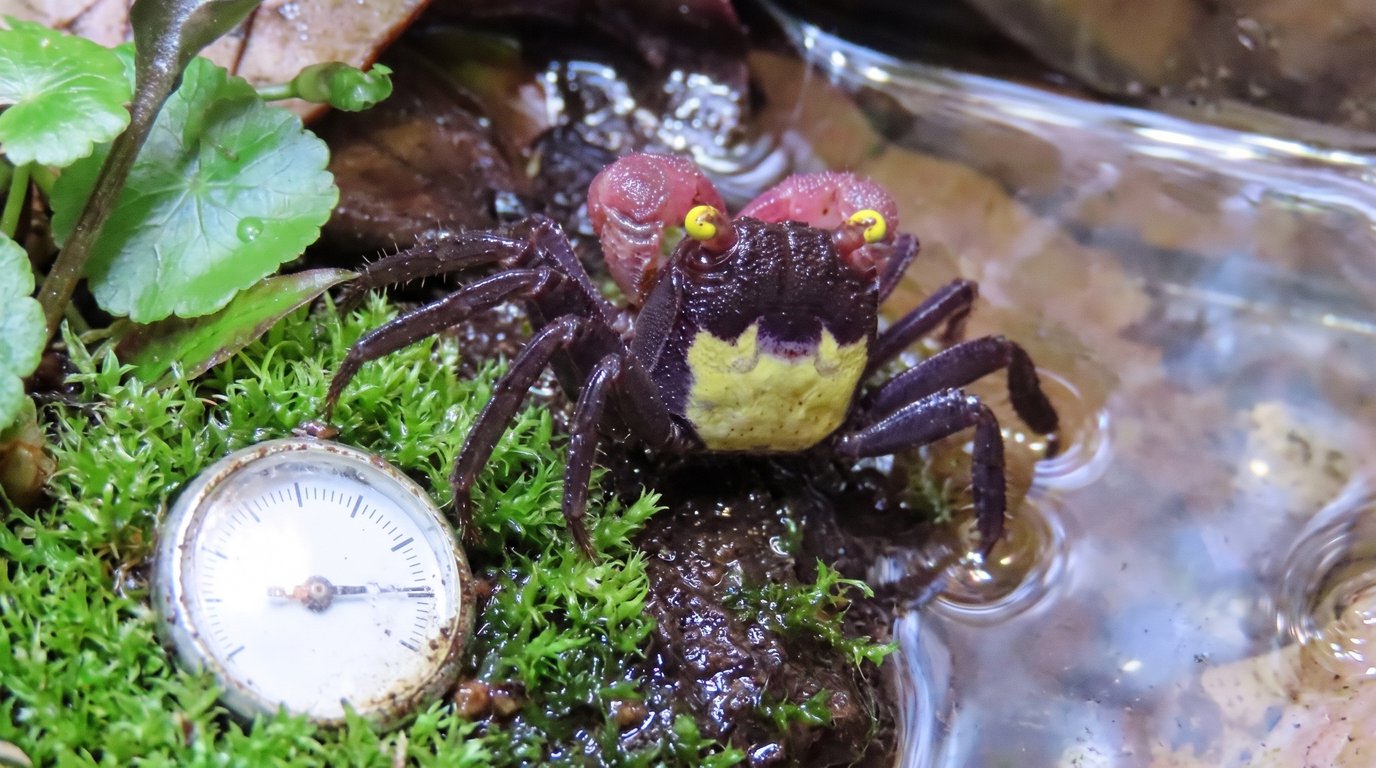
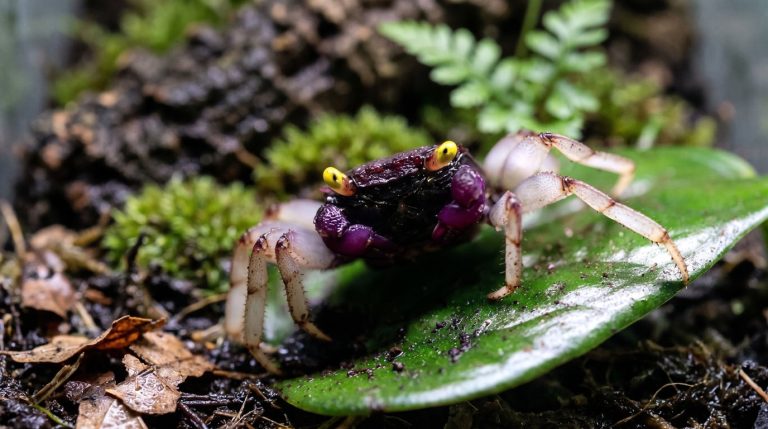
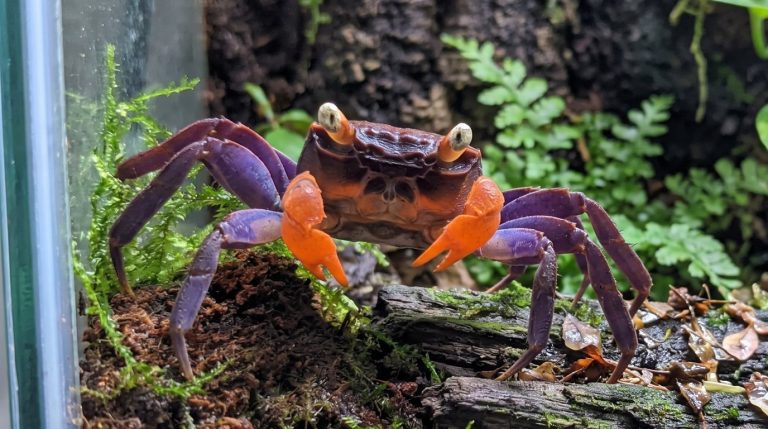
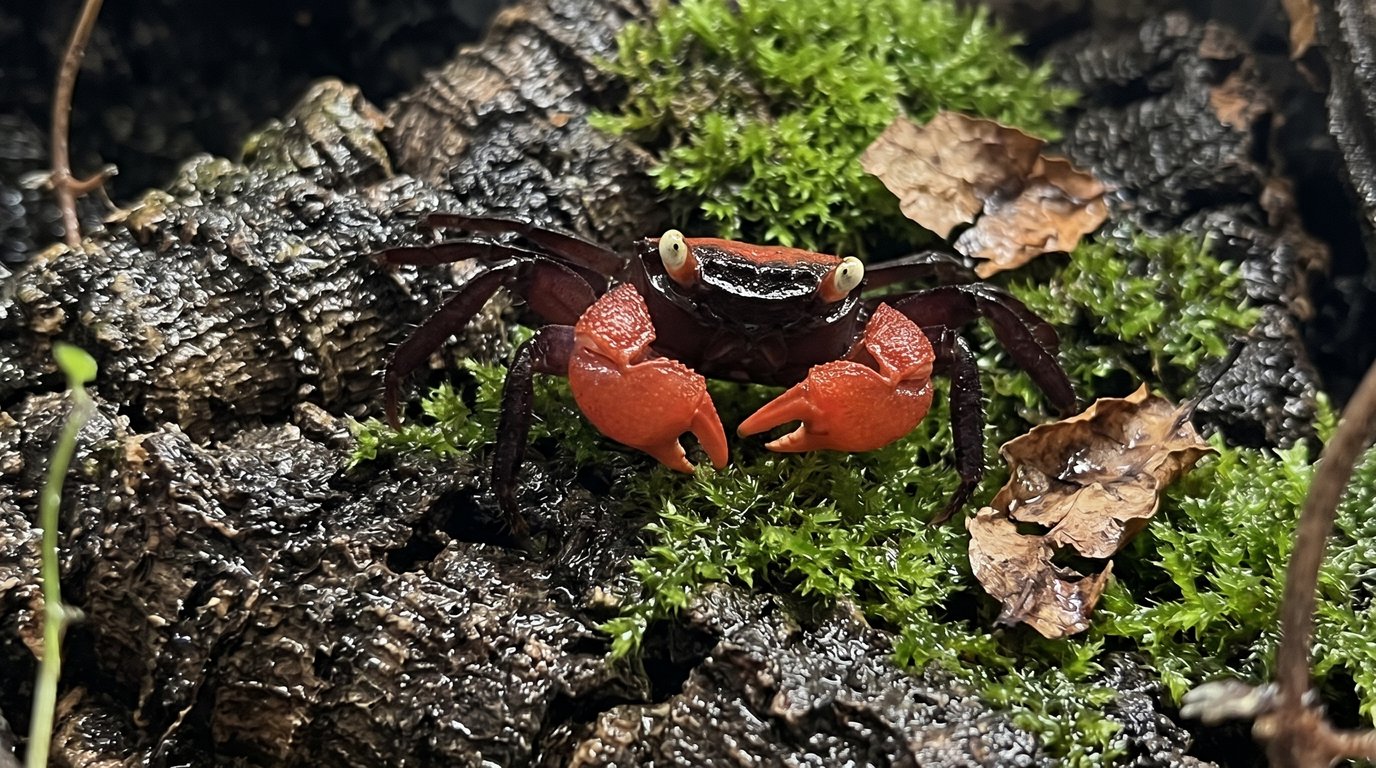
In the wild, the two vampire crabs described from central Java in 2015, Geosesarma dennerle and G. hagen, live on land near hill streams. They hide under rocks and dense plants and dig burrows near the water’s edge.2 Copy that vampire crab habitat at home: deep moss, soil they can dig in and a shaded corner away from any heat source. That way there’s always a cooler spot a crab can walk to.
Heat and humidity pull against each other, too. With the same moisture in it, warmer air reads as less humid.3 A tank you warm up dries out faster unless you also keep a vampire crab tank humid with a closed lid, damp moss and regular misting.
- The land thermometer reads 72-85°F (22-29°C) in the early morning and in the afternoon.
- The water section reads inside the same range.
- No part of the tank sits in direct sun.
- There’s a shaded, damp corner well away from any heater or mat.
Keep vampire crab tank mates inside their own temperature range
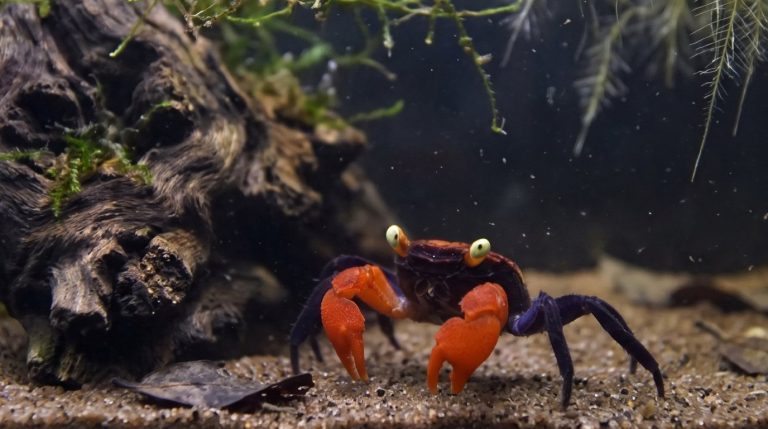
Check any shrimp or fish before you settle on a temperature, because the water they share has to suit both. Neocaridina shrimp are kept at 72-77°F (22-25°C). All of that sits inside the crab range, so a tank held at 72-77°F suits both. If you’re still deciding whether vampire crabs can live with shrimp in your tank, temperature is the first test, and Neocaridina pass it.
Bee and Crystal shrimp are a harder fit. They’re kept at 60-72°F (15.5-22°C), which meets the crab range only at 72°F (22°C). Don’t warm their water to suit the crabs. For a small fish, look up its own temperature range and make sure it overlaps the crabs’ before it goes in.
Buy vampire crabs after a few days of steady thermometer readings
Order your crabs once both thermometers have held 72-85°F (22-29°C) for several days, morning and afternoon, ideally through the warmest days of your week. You choose Male or Female for each crab on the product page when you buy tank-bred vampire crabs. Everything in our catalog is bred or propagated in our own tanks rather than collected from the wild.
References
3 Sources
- Buck, Juarez, Lacey, O’Connell and Watson-Zink, Aquatic respiratory rates in red devil vampire crabs (Geosesarma hagen) are dependent on interactions between temperature, sex, and body size, bioRxiv preprint (not peer reviewed), July 2026.
- Ng, Schubart and Lukhaup, New species of “vampire crabs” (Geosesarma De Man, 1892) from central Java, Indonesia, and the identity of Sesarma (Geosesarma) nodulifera De Man, 1892 (Zenodo archive copy of the paper), Raffles Bulletin of Zoology 63: 3-13, 2015.
- A Discussion of Water Vapor, Humidity, and Dewpoint, and Relationship to Precipitation, National Weather Service, Louisville, KY (NOAA), undated.
Ready to get started?
Shop our Vampire Crab collection
8 products available · Live Arrival Guarantee