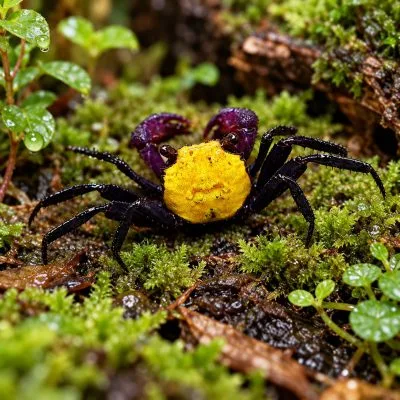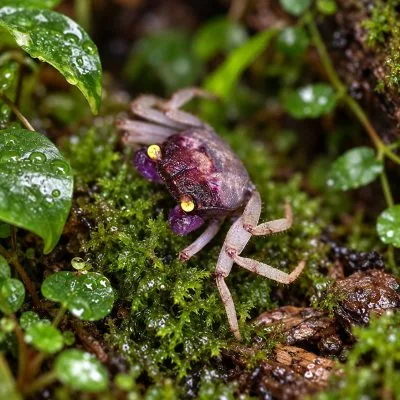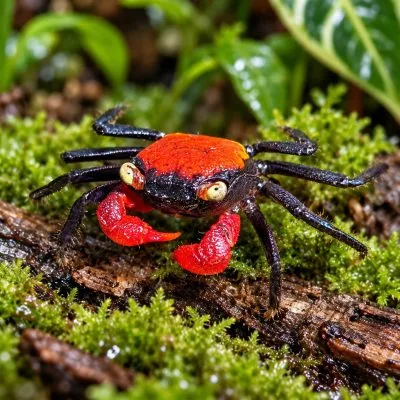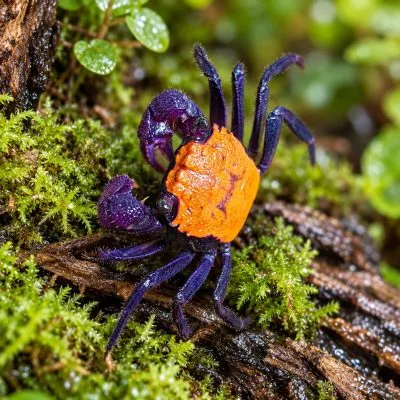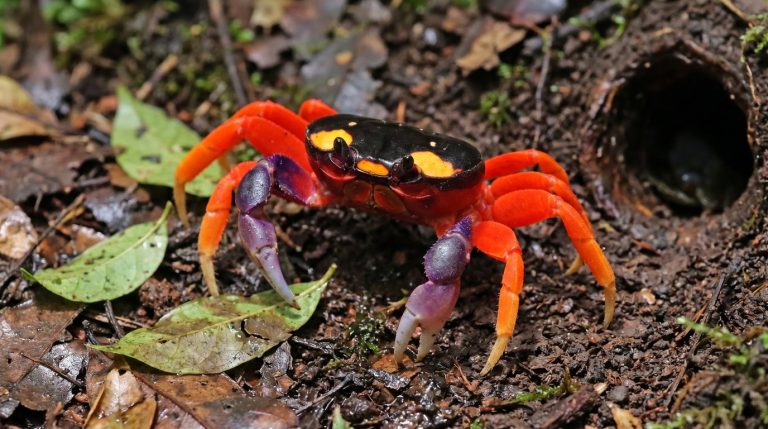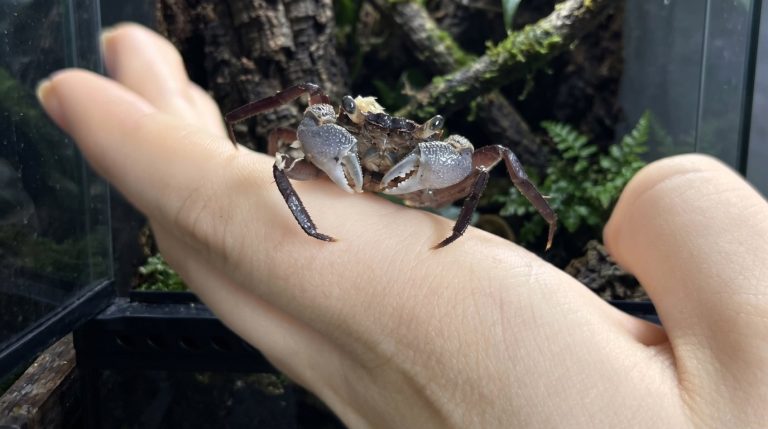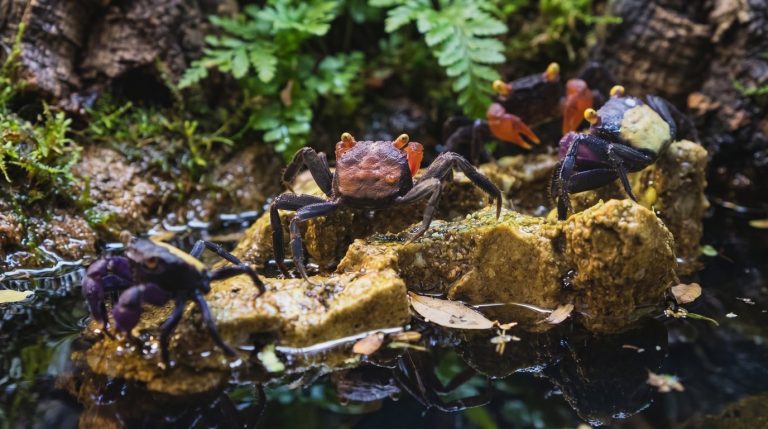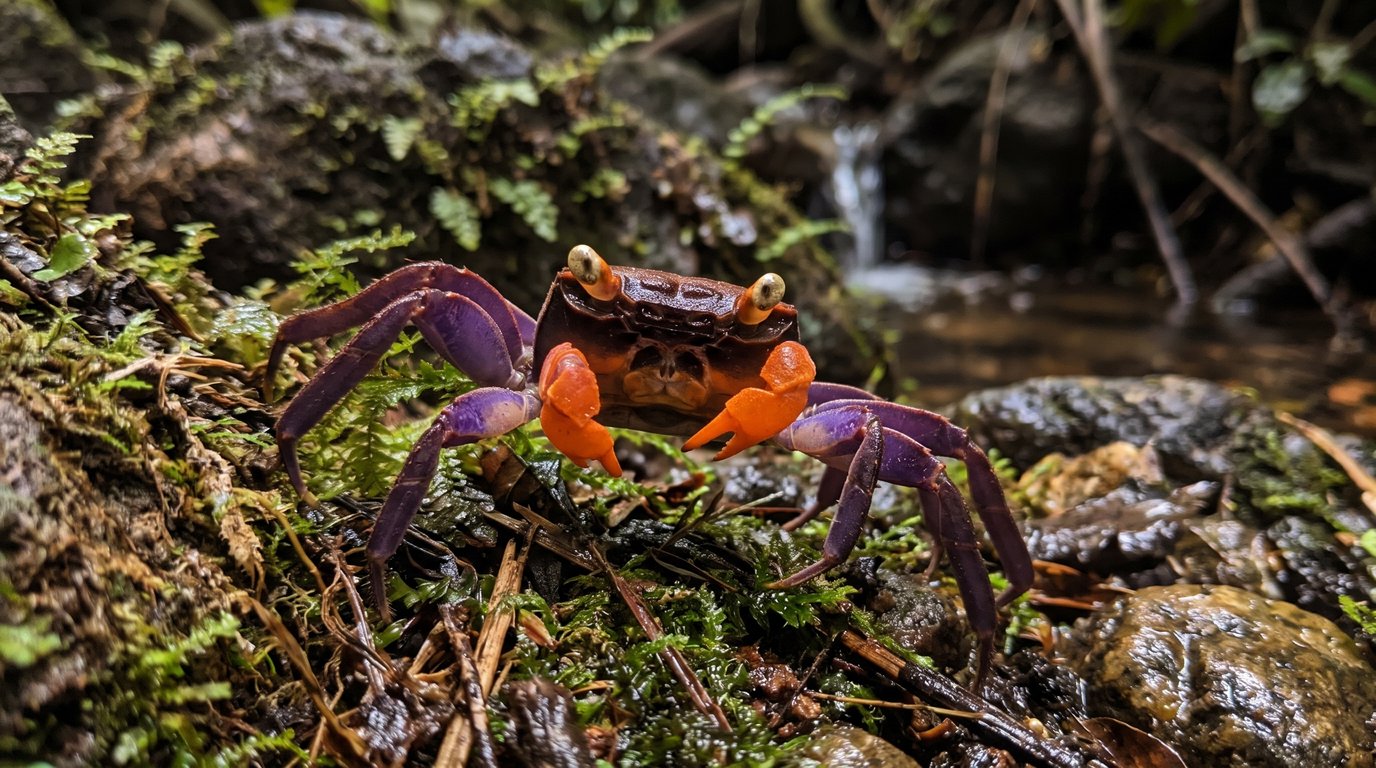
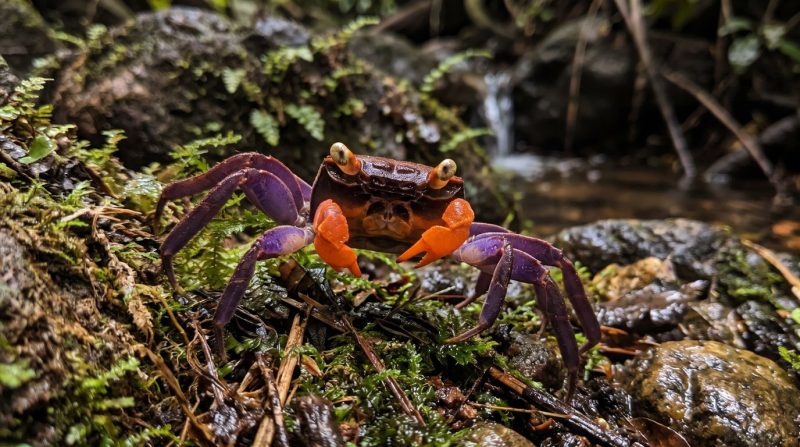
The best-known vampire crabs live on damp ground beside hill streams in Southeast Asia. They hide under rocks and dense plants and dig burrows near the water’s edge.1 To give yours the same habitat, build a closed paludarium that’s mostly damp land, with soft soil to dig in and plenty of cover. Add a freshwater section every crab can walk into, go fully under and climb back out of.
What does a vampire crab habitat look like in the wild?
Wild vampire crabs live on damp ground close to fresh water, with cover nearby. The two species described from central Java in 2015, Geosesarma dennerle and G. hagen, live along hill streams. There they hide under rocks and dense plants, dig burrows near the water’s edge, and the young stay closer to the water than the adults do.1
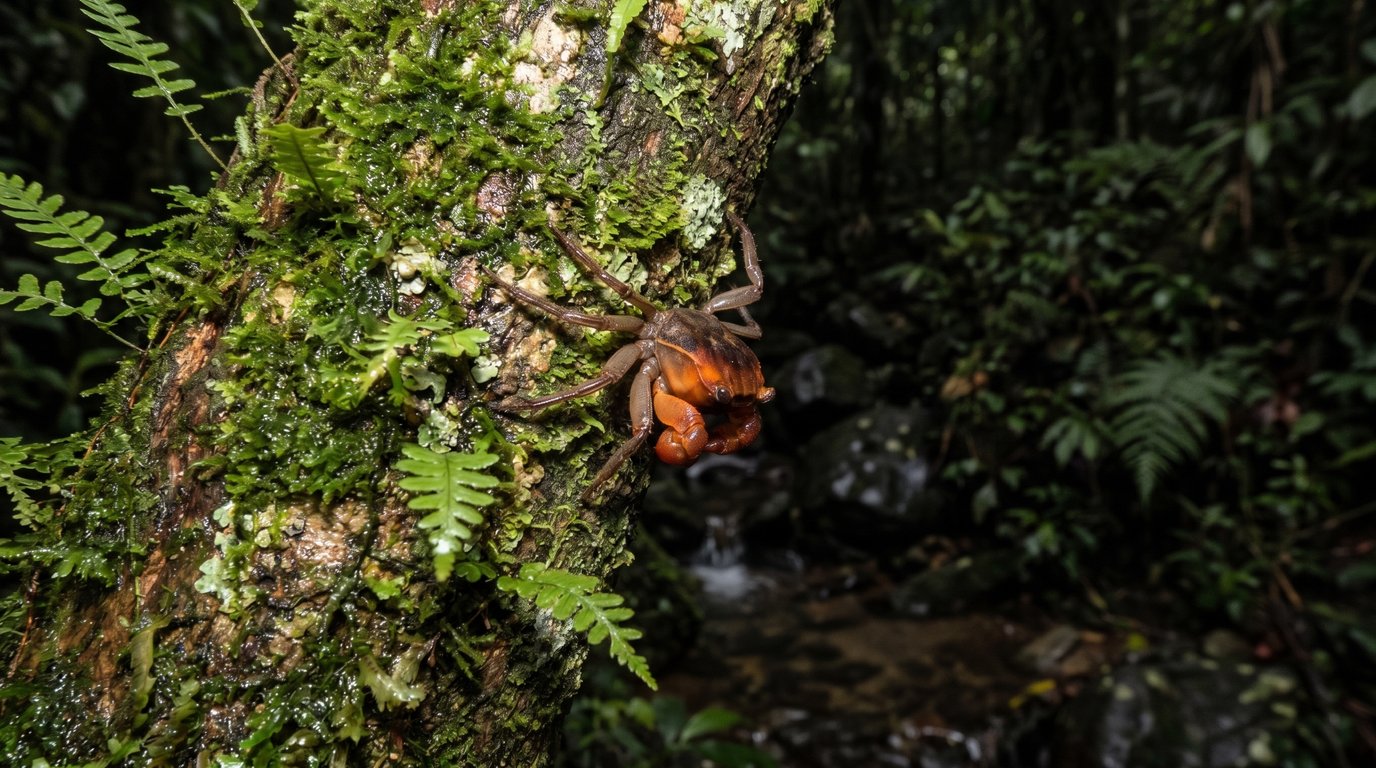
A stream doesn’t have to be big or fast. One field study of wild vampire crabs of an unnamed species in Java found them in orchards with moist, loose soil. There was no flowing river nearby, only slow streams lined with plants. The adults foraged above the water, some of them up on moss-covered branches, while the younger crabs kept nearer the water.2
Not every vampire crab lives on a stream bank in the hills, either. On Borneo, most species live in lowland forest or in limestone caves. A species described from Sarawak in 2026 lives in steep, cool, shaded mountain forest thick with moss, among leaf litter near small streams.3
So what do the places described above share? Damp ground, cover overhead, soil soft enough to dig and fresh water a few steps away. That’s the part your tank has to copy. A trade name alone rarely tells you which of those habitats your crab’s line started in. Tracing where vampire crabs come from starts with the name you bought them under.
Why does a vampire crab habitat need water as well as land?
Because vampire crabs live on land but can’t do without water. Land crabs in general keep water in their gill chambers, and when they dry out, the gills collapse and stop working well.4 In the Java field study, the crabs could stay away from water for long stretches, but only while their bodies stayed moist.2
In our paludariums, the crabs spend their time on land and climb down into the water from time to time to feed and to molt. That’s why the water section has to be one a crab can climb into and fully enter.
A tank that’s all land, with only a water dish too small to get into, takes away the place your crabs molt. Don’t swing the other way and flood the tank, either. Vampire crabs can’t live in water full time, so the land is where they rest, dig and hide.
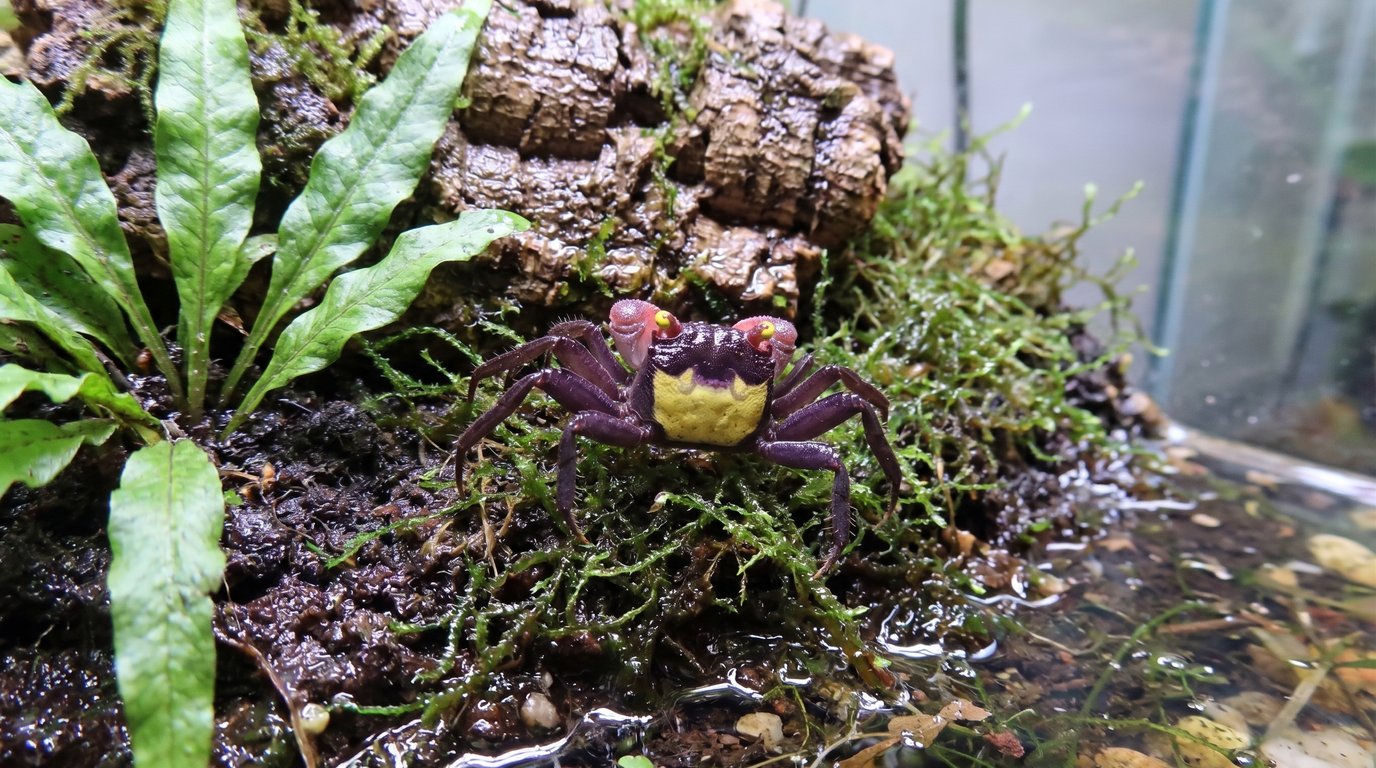
Rebuild the stream bank inside a vampire crab paludarium
Match each part of the wild habitat with a part of the tank and you’ve covered most of the setup that the rest of vampire crab care builds on.
| In the wild | In your paludarium |
|---|---|
| Damp ground beside a stream | A land section that takes up most of the tank and stays moist |
| Burrows dug near the water’s edge | Soft, damp soil deep enough to dig into, sloping down to the water |
| Rocks and dense plants to hide under | Stones, cork, leaf litter, moss and plants spread across the land |
| Moss-covered branches above the water | Wood or cork to climb, with moss on it |
| Small, slow freshwater streams | A fresh water section each crab can walk into, go fully under and climb out of |
| Damp air under a forest canopy | A closed lid, damp moss and misting about once a day |
The soil does more work than anything else in your vampire crab tank setup. Wild vampire crabs dig, and a crab with nowhere to dig has fewer places to hide. Keep the soil damp, not waterlogged, and give it enough depth near the water for a burrow.
Moss is the easiest way to copy the forest floor. Java moss grows out of the water once it has adjusted. It does best where it stays wet, at the water’s edge or on wood and stone that reaches down into the water, and creeps up onto the land from there. Where it dries out, it browns and dies back. Plants that like the same damp conditions fill the rest, and the case for planting at all is set out under whether vampire crabs need vegetation.
Use plain fresh water in the water section. Vampire crabs are inland freshwater crabs.3 Over 90% of the species whose eggs had been measured by 2019 have large eggs that hatch straight into tiny crabs, with no larval stage that needs the sea.5 A few species do have sea-going larvae, but crablets turn up in home paludariums running fresh water, so the crabs sold in the hobby don’t need salt to breed.
Then close it up. A lid holds in the damp air, and the crabs climb as well as dig, so the lid is also what keeps them in. If you’re tempted to leave the top open for the look, check whether vampire crabs will escape from an open top enclosure before you do.
Keepers with a closed tank mist it about once a day, more often while new moss settles in, to keep a vampire crab tank humid behind that lid.
Keep the land at about 78°F (26°C), anywhere within 72-85°F (22-29°C). Plenty of keepers manage that at room temperature with no heater. If your room runs cool, the way you heat a vampire crab paludarium decides whether the land stays damp.
A good vampire crab habitat hides its crabs most of the day
Expect to see little of your crabs once the habitat is right. By day vampire crabs sit hidden in burrows they dig, in crevices, under stones, cork or leaves, or among dense plants, and keepers often go days without seeing one. Some crabs stay out of sight for weeks and are still alive.
That can feel like something’s wrong. It usually isn’t. A crab that can stay hidden is a crab that has found the cover its wild relatives live under. Vampire crabs are out mostly in the evening, at night and in the early morning. A quiet look with a dim light after dark shows you far more than staring at the tank at noon. Some crabs show up by day too, so calling vampire crabs nocturnal is only right if you add “mostly”.
- Every crab has more than one place to hide on the land.
- The soil near the water is soft and damp enough to dig.
- Moss and leaf litter stay damp between mistings.
- Don’t pull up hides or dig through the soil to find a crab you haven’t seen for a few days.
Add vampire crabs once the habitat stays damp and warm
Order your vampire crabs once the land has stayed damp and the thermometer on it has held 72-85°F (22-29°C) for several days. That’s also where buying tank-bred animals matters. Several vampire crab species are collected from the wild in large numbers for the aquarium trade, with unknown effects on the wild populations.6 Everything in our catalog is bred or propagated in our own tanks rather than collected from the wild.
When you choose tank-bred vampire crabs, you pick Male or Female for each crab on the product page.
References
6 Sources
- Ng, Schubart and Lukhaup, New species of “vampire crabs” (Geosesarma De Man, 1892) from central Java, Indonesia, and the identity of Sesarma (Geosesarma) nodulifera De Man, 1892 (Zenodo archive copy of the paper), Raffles Bulletin of Zoology 63: 3-13, 2015.
- Kurniawan, Waluyo, Nofreeana and Aji, Habitat and Food of Vampire Crabs (Geosesarma sp.) in Menoreh Mountain, Yogyakarta, Indonesia, Media Konservasi 30(1), 2025.
- Grinang, Ng and Ng, A new species of vampire crab of the genus Geosesarma De Man, 1892 (Crustacea: Brachyura: Sesarmidae) from a montane forest in southwestern Sarawak, Malaysian Borneo, Raffles Bulletin of Zoology 74: 457-464, 2026.
- Lucu and Turner, Ionic regulatory strategies of crabs: the transition from water to land, Frontiers in Physiology 15: 1399194, 2024.
- Shy and Ng, Geosesarma mirum, a new species of semi-terrestrial sesarmid crab (Crustacea, Decapoda, Brachyura) from central Taiwan, ZooKeys 858: 1-10, 2019.
- Ng and Wowor, Two new species of vampire crabs (Crustacea: Decapoda: Brachyura: Sesarmidae: Geosesarma De Man, 1892) from Java, Indonesia, Raffles Bulletin of Zoology 72: 469-478, 2024.
Ready to get started?
Shop our Vampire Crab collection
8 products available · Live Arrival Guarantee