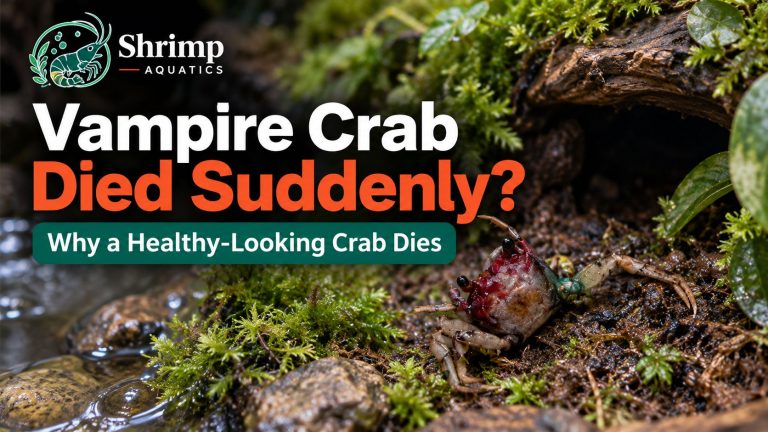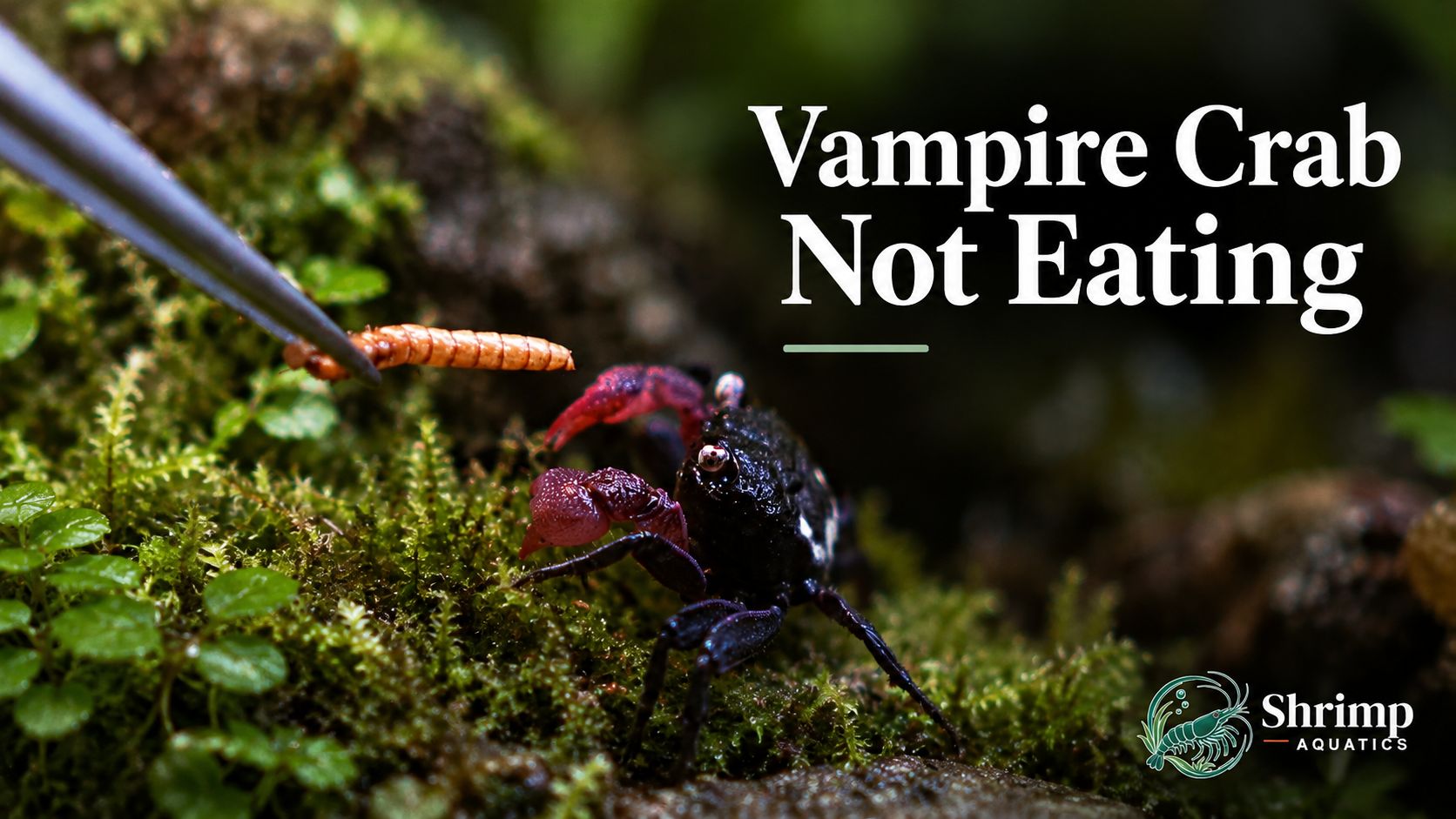
Never once seen your vampire crab eat? It’s probably eating fine, just at night and out of sight, because a vampire crab (Geosesarma) mostly feeds after dark and food set out in the evening goes missing overnight. So check the food the next morning before you worry. A new crab often hides and ignores food at first, and its first meal can come anywhere from the first night to about a week after it arrives. A crab close to a molt may skip food for a while too.
Is your vampire crab eating when you’re not looking?
Often, yes. Vampire crabs mostly eat in the evening and at night, so you may never actually see yours eat, especially a new one. One keeper held food out on tweezers to a weak little female, who ignored it, then pounced on it and dragged it into her hut the moment the tweezers were gone. What you’ll notice instead is food set out the evening before that’s smaller or gone by morning. If you rarely see your crabs at all, that fits too, because vampire crabs are mostly nocturnal and spend most of the day hidden.
Run this check for a few nights:
- At lights-off, put a small portion of food at the entrance to the crab’s burrow or hide, or wherever it usually sits.
- Use one food at a time from the usual list of what vampire crabs eat, so you know which one it took.
- Look the next morning. Food that’s smaller or gone is being eaten, though in a shared tank you can’t always tell by whom.
- Lift whatever is left, and repeat before you decide anything.
Don’t expect every crab to pass on the first night. One keeper laid a piece of food right at each new crab’s front door. By morning one crab had eaten its share, and the other still hadn’t touched it.
How long before a new vampire crab starts eating?
Anywhere from the first night to about a week, and crabs in the same group differ. A newly bought vampire crab often eats little or nothing you can see at first: it hides, ignores some of the food on offer and feeds at night. A few crabs eat very little for weeks. New crabs also stay out of sight at first and show themselves more once they’ve settled, which can take from about two weeks to half a year.
A move can set a crab back, too. One keeper’s crabs were always nibbling at cucumber, grapes and pepper while they were kept in the breeder’s tank, then hardly touched anything once they moved into the keeper’s own. Another keeper lifted almost all of the food back out every morning for two months or more, before it finally began to disappear overnight.
So what should you do with a new crab that won’t eat? Mostly, leave it be. Offer a small portion at night near its hide, check in the morning and lift what’s left. A new crab that isn’t eating is often just settling in, but new arrivals can also die in their first couple of weeks, so keep the warning signs further down in mind.
Do vampire crabs stop eating around a molt?
They may, so a crab that skips food for a while could simply be close to a molt. Crabs of other kinds that have been studied stop feeding around a molt and shelter while the new shell is still soft.12 Nobody has timed this in vampire crabs, so don’t count days.
In our paludariums, a molting crab stays down in the water for a few hours. Leave it there, and don’t lift it out to check. Our crabs eat their old shell after a molt, so we leave it in the tank for them. A shed that looks like a dead crab is a normal part of vampire crab molting.
Which foods get a reluctant vampire crab eating?
Animal food, first. Many vampire crabs ignore fruit, vegetables, tuna and some prepared foods, such as tablets, food sticks or hermit crab food. Where crabs refused those, animal food got them eating: frozen bloodworms, small pieces of smelt, worms, small live crickets, or fish flakes and pellets.
One keeper’s new crabs barely touched the hermit crab food the pet store had been giving them. Then the keeper offered a worm, and one crab dove at it and dragged it straight back into its hollow log. No single food works for every crab, and some crabs happily eat vegetables. If yours ignores one food, try a different kind, and try animal food before anything else.
At Shrimp Aquatics, we feed our vampire crabs vegetables, fruit and dried insect larvae, among other foods. That mix suits a crab that’s already eating. For one that won’t, start with the animal food above, and go back to a varied mix once it’s feeding again. Keep each offer small, because a crab that’s barely eating won’t clear a big pile.
When should a vampire crab that won’t eat worry you?
Take it seriously when food you set out is still there morning after morning from a crab that’s been in your tank a while, or when new arrivals start dying. Newly bought vampire crabs often die between arrival and about two weeks later, even in a tank where other crabs do well, and some stop eating, hide and die within days. Keepers who checked their tank mostly found nothing wrong and put the losses down to the crabs’ condition on arrival, after import, shipping and handling.
Either way, check the tank today: the lid is closed, the land and moss are damp, the temperature sits at about 78°F (26°C), inside 72-85°F (22-29°C), and every crab can climb into the water and back out. If your vampire crabs are dying as well as refusing food, work through the other signs one at a time.
What not to do while your vampire crab is off its food
Mostly, don’t interfere. We know it’s tempting to do something, but a crab that isn’t eating needs quiet, small meals and a clean tank more than it needs your help.
- Don’t force-feed it or keep pushing food in front of it.
- Don’t lift the crab out to look at it, and never while it sits in the water, where it may be molting.
- Don’t take out a fresh shed. Leave it in the tank for the crab.
- Don’t pile up food for it. Food left in a humid tank goes moldy, so lift leftovers the next morning.
- Don’t switch foods every night. Give one food a few nights before you try the next.
- Don’t dig up hides or burrows to find a crab you haven’t seen for a few days.
What the research says about crabs that stop eating around a molt
The two studies behind the molt section are on larger crabs, not vampire crabs, so read them as a reason for patience rather than a timetable. In lab-held Chinese mitten crabs (Eriocheir sinensis), crabs close to a molt had stopped eating, and crabs sampled soon after a molt still had soft shells, sheltered in a corner and didn’t eat.1 Mud crab researchers write that crabs stay still in shelters and don’t feed during and just after a molt.2
Buying tank-bred vampire crabs once your tank is ready
Order vampire crabs once the land, water and hides that everyday vampire crab care asks for are set up and running, so new crabs go into a tank that’s ready for them. You choose Male or Female for each crab on the product page when you buy tank-bred vampire crabs. Everything in our catalog is bred or propagated in our own tanks rather than collected from the wild. When your crabs arrive, follow the instructions supplied with your order.
References
2 Sources
- Huang and colleagues, Transcriptomic variation of hepatopancreas reveals the energy metabolism and biological processes associated with molting in Chinese mitten crab, Eriocheir sinensis, Scientific Reports 5: 14015, 2015.
- Zhang and colleagues, Molting Alters the Microbiome, Immune Response, and Digestive Enzyme Activity in Mud Crab (Scylla paramamosain) (PubMed Central copy), mSystems 6(5): e00917-21, 2021.
Ready to get started?
Shop our Vampire Crab collection
8 products available · Live Arrival Guarantee