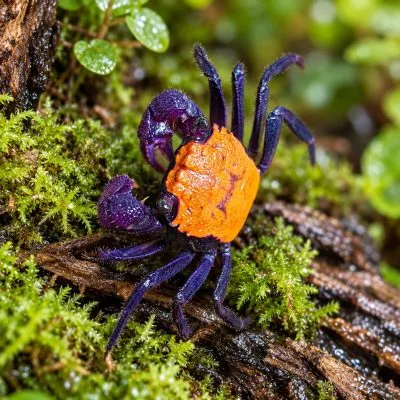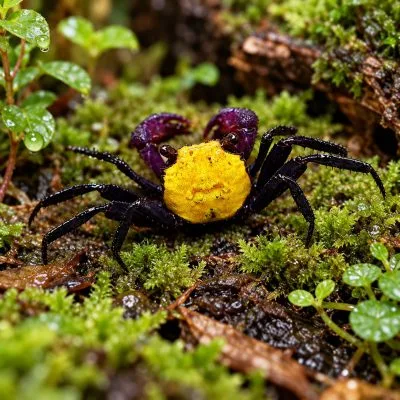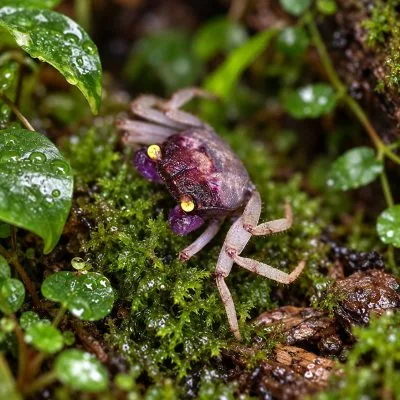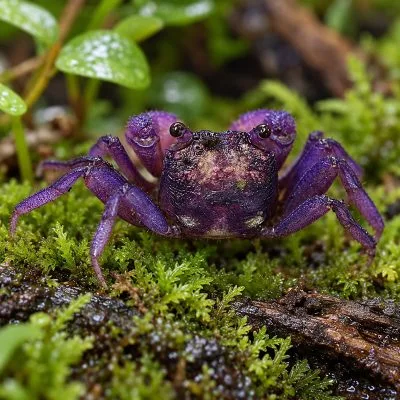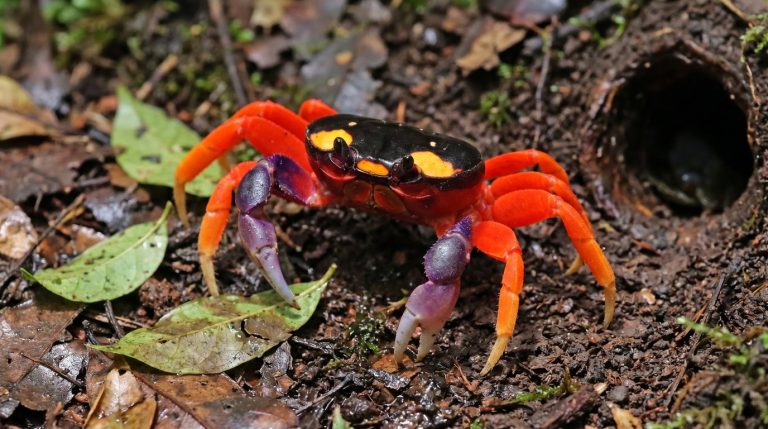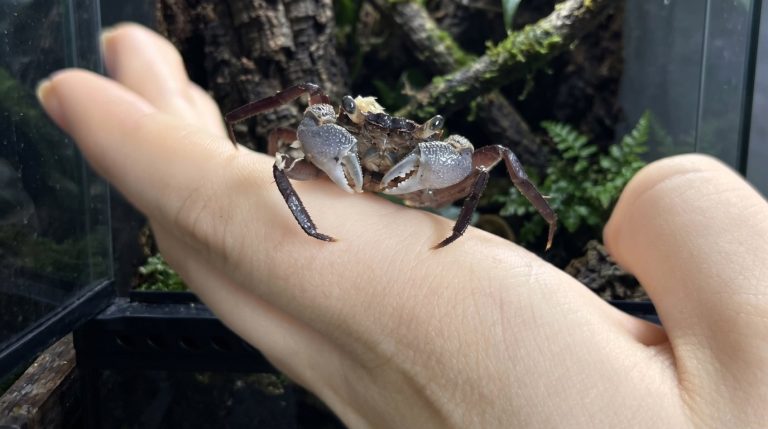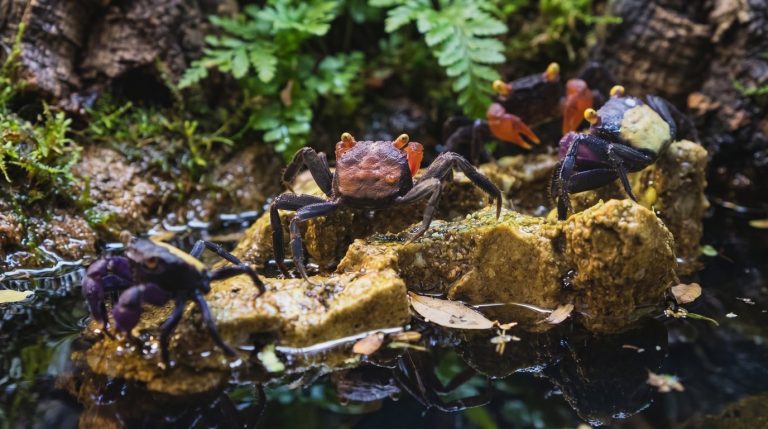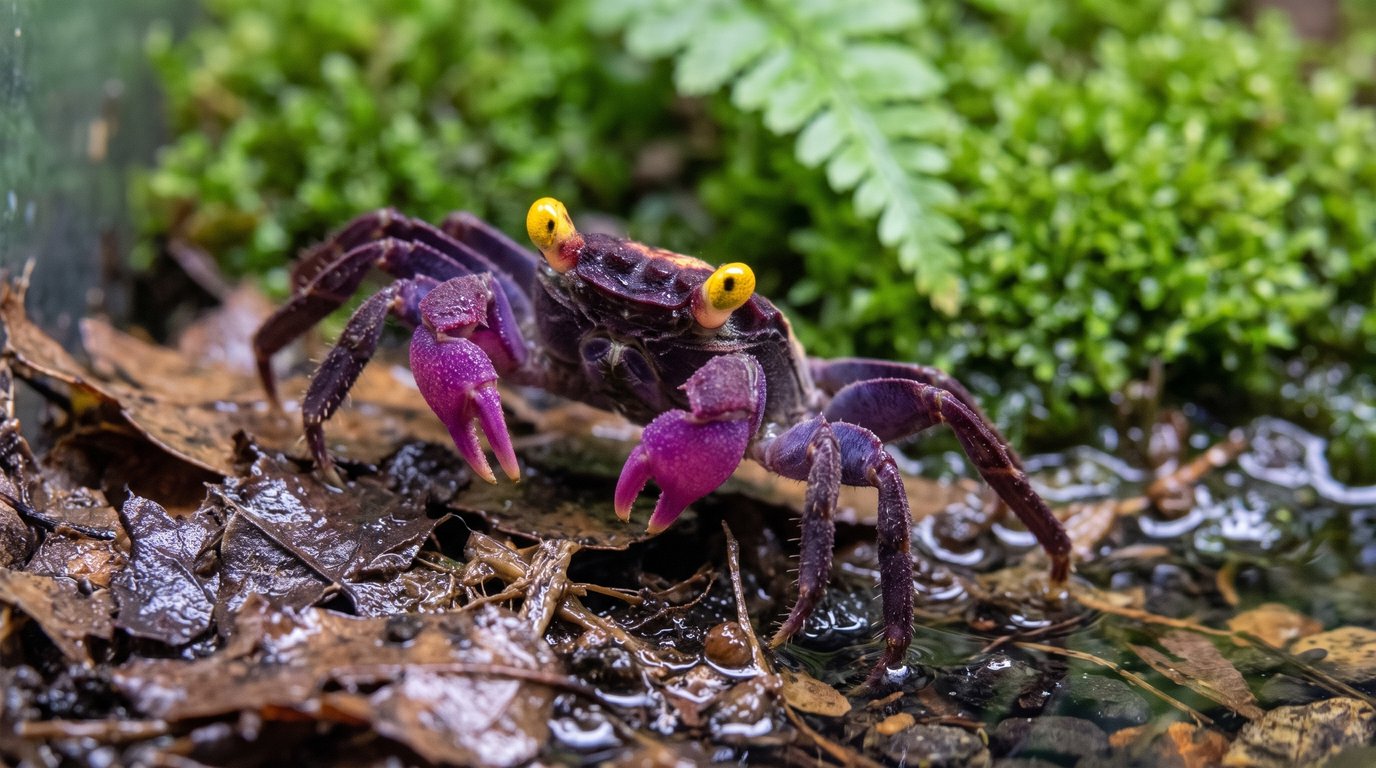
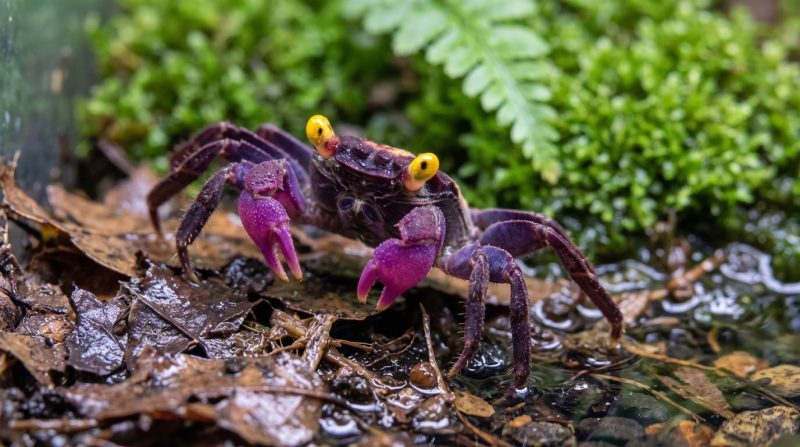
No, vampire crabs and frogs shouldn’t share a tank. A vampire crab needs a water section it can climb into and fully enter to molt. That same water is a drowning risk for dart frogs, a frog many keepers want to add. Frogs also swallow small moving prey whole, so crablets, and any adult crab small enough for a bigger frog’s mouth, can become food. Give the frog a vivarium of its own and keep the crab tank to the animals that suit vampire crab care.
Why can’t a dart frog share the vampire crab water section?
Because the water the crab needs is the water a dart frog can drown in. Dart frogs aren’t strong swimmers and may drown in deep water, which is why a dart frog enclosure usually has nothing more than a small, shallow pond.1
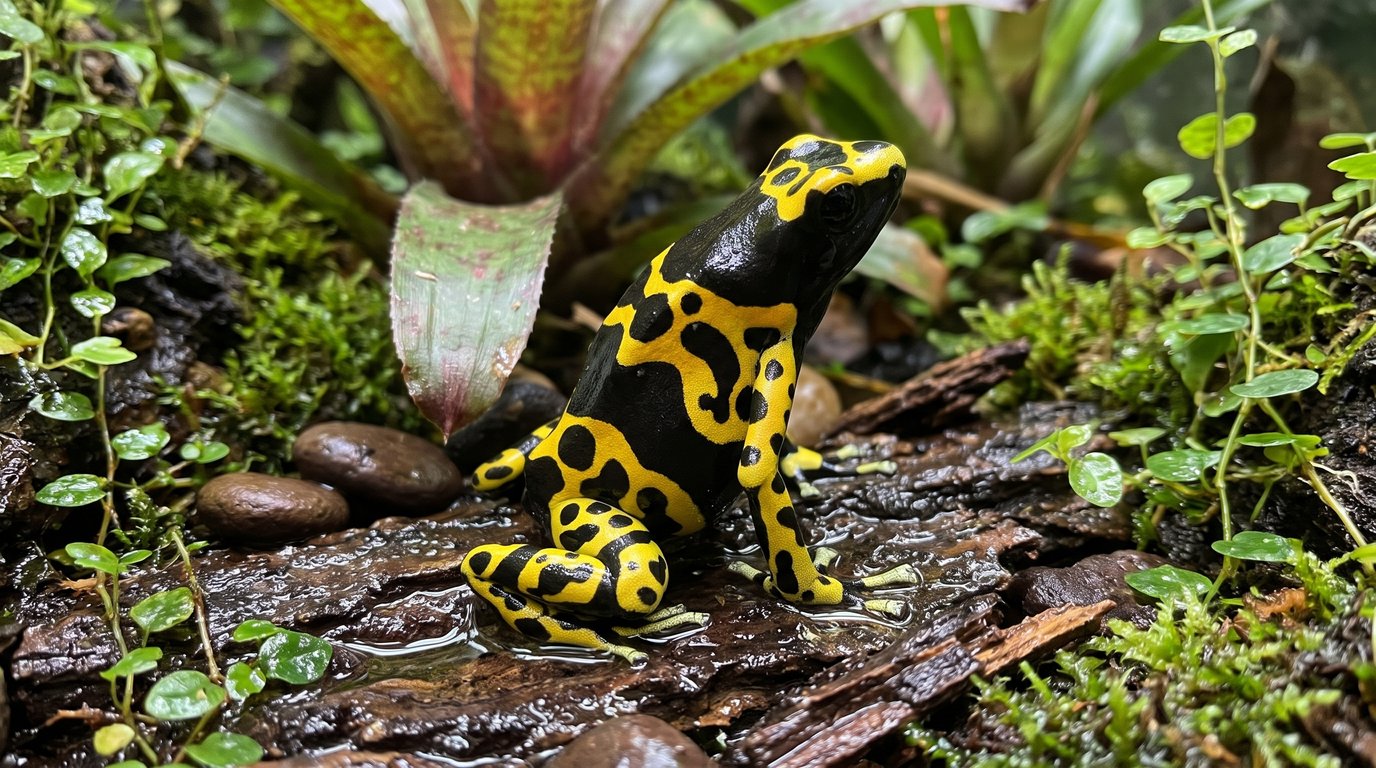
The crab can’t do without that water. Molting is the reason vampire crabs need a water area in a vivarium deep enough to climb into and go fully under. Make it shallow enough to be safe for a dart frog and it stops working for the crab. The two needs pull against each other in the same spot.
Temperature, on the other hand, isn’t what rules dart frogs out. In one public aquarium’s husbandry, lowland dart frogs were kept and bred best at 78-80°F (25-27°C),1 which sits inside the vampire crab temperature range of 72-85°F (22-29°C). Mountain species were kept cooler in that same collection, so check the species you have before you assume the air suits both.
So the deal-breaker is the layout and the animals themselves, not the thermometer. That’s why the next two questions matter more than any heater setting.
Can a vampire crab catch or injure a frog?
It can’t be ruled out, and a small frog or a froglet is most at risk. Vampire crabs can catch and eat small fish. A sleeper goby has been found half eaten beside a crab burrow, and two male guppies were taken within two hours in another tank.
You’d rarely see it happen, because vampire crabs are nocturnal for the most part, coming out in the evening, at night and in the early morning. Any frog resting near the water’s edge or on the ground at those hours shares the floor with a crab that’s out looking for food.
Crabs do take frogs in the wild. On the Greek island of Karpathos, the freshwater crab Potamon karpathos was seen grabbing adult water frogs, holding one under water until it stopped moving and starting to eat it.2 Many frogs there carry missing toes, missing limbs or scars from crab attacks. That crab is about 75 mm (3 inches) across the shell, far bigger than a vampire crab. It shows what a claw can do, not how often a vampire crab would try.
We haven’t kept frogs with our vampire crabs, so we can’t tell you how often it goes wrong.
Nobody has published a case of a vampire crab attacking a frog either. With a crab that already takes fish and a frog that can’t swim away from it, we think that’s too much risk to test on your own animals.
Will a frog eat your vampire crabs or crablets?
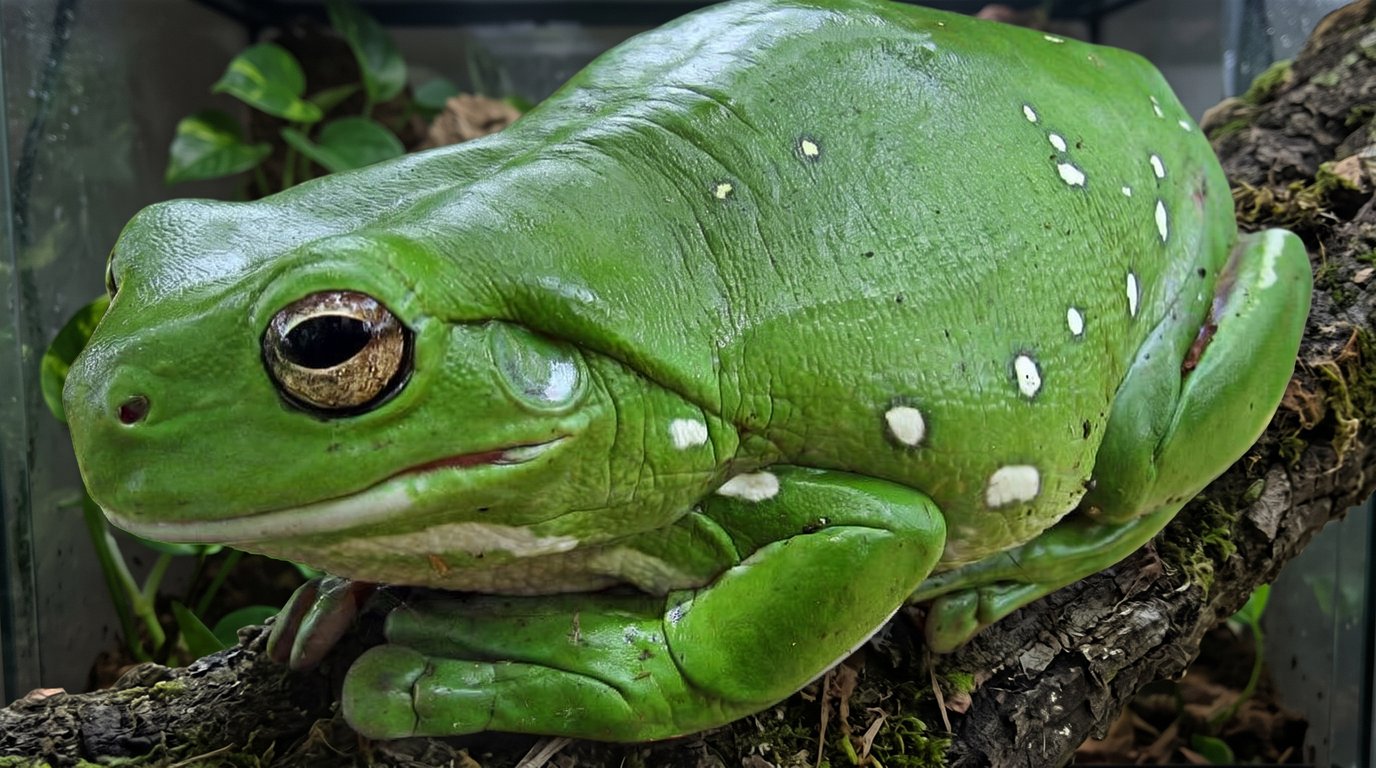
Yes, if the crab moves and fits in the frog’s mouth. Frogs and toads swallow their prey whole, the width of a frog’s head sets how big that prey can be, and it’s movement that sets off the attack.3 A walking crab is exactly the kind of target a frog is built to strike at.
Crablets are the easiest meal in the tank. Adult vampire crabs already eat the crablets they catch, which is why moving the young to a tank of their own raises the most of them. Add a frog and you’ve added a second predator, and vampire crab breeding in that tank becomes a feeding station.
A big-mouthed frog may take an adult crab too. A larger tree frog or a horned frog can have a mouth wide enough for a crab that small. Size the risk by the frog’s mouth, not by how peaceful it looks. Small lizards raise the same worry for crablets, which is one reason mourning geckos shouldn’t live with vampire crabs either.
Is any frog safe to keep with vampire crabs?
No frog is a safe match, and each type fails for its own reason. The common candidates line up like this:
| Frog | Main problem with vampire crabs |
|---|---|
| Dart frogs | Weak swimmers that can drown in the water the crabs need; small, so exposed to a crab hunting at night |
| Tree frogs | Can swallow crablets, and any crab that fits the frog’s mouth |
| Horned frogs | Wide-mouthed predators that swallow prey whole |
| African dwarf frogs | Fully aquatic, so they’d live in the crabs’ water section around the clock |
The African dwarf frog sometimes turns up on vampire crab tank mate lists, but the one sold in the trade, Hymenochirus boettgeri, is a small, fully aquatic frog.4 It needs a proper aquarium to swim in, and a crab tank’s water section is mostly a place to soak and molt. It would spend all day and night where the crabs come down to feed.
Tree frogs get suggested because they live up in the branches while the crabs stay low. One keeper reports housing green tree frogs with vampire crabs in three paludariums with no problems. That report gives no tank size, no time span and no count of losses, and the frog’s mouth hasn’t changed. One quiet setup doesn’t make it a safe plan.
If you’re set on both, keep them in two enclosures, each built for its own animal. A dart frog vivarium with a shallow dish and a crab paludarium with real water sit happily side by side on one shelf.
What can live with your vampire crabs instead of a frog?
Shrimp are the easiest choice for the water section, then small, quick fish. Because vampire crabs can live with shrimp that share their temperature, a colony of Neocaridina gives the water section life without anything that can swallow a crab.
If you’d like movement in the water, the fish that can live with vampire crabs are small mid-water species whose own temperature range overlaps 72-85°F (22-29°C). Even they need dense plants and well-fed crabs.
When the tank is set up for crabs alone, you can stock tank-bred vampire crabs, choosing Male or Female for each crab on the product page. Everything in our catalog is bred or propagated in our own tanks.
References
4 Sources
- The Husbandry of Poison-Dart Frogs (Family Dendrobatidae), S. L. Barnett, National Aquarium in Baltimore, Proceedings of the Association of Reptilian and Amphibian Veterinarians, 1996.
- Lethal grip for an endangered endemic frog: the freshwater crab Potamon karpathos preys on Karpathos water frog Pelophylax cerigensis, Herpetozoa 37: 295-298, 2024.
- What does a Pacman eat? Macrophagy and necrophagy in a generalist predator (Ceratophrys stolzmanni), PeerJ 7: e6406, 2019.
- Amphibian Hymenochirus boettgeri as an experimental model for infection studies with the chytrid fungus Batrachochytrium dendrobatidis, Virulence 14(1): 2270252, 2023.
Ready to get started?
Shop our Vampire Crab collection
8 products available · Live Arrival Guarantee