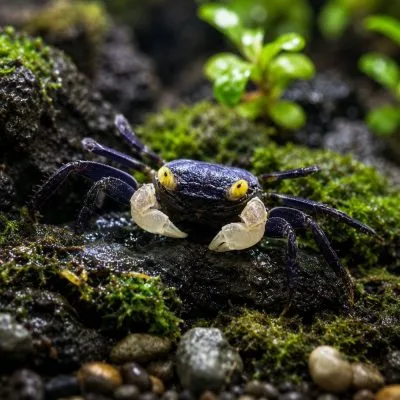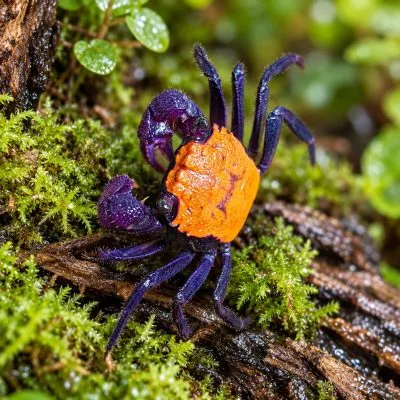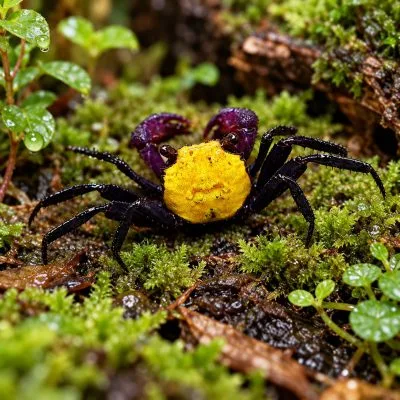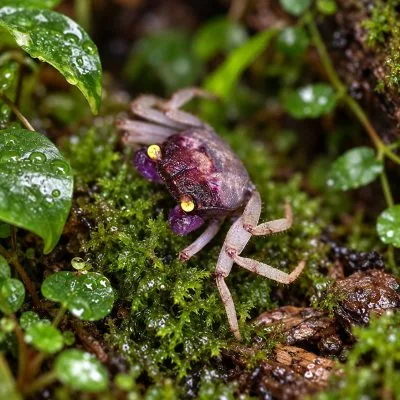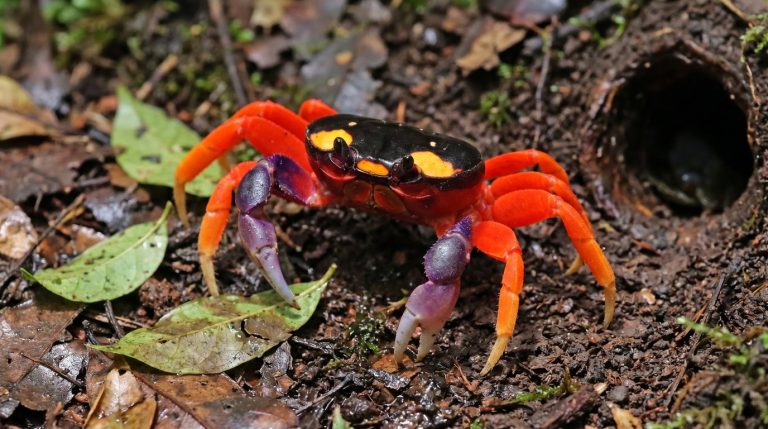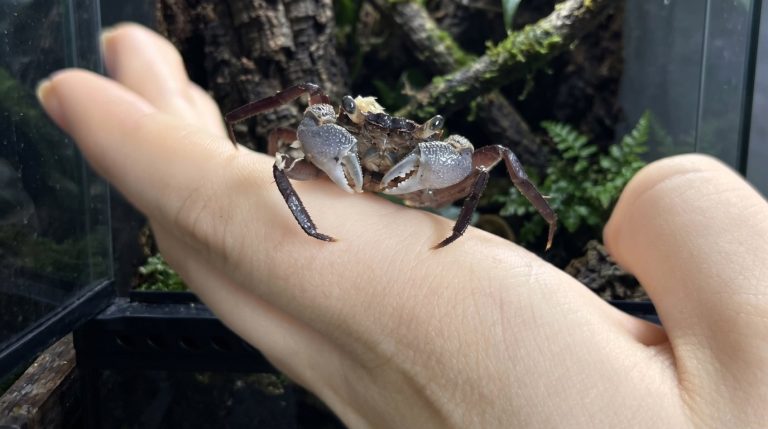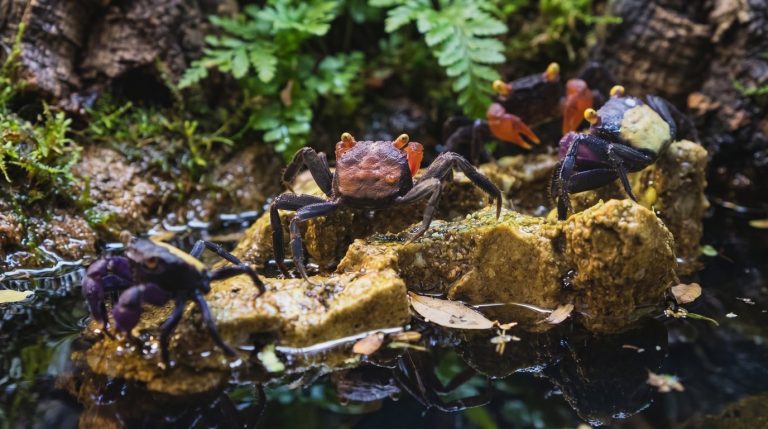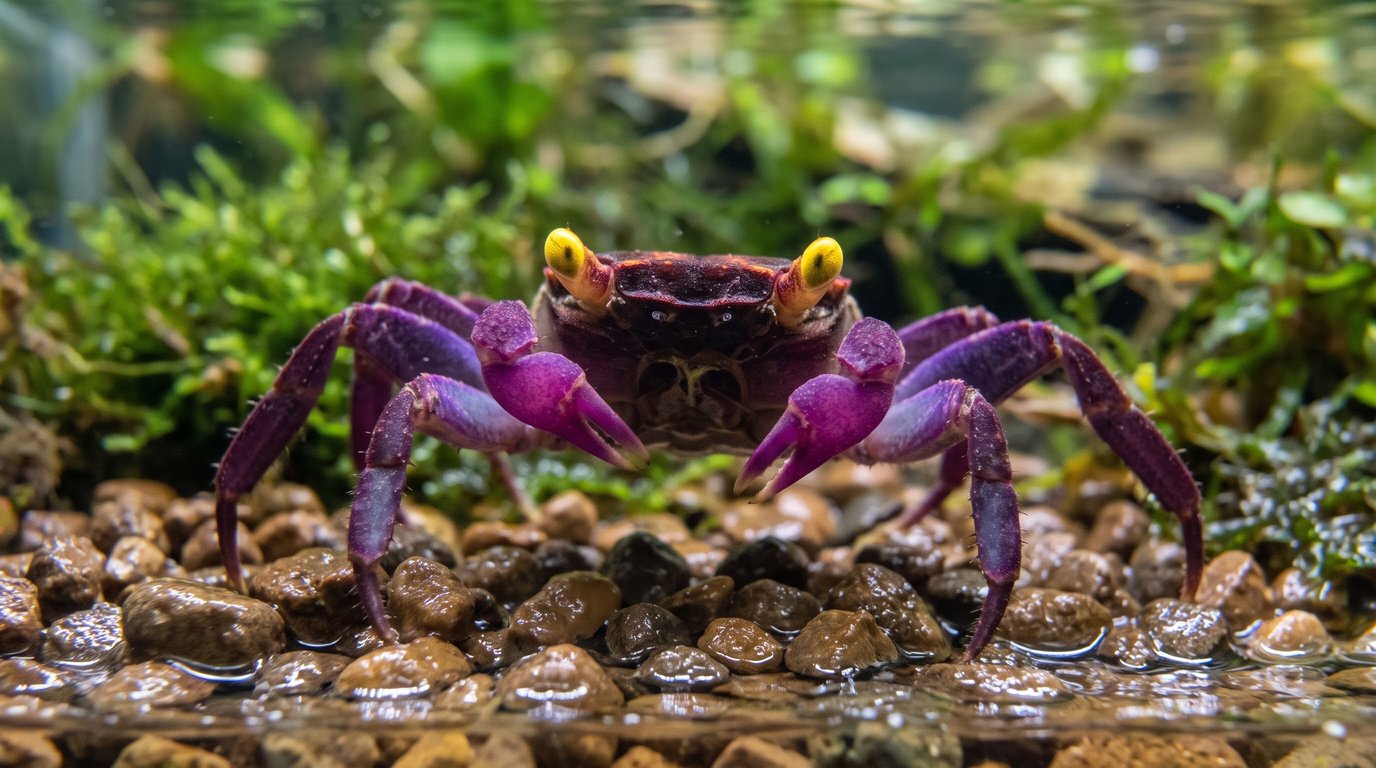
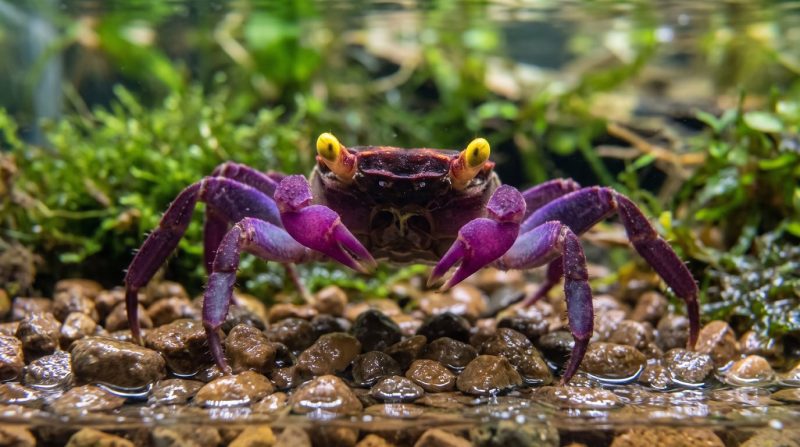
Small, quick, peaceful fish that swim in mid-water can live with vampire crabs, as long as each fish’s own temperature range overlaps the crabs’ 72-85°F (22-29°C). Endlers or guppies are the easiest match, then a small rasbora or a small tetra checked species by species. Bottom dwellers, bettas and anything big or pushy stay out, and crablets still need moving out whatever fish you choose. All of this assumes the paludarium already works for the crabs, with real land, a tight lid and water they can climb into, which is the core of vampire crab care.
How do you tell if a fish can share water with vampire crabs?
Check four things before you buy the fish. If it fails one, it doesn’t go in, however calm it looks in the store tank.
- Its listed temperature range overlaps 72-85°F (22-29°C), ideally around the 78°F (26°C) vampire crabs are usually kept at.
- It stays small and swims in mid-water or near the surface, away from the bottom where the crabs hunt.
- It’s quick enough to dart off when a claw reaches for it.
- It has no habit of chasing, nipping or bullying tank mates.
Temperature comes first because the water has to suit both animals at once. You can’t take the crabs outside their range for a fish, and you shouldn’t push a fish outside its own range for the crabs, so only the overlap counts. Set the tank inside the vampire crab temperature range first, then look for fish whose listing sits inside it.
The fish’s water chemistry has to fit everything else in the water too. Because vampire crabs can live with shrimp, your water section may hold shrimp as well, and then the fish needs to be happy in shrimp water, which rules out a few popular soft-water species further down.
Then look at the water section itself. Fish need room to swim, and a crab tank is built mostly as land. Plan how much water vampire crabs need for the crabs first. If what you end up with is a shallow dish the crabs use for soaking and molting, fish don’t belong in it.
Which small fish match the vampire crab temperature range?
Guppies, Endlers, chili rasboras and ember tetras match the vampire crab range best on paper. Neon tetras and harlequin rasboras share only its cooler part, and white cloud mountain minnows barely touch it. The table sets each fish’s listed range against 72-85°F (22-29°C).
| Fish | Listed temperature | Shared with the crab range | Fit |
|---|---|---|---|
| Guppy (Poecilia reticulata) | 64-82°F (18-28°C)1 | 72-82°F (22-28°C) | Good |
| Endler’s livebearer (Poecilia wingei) | Kept and bred at 81-82°F (27-28°C) in one lab study2 | 81-82°F (27-28°C) | Good; check your seller’s temperature |
| Chili rasbora (Boraras brigittae) | 77-82°F (25-28°C)3 | All of it | Good |
| Ember tetra (Hyphessobrycon amandae) | 75-82°F (24-28°C)4 | All of it | Good |
| Harlequin rasbora (Trigonostigma heteromorpha) | 72-77°F (22-25°C)5 | 72-77°F (22-25°C) | Cooler tanks only |
| Neon tetra (Paracheirodon innesi) | 68-79°F (20-26°C)6 | 72-79°F (22-26°C) | Poor; needs soft, acidic water |
| White cloud mountain minnow (Tanichthys albonubes) | 64-72°F (18-22°C)7 | 72°F (22°C) only | Poor |
These are keeping ranges from aquarium references, the temperatures each fish is usually kept at, not limits anyone measured in a lab. They’re still the best guide you have to where a fish does well.
Guppies and Endlers are the easiest fish to match
Guppies and Endlers are the fish we’d start with. Guppies share 72-82°F (22-28°C) with the crabs and are listed for pH 7.0-8.0 water.1 If Neocaridina share the water, keep the pH at 7.0-7.6, where that listing meets the shrimp’s pH 6.8-7.6.
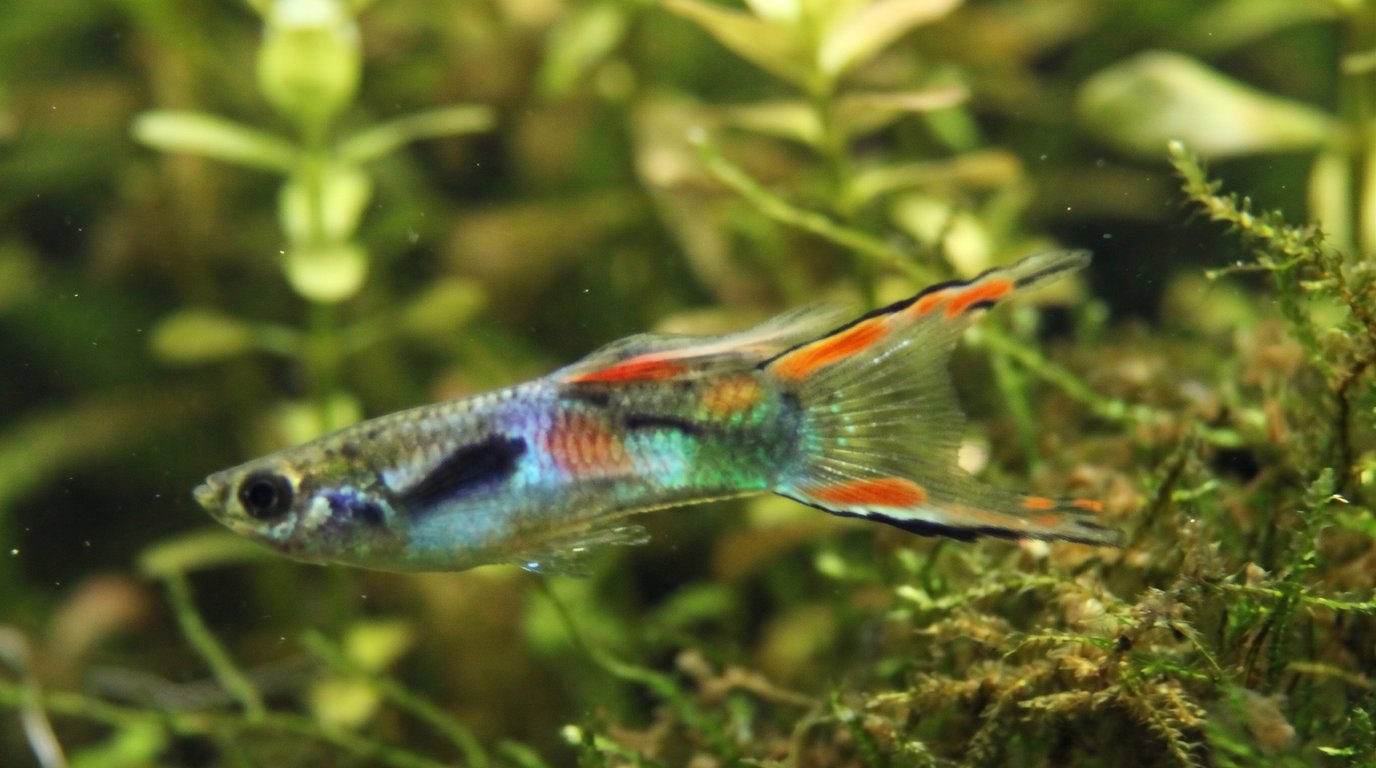
We have kept small, peaceful fish with our vampire crabs, such as Endlers or guppies, small rasboras and small tetras.
Guppies usually do fine in the water section with vampire crabs, even in a large paludarium full of crablets. A crab can still catch one, though. Two adult male guppies were taken within two hours in a tank whose crabs had arrived about a month before.
Endler’s livebearers have no full published range. One lab group was kept and bred at 81-82°F (27-28°C),2 which is inside the crab range, so ask your seller what temperature their Endlers live at and match it.
Chili rasboras and ember tetras sit inside the crab range
If you’d like a small school, chili rasboras and ember tetras are listed entirely inside the crab range: 77-82°F (25-28°C) for the chili rasbora and 75-82°F (24-28°C) for the ember tetra.34 Both stay around 2 cm (under an inch), and both are quick mid-water fish.
The chili rasbora is listed for slightly acidic water, pH 6.5-7.0.3 If Neocaridina share the water, that leaves pH 6.8-7.0, the narrow band the rasbora’s listing shares with the shrimp’s 6.8-7.6. Many small rasboras and tetras eat shrimplets, so give any shrimp dense moss to retreat into.
Neon tetras and harlequins only fit a cooler crab tank
Neon tetras and harlequin rasboras overlap only the cool end of the crab range. The harlequin is listed at 72-77°F (22-25°C) and grows to about 5 cm (2 inches), bigger than the fish above.5 The neon is listed at 68-79°F (20-26°C),6 so both sit at or below the 78°F (26°C) a vampire crab tank usually runs at.
The neon has a second problem. It’s listed for very soft, acidic water, pH 5.0-7.0 at 1-2 dGH,6 far softer than the 6-10 dGH Neocaridina need. We’d pass on neons for a crab tank that holds shrimp.
White cloud mountain minnows are listed for cool water, 64-72°F (18-22°C),7 and meet the crab range only at its bottom edge. On their listing, they’re a poor match.
Once the fish and the water section have settled, you can stock tank-bred vampire crabs, choosing Male or Female for each crab on the product page. Everything in our catalog is bred or propagated in our own tanks.
Can vampire crabs live with a betta fish?
No. A betta is a poor fit for a vampire crab tank, even though it’s sold as a small-tank fish. Temperature isn’t the problem: bettas are listed at 75-86°F (24-30°C), so they share 75-85°F (24-29°C) with the crabs.8 Temperament is. A betta is a known hunter of small shrimp, and it guards its space against tank mates. That’s exactly the kind of fish that bothers a crab when it comes down to molt.
If you’d like a betta, keep it in a tank of its own, and give the crabs’ water section guppies, Endlers or shrimp instead.
Why do bottom dwellers and big fish fail in a vampire crab tank?
Each of them fails one of the four checks. Bottom dwellers share the floor with the crabs, and big or aggressive fish can turn the tables and eat a crab.
Corydoras, otocinclus, loaches and gobies spend their day on the bottom, which is where a vampire crab hunts from the water’s edge and its burrows. A sleeper goby has been found half eaten beside a crab burrow. If a fish lives on the bottom and doesn’t dart away, give it a tank of its own.
We keep only small, peaceful fish with our crabs. An aggressive fish can eat a crab, or harass one that has come down into the water to molt, and a molt that’s disturbed can fail. Think of cichlids, larger barbs and big gouramis here. A smaller fish can do it too, so if any fish keeps pestering crabs that come down into the water, move it out: vampire crab molting is when a crab can least defend itself.
How do you stop vampire crabs and fish from eating each other?
You can’t rule it out, but you can make it rare. Vampire crabs can catch and eat small fish: half of one group of community fish was lost while the crabs went two days without food. Many other tanks lose none, and our own crabs rarely manage to catch fish. We haven’t lost any to them.
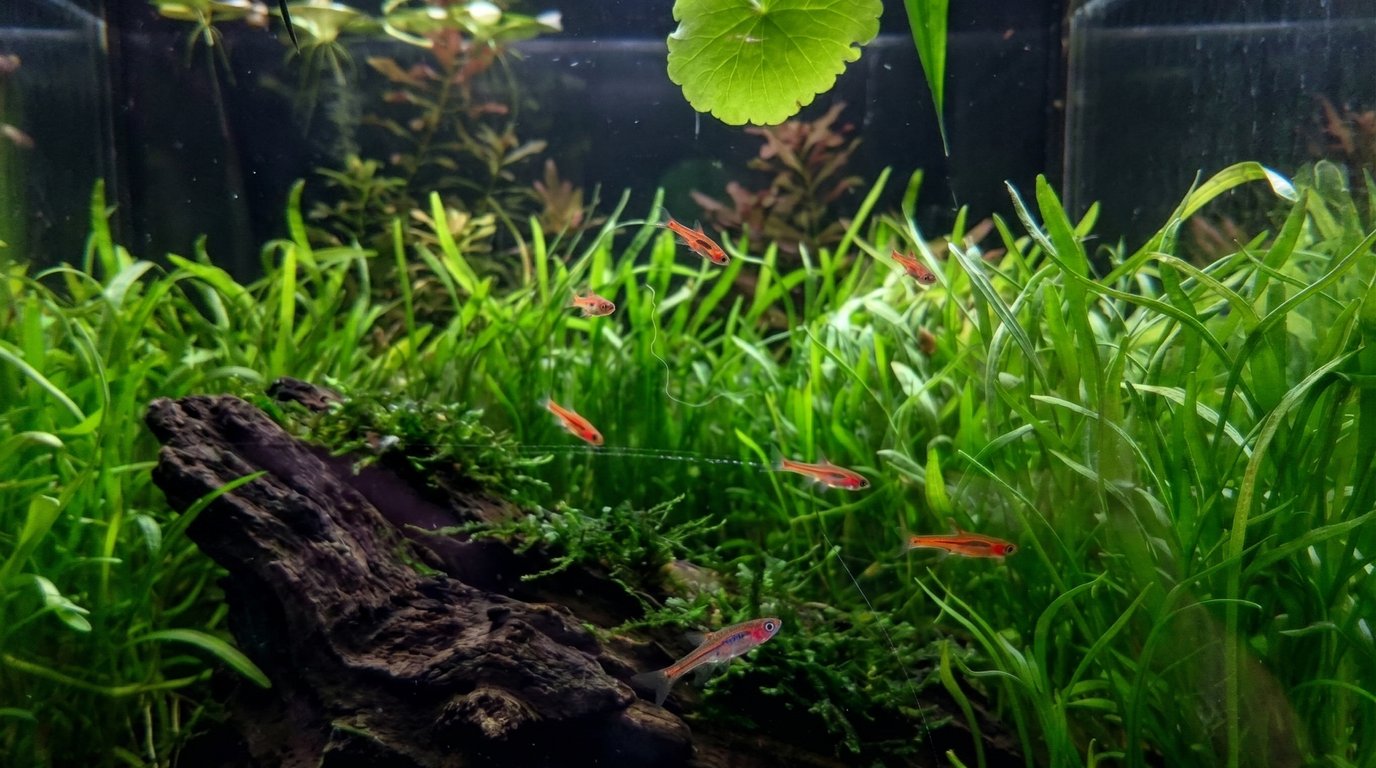
What keeps the losses low is mostly what you do every week:
- Work out how often to feed vampire crabs in your tank and don’t skip days, because a hungry crab hunts harder.
- Plant the water densely with moss and floating plants, so a fish always has somewhere to get out of reach.
- Pick fast mid-water fish, and leave slow ones and bottom sleepers in another tank.
- Watch the fish for the first few weeks after the crabs go in, and move them out if the crabs start hunting them.
Crablets are the other side of it. Adult crabs eat the crablets they catch, and a crablet a few millimeters across is small enough for a fish’s mouth, so don’t count on the fish leaving them alone either. Raising young alongside fish is the hard way to do vampire crab breeding; a tub of their own raises the most.
Would shrimp suit your vampire crab water section better than fish?
In a small water section, we’d pick shrimp over fish. Neocaridina graze the moss and glass and don’t need open water to swim in, and their water fits guppies too, so you can add both later if the section is big enough.
Shrimp still go through the same temperature check you ran for the fish, and the young shrimp need dense plants to hide in.
Small snails can go in alongside either. Vampire crabs eat bladder snails and small ramshorns, while ramshorns from about 1 cm across mostly survive, so treat snails as one more entry on your list of vampire crab tank mates.
If you do add fish, add a few small ones, give them the densest planting you can, and keep feeding the crabs. A fish that can’t stay out of reach doesn’t belong in the tank.
References
8 Sources
- Poecilia reticulata, Guppy: FishBase species summary, FishBase (Froese and Pauly, eds.), accessed 2026-11-10.
- Life history traits of Endler’s fish (Poecilia wingei), AACL Bioflux 14(3): 1727-1733, 2021.
- Boraras brigittae: FishBase species summary, FishBase (Froese and Pauly, eds.), accessed 2026-11-10.
- Hyphessobrycon amandae: FishBase species summary, FishBase (Froese and Pauly, eds.), accessed 2026-11-10.
- Trigonostigma heteromorpha, Harlequin rasbora: FishBase species summary, FishBase (Froese and Pauly, eds.), accessed 2026-11-10.
- Paracheirodon innesi, Neon tetra: FishBase species summary, FishBase (Froese and Pauly, eds.), accessed 2026-11-10.
- Tanichthys albonubes, White cloud mountain minnow: FishBase species summary, FishBase (Froese and Pauly, eds.), accessed 2026-11-10.
- Betta splendens, Siamese fighting fish: FishBase species summary, FishBase (Froese and Pauly, eds.), accessed 2026-11-13.