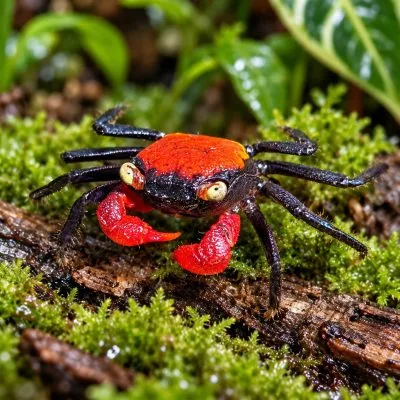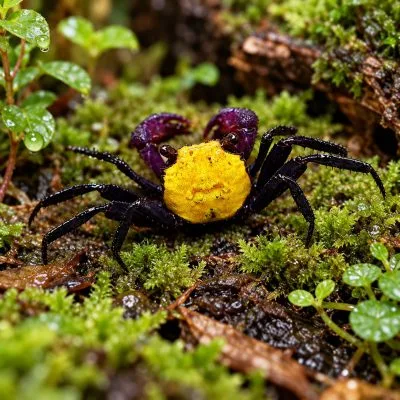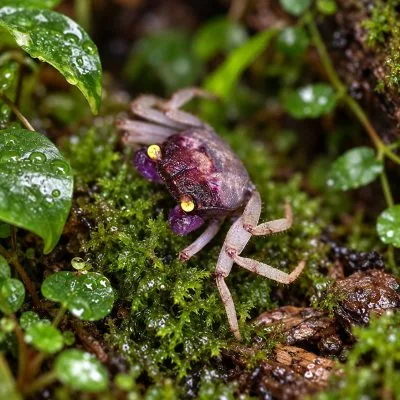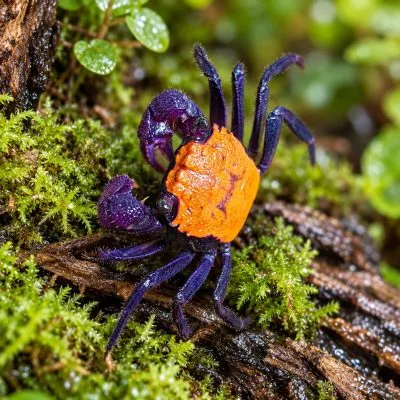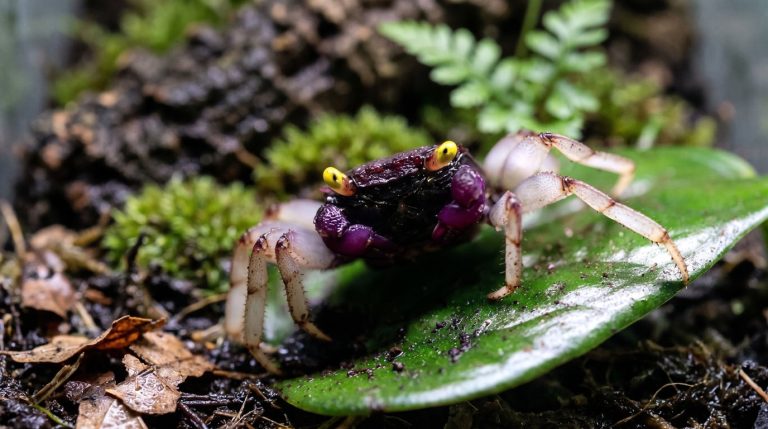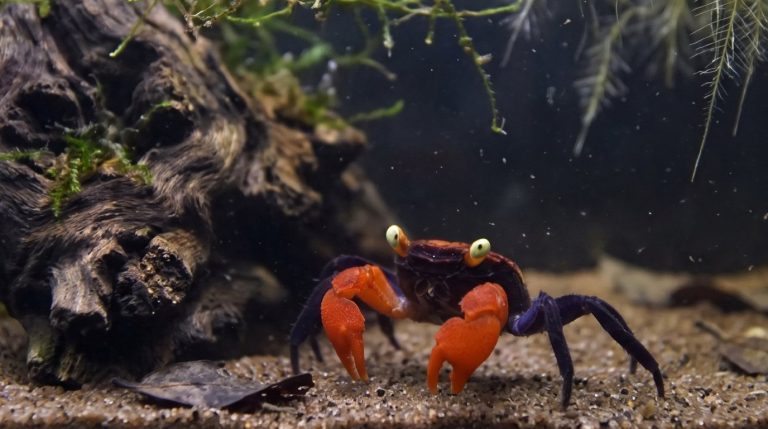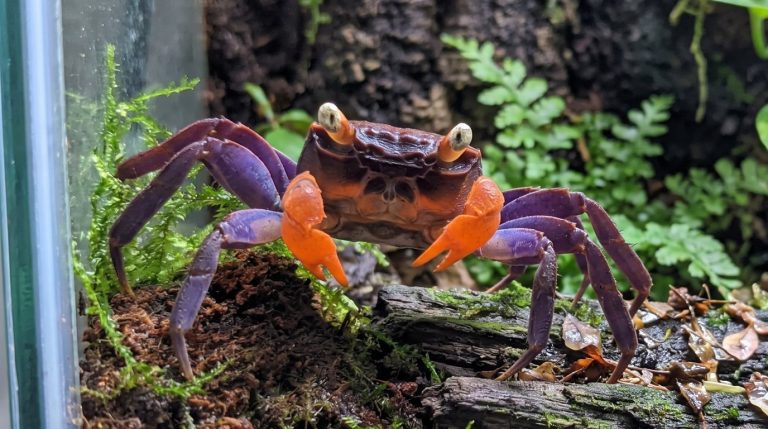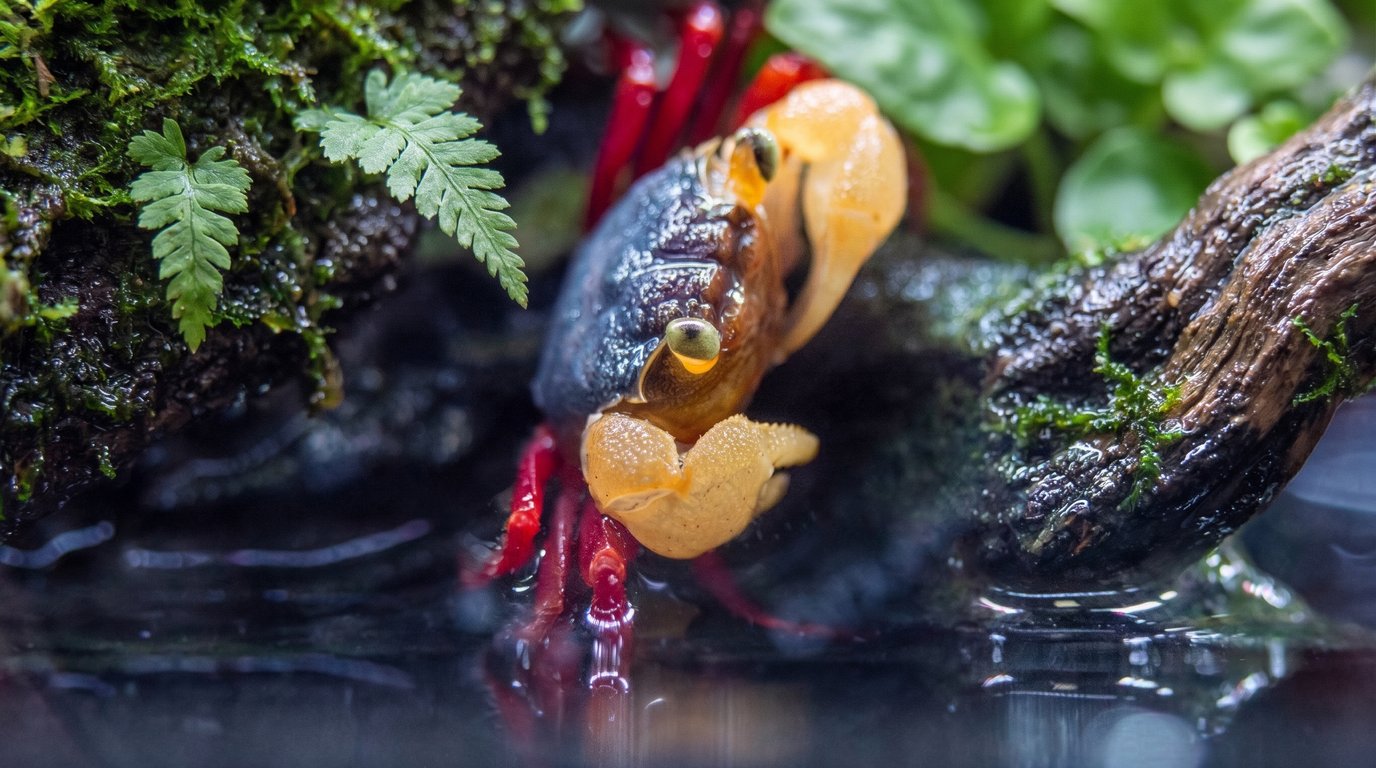
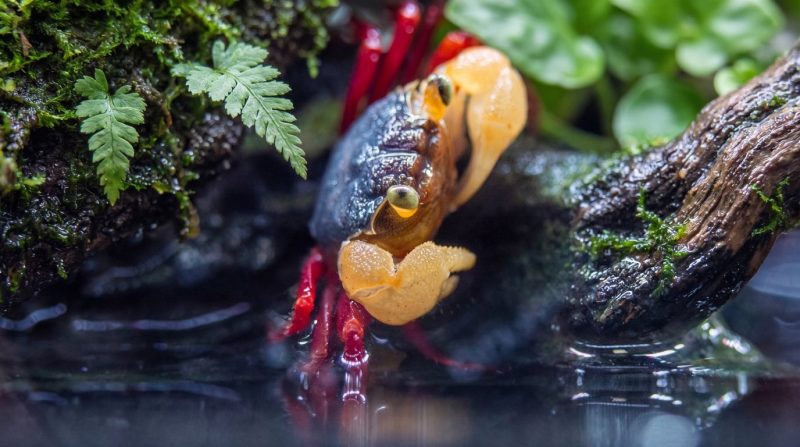
Vampire crabs need less water than most people expect: a shallow water section on a smaller part of the floor, deep enough for your largest crab to sit fully under and walk back out of. The rest is damp land and humid air. What you’re measuring is depth and a way out, not gallons.
How deep should the water be for vampire crabs?
Make the water deep enough to cover your largest vampire crab completely where it sits, and no deeper than you need for that. These are small animals. In two described Java species, adult shells measure roughly 11-15 mm across, about half an inch.1 So you’re covering a small crab, not filling a pond.
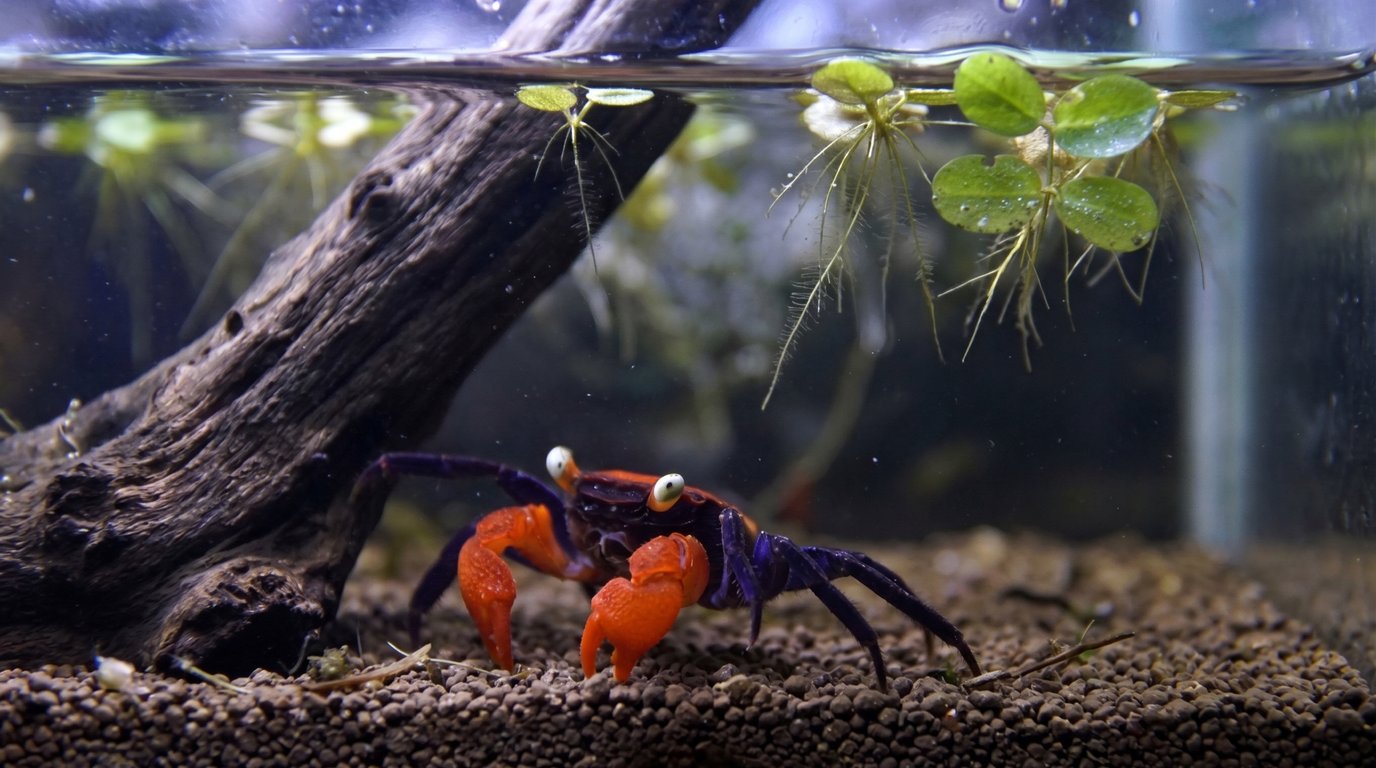
Here’s a simple way to set it. Shape the bottom as a slope that starts at the land’s edge with no water at all and runs down to the deepest point. Then fill until the deep end stands clearly over the back of your biggest crab. Every crab can pick its depth, and every crab has a way out along the slope. Once the depth and the way out are right, the water is the easy part of vampire crab care.
What about gallons? Nobody has worked out a volume a vampire crab needs, and the number on the tank tells you little anyway. A wide, shallow pool and a narrow, deep one can hold the same water, and only one of them is easy to climb out of. The land should still take most of the floor, even though vampire crabs need a water area in a vivarium they can fully enter.
Why a molting vampire crab sets the water depth
The depth is there for molting. A vampire crab goes into the water to shed its shell, so the water has to be deep enough for it to get fully under, even on the day it’s at its biggest.
In our paludariums, the crabs spend their time on land and climb down into the water from time to time to feed and to molt. A molting crab stays down in the water for a few hours, so the water section has to be one a crab can climb into and fully enter.
A few hours under water is a long time for a land crab, which is why the exit matters as much as the depth. A crab that has just molted is soft, so give it a slope it can walk up, not a ledge it has to climb. If you find a crab sitting still in the water, the signs of vampire crab molting will tell you whether to leave it alone.
Not every vampire crab sheds in the water. Keepers of a few other species report molts on land, so it’s worth having damp hides on the land as well as a pool every crab can fully enter.
How little water does a vampire crab use between molts?
Between molts, a vampire crab uses very little of its pool. In one described Java species, adults are seldom found in the water and mostly live on moist banks.1 Expect your crabs to spend most of their time on land, with trips down to the water now and then.
So where does the water go? Into the gills. Crabs of their family hold water in their gill chambers and keep it moving while they’re out in the air.2 Land crabs also drink, and one that doesn’t drink loses body fluid.3 That’s a top-up, not a swim, and a small pool covers it.
The catch is that the top-up only works if the crab doesn’t dry out in between. One field study of wild vampire crabs in Java found they can stay away from water for long stretches, as long as their bodies stay moist.4 In your tank, that moisture comes from the land and the air, which is the next part of the answer.
Count the damp air and moss as part of a vampire crab’s water
A closed vampire crab tank needs misting about once a day, more while new moss and plants settle in and less once they’ve adapted. Spray when the moss or the top of the substrate starts to look dry. That water never collects in the pool, but your crabs live in it all day.
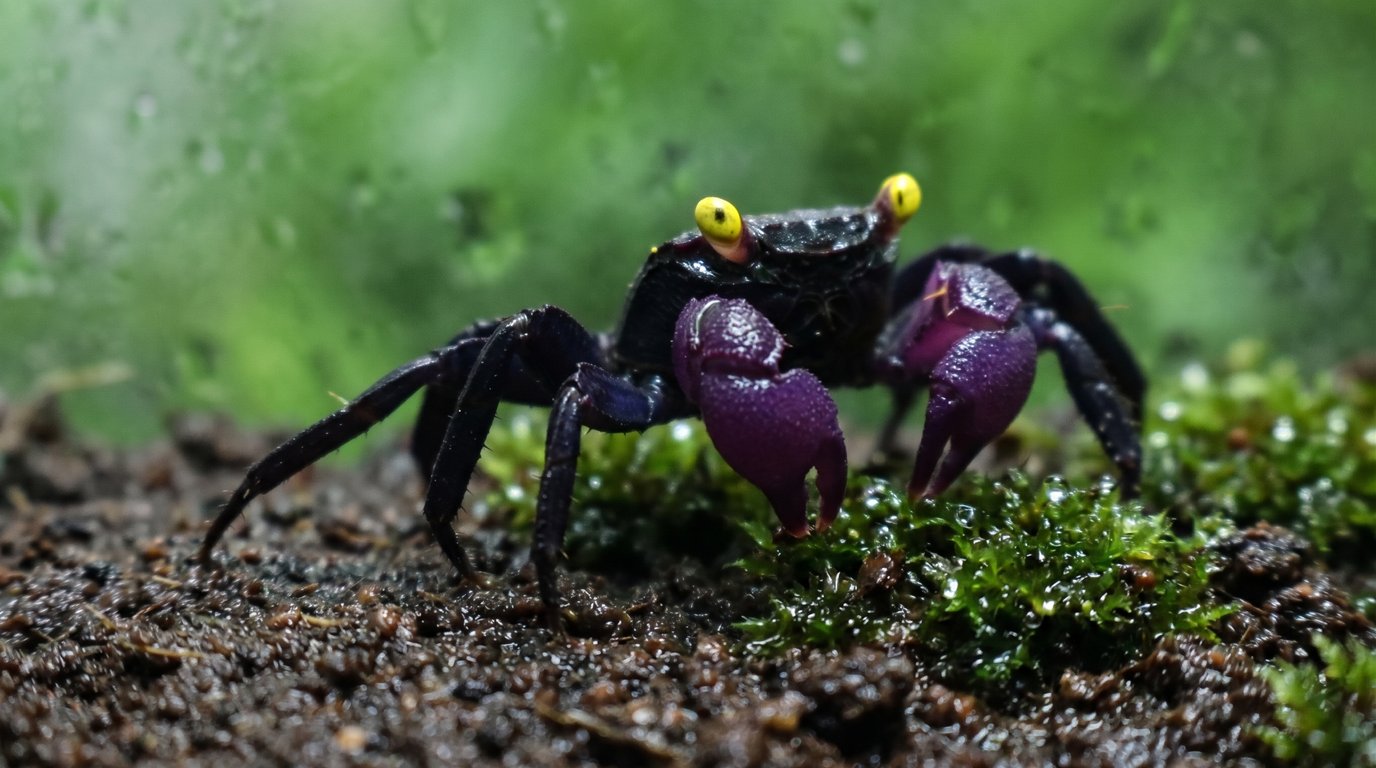
You can see how much the damp air carries in a lab setup. In a preprint study, adult red devil vampire crabs (Geosesarma hagen) were each housed on moist soil with a cup of water, in a humid room.5 Those were adults between molts, kept for a breathing study, so it isn’t a model for a home tank. It does show that the daily water need sits mostly in the soil and the air.
That’s why a lid matters as much as the pool. An open tank loses the humid air you just sprayed in, and a crab with a full pool but dry air is still drying out. The details on timing and mold are in how often to mist a vampire crab paludarium.
Is more water safer for vampire crabs?
No. Once the water covers your largest crab, extra depth or extra area gives your vampire crabs nothing they use. It takes floor space away from the land they live on, and deep water with a steep edge is a trap for a crab that can’t climb out.
We know the pull: more water looks safer, and a big pool looks good. But vampire crabs can’t live in water full time, and a crab that can’t find its way out is in trouble. If you want a bigger pool for shrimp or fish, keep the slope all the way along one side and keep most of the floor as land.
The volume you choose changes the upkeep more than it changes the crabs. A pool of a few cups fouls quickly in a warm, humid tank and needs changing often, while a larger one with a small filter can go longer. Either works with the same rules for vampire crab water changes and filtration.
How much water do baby vampire crabs need?
Baby vampire crabs need even shallower water than adults: about 1 cm (under half an inch) deep, or a dish they can walk out of. In one described Java species, the young are often in the water or right at its edge, while adults stay up on the banks.1 Keep water close to them, but shallow enough to stand in.
If crablets turn up in your main tank, the same slope that starts at zero gives them a shallow edge to use. If you raise them apart, one of the choices in vampire crab breeding, the container and moss matter as much as the water.
Set up the water section before your vampire crabs arrive
Build the pool, the slope and the lid first, then run the tank until it holds its humidity from one day to the next before you add any vampire crabs. Fill the water section with tap water treated with a conditioner for chlorine and chloramine, or with remineralized RO water.
Everything in our catalog is bred or propagated in our own tanks rather than collected from the wild. When you choose tank-bred vampire crabs, you pick Male or Female for each crab on the product page.
References
5 Sources
- Ng, Schubart and Lukhaup, New species of “vampire crabs” (Geosesarma De Man, 1892) from central Java, Indonesia (archived copy on Zenodo), Raffles Bulletin of Zoology 63: 3-13, 2015.
- Species-specific gill’s microbiome of eight crab species with different breathing adaptations, Scientific Reports 13: 21033, 2023.
- Lucu and Turner, Ionic regulatory strategies of crabs: the transition from water to land, Frontiers in Physiology 15: 1399194, 2024.
- Kurniawan, Waluyo, Nofreeana and Aji, Habitat and Food of Vampire Crabs (Geosesarma sp.) in Menoreh Mountain, Yogyakarta, Indonesia, Media Konservasi 30(1): 141-153, 2025.
- Juarez, Buck, Lacey, O’Connell and Watson-Zink, Sexual dimorphism of metabolism in vampire crabs (Geosesarma hagen) is temperature and size-dependent (preprint), EcoEvoRxiv, 2024.
Ready to get started?
Shop our Vampire Crab collection
8 products available · Live Arrival Guarantee