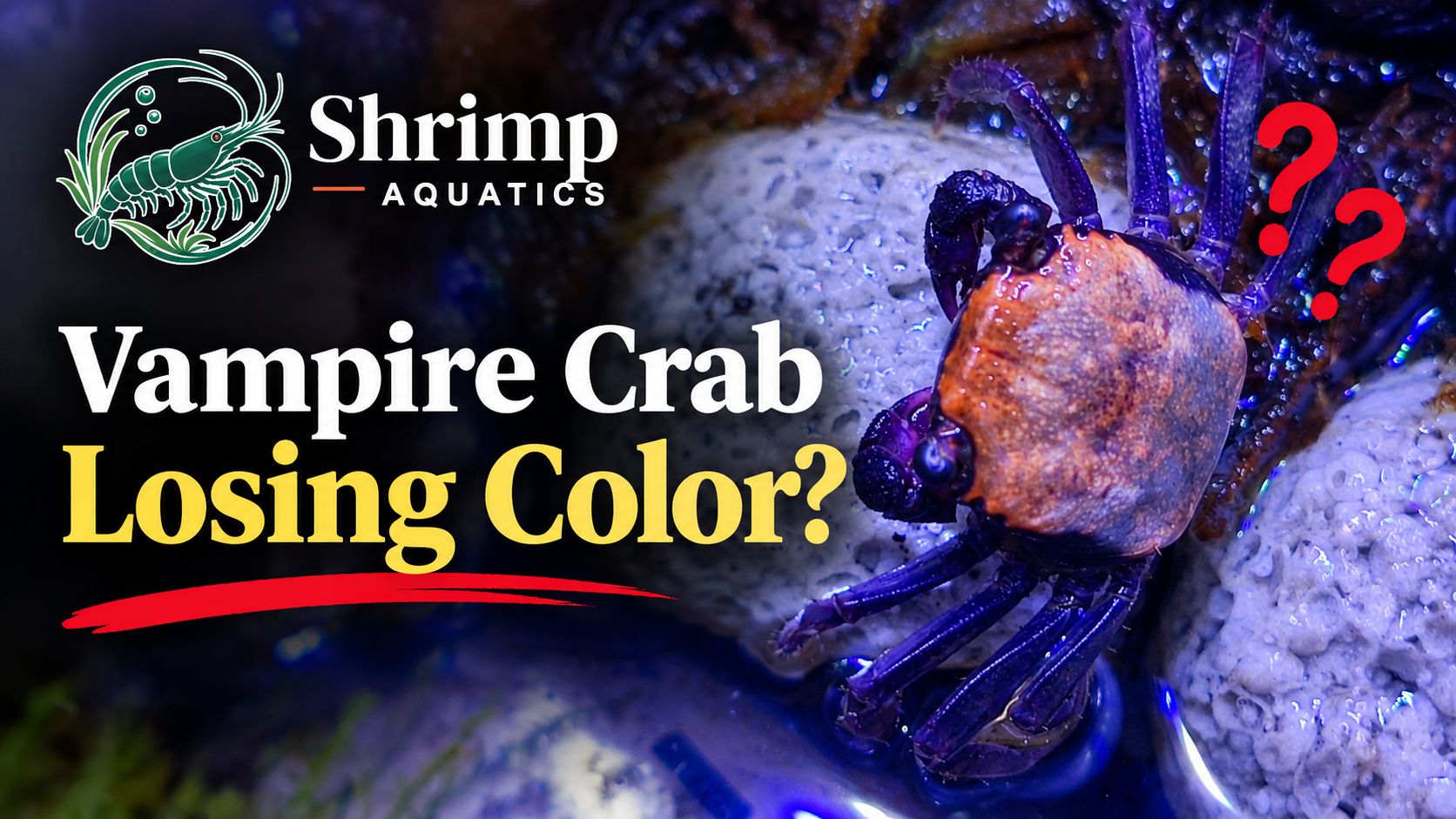
Did your vampire crab (Geosesarma) turn pale, yellowish or washed out almost overnight? Most often it has just molted, and its normal color comes back as the new shell hardens, in about 1 to 4 days for most crabs and at most about a week. Young crabs are duller by nature and color up over months. A crab that turns pale, grey or blotchy and also hides, stops eating or goes still, especially after a heat spell or shipping, may be in trouble.
Did your vampire crab just molt?
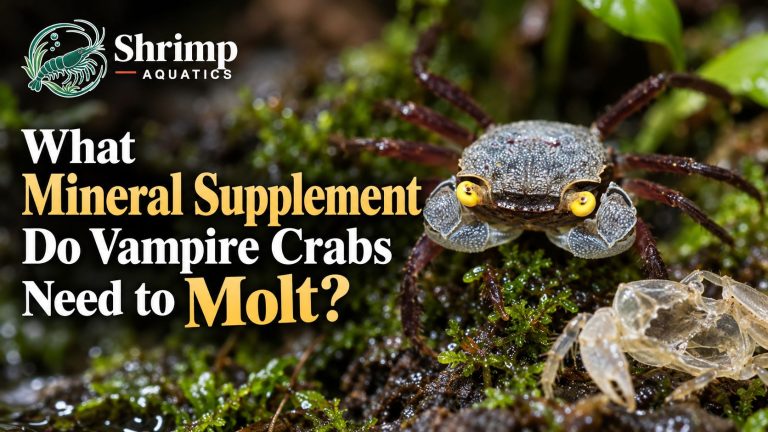
If the paleness came on suddenly, a fresh molt is the most likely reason. While the new shell is still soft, a vampire crab often looks pale, washed out or yellowish. Red crabs can look yellow or orange, and the claws can look almost white. The color returns as the shell hardens, in about 1 to 4 days for most crabs and at most about a week. One keeper found a red crab gone light orange, then found its shed in the water the next day. The crab was already redder by then, and eight days after it was first found it looked completely normal and was very active.
So look around for the shed. It looks like a whole crab and is easy to take for a dead one, but its eyes are empty and see-through, it’s hollow and the back lifts open. A dead crab still has its eyes, is full inside and soon smells. In our paludariums, a molting crab stays down in the water for a few hours. Our crabs eat their old shell after a molt, so we leave it in the tank for them. A pale crab beside a fresh shed is ordinary vampire crab molting, so give it that week before you worry.
Is a dull young vampire crab really losing color?
Probably not, if it has never had its full color. Young crabs are duller than adults, and baby vampire crabs color up slowly over many molts, so a plain youngster is still on its way rather than fading.
Can food bring back a vampire crab’s color?
Don’t count on it. Crustacean shell color does come from a pigment in food, astaxanthin, which crustaceans take up through their diet and can’t make for themselves,123 but no food is a known fix for a pale vampire crab. Nobody has tested a food for color in vampire crabs.
So feed the usual varied mix of what vampire crabs eat, with some animal food in it, and don’t expect any one food to bring a pale crab’s color back.
Why does your vampire crab look different from morning to evening?
It may just be reacting to light, background or a disturbance, and that isn’t fading. Some crabs of other kinds shift color fast. They can darken within minutes when they’re caught or stressed, or turn lighter or darker to match their background over a couple of hours.45
Those crabs aren’t vampire crabs, so read them as a reason for patience, not a rule. Did your crab look pale while you were netting a tank mate or moving decor? Then check it again later. Judge its color at the same time of day and under the same light before you decide it’s fading.
When is a pale vampire crab a warning sign?
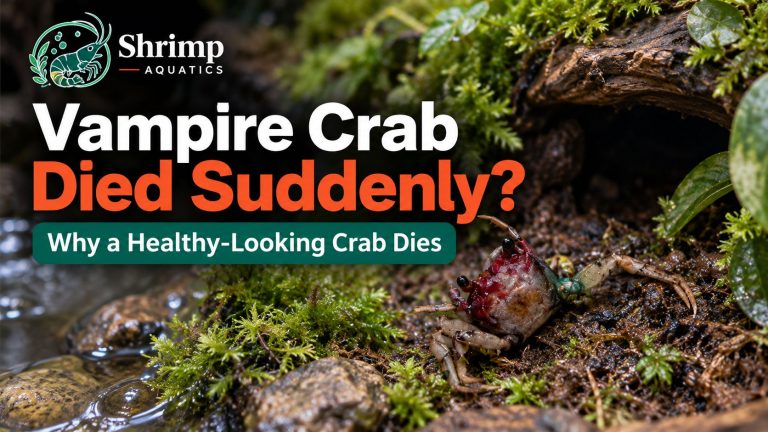
When there’s no fresh molt behind the paleness and other signs come with it. A crab that turns pale, grey or blotchy and also sits still, has limp legs or has lost a claw can die within days. This has followed heat spells, transport and molts that didn’t harden. Not every pale crab dies, but that combination needs action today.
Newly bought vampire crabs often die between arrival and about two weeks later, and some stop eating, hide and die within days. Keepers who checked their tank mostly found nothing wrong and put the losses down to the crabs’ condition on arrival, after import, shipping and handling. If your pale crab has stopped taking food too, start with the checks for a vampire crab not eating.
Then check the tank now: the lid is closed, the land and moss are damp, the temperature sits at about 78°F (26°C), inside 72-85°F (22-29°C), and every crab can climb into the water and back out. If your vampire crabs are dying, go through the causes one at a time.
What not to do with a pale vampire crab
Mostly, leave it alone and watch. It’s tempting to do something, but a pale crab usually needs time and a stable tank, not a fix.
- Don’t lift a pale crab out of the water. It may be molting.
- Don’t take out a fresh shed, and don’t mistake it for a dead crab.
- Don’t add color-enhancing products or supplements expecting a fix. Nothing shows they turn a pale vampire crab back to its color.
- Don’t turn up the heater to perk it up. Some of the crabs that faded and died had just been through a heat spell.
- Don’t dig up hides or burrows to find a crab you haven’t seen since it turned pale.
What the research says about crab shell color
These studies were done on other crustaceans, so they explain how shell color works, not what your vampire crab will do. In crustaceans, the pigment astaxanthin sits in the shell bound to proteins such as crustacyanin, which gives colors from red and purple to blue and yellow.1 In a marine prawn, that pigment is taken up through the diet, and albino prawns carried significantly less of it than light or dark ones.2
The two named crabs are a swimming crab (Portunus trituberculatus) and a fiddler crab (Uca capricornis). Juvenile swimming crabs’ shells turned steadily redder over a 56-day feeding trial as the astaxanthin in their food went up, and the authors note that crustaceans can’t make the pigment themselves.3 In the fiddler crab, the color pattern changes at molts and stays very stable between them, yet most crabs that were caught or stressed darkened within 20 minutes, and some began to regain their color within that time.4 Juvenile shore crabs, another marine crab, turned lighter on a white background and darker on a black one over 2 hours.5
Ordering tank-bred vampire crabs for a paludarium that’s ready
Order once the land, water and hides that everyday vampire crab care asks for are set up and running. You choose Male or Female for each crab on the product page when you buy tank-bred vampire crabs. Everything in our catalog is bred or propagated in our own tanks rather than collected from the wild. Color changes with age and around a molt, so no listing can promise how a crab will look on a given day, or that it will breed.
References
5 Sources
- Šimat and colleagues, Astaxanthin from Crustaceans and Their Byproducts: A Bioactive Metabolite Candidate for Therapeutic Application (PubMed Central copy), Marine Drugs 20(3): 206, 2022.
- Ertl and colleagues, Molecular Characterisation of Colour Formation in the Prawn Fenneropenaeus merguiensis, PLOS ONE 8(2): e56920, 2013.
- Deng and colleagues, Dietary Astaxanthin Can Promote the Growth and Motivate Lipid Metabolism by Improving Antioxidant Properties for Swimming Crab, Portunus trituberculatus (PubMed Central copy), Antioxidants 13(5): 522, 2024.
- Detto, Hemmi and Backwell, Colouration and Colour Changes of the Fiddler Crab, Uca capricornis: A Descriptive Study, PLOS ONE 3(2): e1629, 2008.
- Stevens, Lown and Wood, Color change and camouflage in juvenile shore crabs Carcinus maenas, Frontiers in Ecology and Evolution 2: 14, 2014.
Ready to get started?
Shop our Vampire Crab collection
8 products available · Live Arrival Guarantee