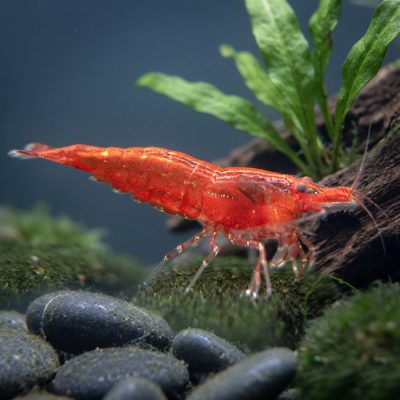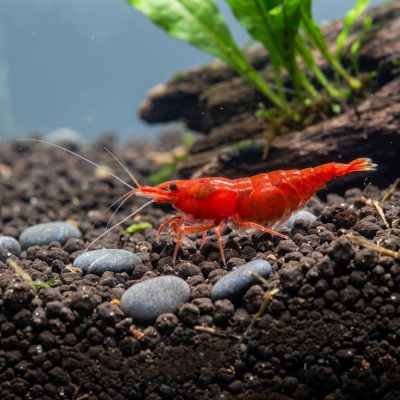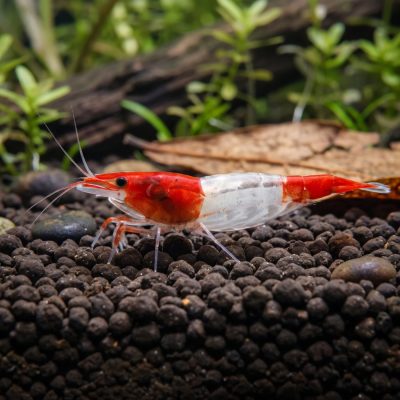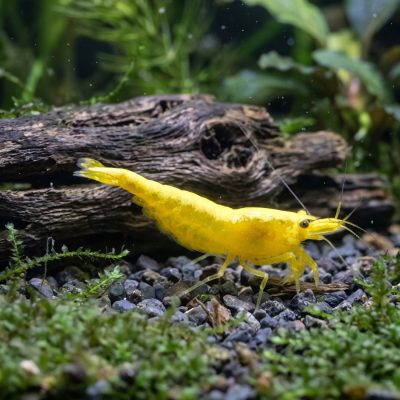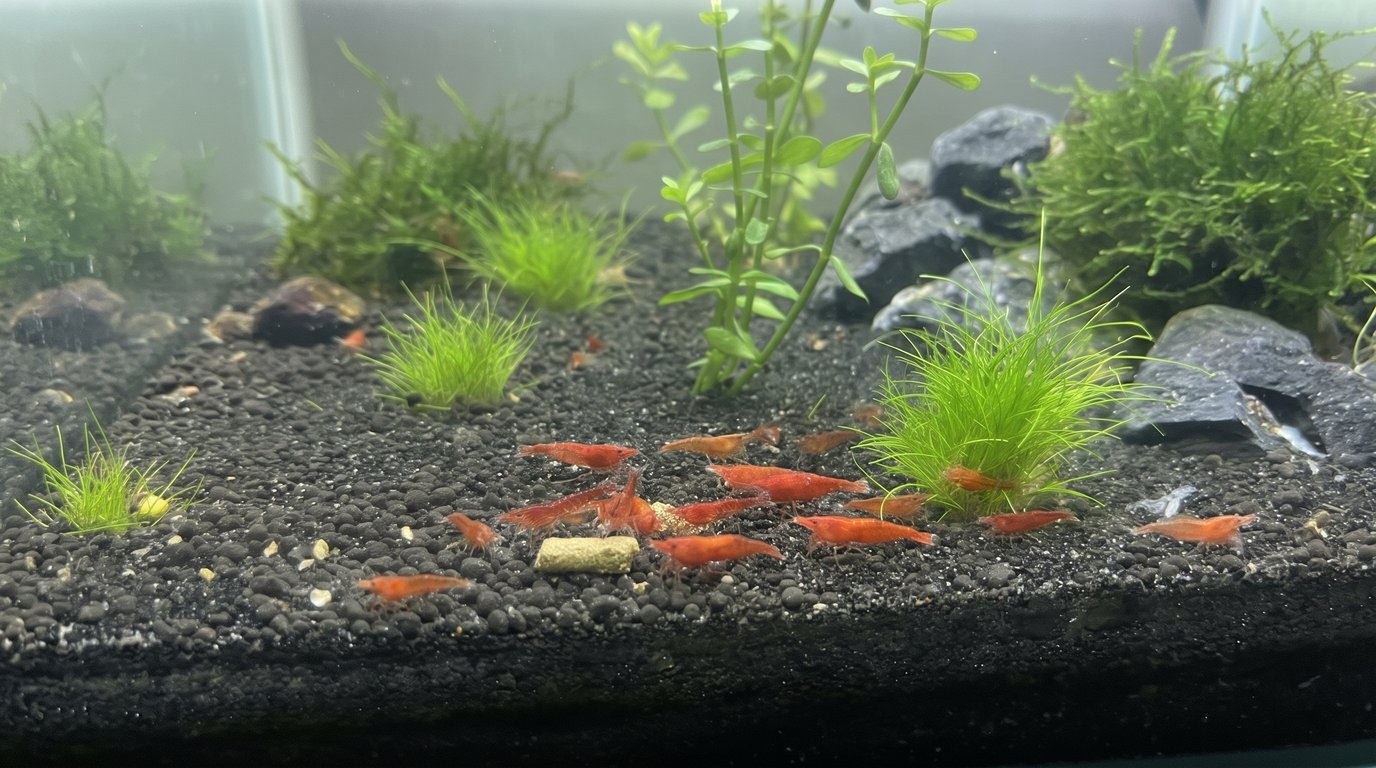
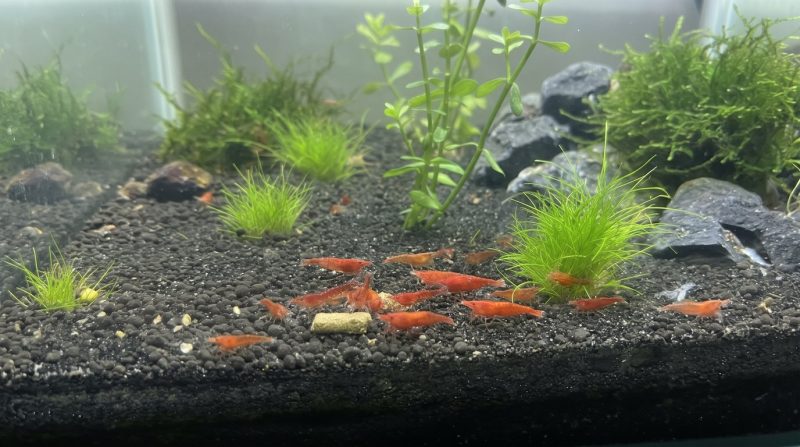
You don’t stock cherry shrimp by the gallon: you start with a group of about 10 in a cycled, stable tank of about 5 gal (19 L) or larger, and breeding fills the tank from there. Starts anywhere from 6 to 30 shrimp have grown into lasting colonies in home tanks. How many shrimp the tank holds months later depends on the space and food the colony has, and has little to do with the size of your first order. Get the tank cycled and steady before anything else, because that’s the base of all Neocaridina shrimp care.
How many cherry shrimp should you start a colony with?
Start with about 10 cherry shrimp (Neocaridina davidi). Colonies have been started with as few as 6 and as many as 30. Every one of those counted groups bred and grew, ending up anywhere from about 30 shrimp to several hundred.
Is 10 enough? Yes. Ten sits in the middle of the starts that have worked, and you don’t need 20 to 50 to begin, because groups of 6 and 10 grew into colonies too. The extra shrimp come from breeding, not from a bigger first order.
Shrimp Aquatics sells every line of its tank-bred Neocaridina shrimp in packs of 1, 10, 20, 50 or 100, and the 10 and 20 packs are groups in the size keepers report starting with.
Is 5 enough? It can be, but you’re leaving yourself less room for bad luck. A group of five or fewer can still become a colony, and it can also fail if there’s no male in it, or if the only one dies. One keeper’s five-shrimp start never bred after its only male died.
Planning two colors? The types of Neocaridina shrimp breed with each other, and mixed young can turn out brown or wild-colored. So each color you want to keep needs its own starting group in its own tank, and that doubles what you buy.
Will a small group of cherry shrimp have both males and females?
A group of ten almost always will, and a group of five is a less safe bet. Cherry shrimp broods come out about half male and half female: in a lab study, young shrimp sexed at 50 days showed a 1:1 ratio.1 In a wild stream population, between 45% and 59% of the adults were female across samples.2 Temperature can tilt it, though. In one lab trial, warmer water gave more males among the young.3
Here’s the plain arithmetic, on the assumption that each shrimp is equally likely to be male or female. A group of five is all one sex about 1 time in 16. A group of ten is all one sex about 1 time in 500. An unsexed group from any seller may not follow that coin-flip assumption exactly, but the point holds: each extra shrimp makes a one-sex group much less likely.
That’s also the answer to how many cherry shrimp need to live together. The number that matters is the one that breeds, so the tank needs at least one male and one female, and buying a group is how you make that likely. No group size makes it certain.
Is there a real per-gallon rule for cherry shrimp?
No. You’ll see 5 to 10 per gallon, 2 to 5 per gallon and one per gallon quoted as rules, and they’re hobby conventions. No published study sets a per-gallon stocking limit for a home tank.
The closest published work is a growth trial. Researchers raised young cherry shrimp for 90 days in 2-liter containers at 2.5, 5 and 10 shrimp per liter, which is about 9.5, 19 and 38 per US gallon. Survival was high at every density, 87-93%, but the shrimp kept at the lowest density grew heavier: females there weighed about 45% more than females at the highest density.4
Why isn’t that a stocking rule? It was a three-month trial on juveniles in small containers, each with Java moss, heavy feeding and a full water change every week. What it does show is that packing young shrimp tighter slowed their growth in that time without changing how many lived.
The bigger reason per-gallon numbers don’t fit is that you never buy the number your tank will hold. You buy a starting group, and the shrimp breed from there. A rule that says 5 per gallon would have you order 50 shrimp for a 10 gallon tank that a group of 10 can grow to fill.
How many cherry shrimp end up in a 2, 5, 10 or 20 gallon tank?
The start doesn’t change with tank size: about 10 shrimp in each. What changes is how far the colony can grow. These are counts keepers made of established, shrimp-only tanks after months of breeding.
| Tank size | Start with | What keepers counted after months |
|---|---|---|
| 2-3 gal | About 10, though about 5 gal (19 L) or larger is the size to plan for | Dozens to a few hundred; about 300 in one 2.5 gal tank |
| 5 gal (19 L) | About 10 | About 50 to 300; one tank leveled off near 50 |
| 8-10 gal | About 10 | About 150 to 600; most counts 200 to 500 |
| 20 gal | About 10 | 200 or more, from one count |
The spread is wide for a reason. Tanks differ in plants, feeding and how often the keeper takes shrimp out, and plenty of these numbers are estimates.
All of these were tanks with no fish. Add fish, even ones sold as shrimp-safe, and fewer young reach adult size, because fish eat shrimplets and sometimes adults too.
Can cherry shrimp live in a 2 or 3 gallon tank?
They can, and keepers have bred them in tanks of 1 to 3 gallons, but a tank of about 5 gal (19 L) or larger is still the one to plan on. A smaller tank asks more of you and gives the shrimp less margin.
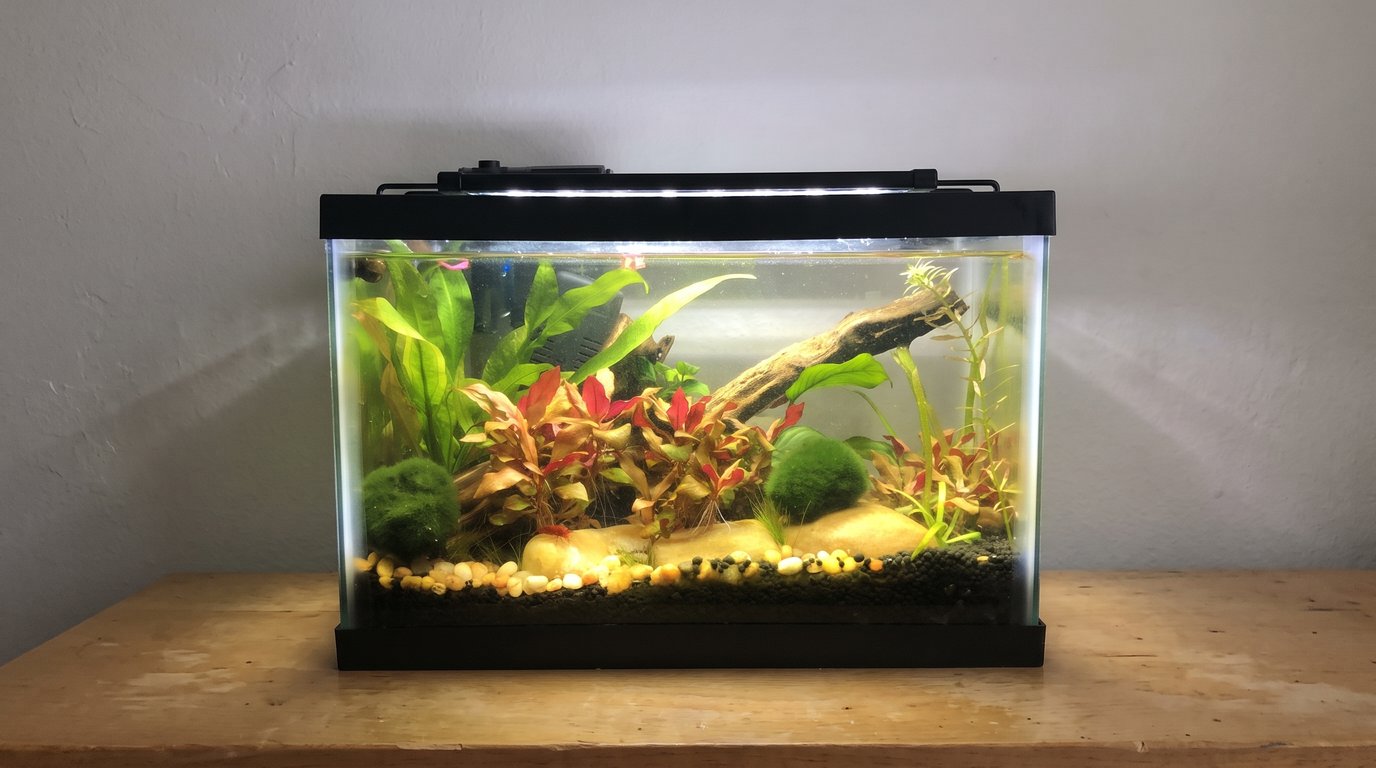
The problems those small-tank keepers describe are the cost of going that small. Shrimp were lost early, before the tank settled. The waste built up enough to need large water changes every week. Breeding was slow at first, and the young stayed small.
Why does a couple of gallons make such a difference? Less water changes faster. Leftover food or one dead shrimp or snail moves the readings in a 2 gallon tank further and quicker than in a 10 gallon one. Keeping your Neocaridina shrimp water parameters steady is most of the job in a small tank, and more water makes that easier.
Colonies in tanks of 5 to 10 gallons have kept breeding for months to a year or more, and about 5 gallons is the typical tank in those accounts. If a 2 or 3 gallon tank is all you have, cycle it fully before the shrimp go in, feed small amounts and test often, and treat 5 gallons as the next step up.
What happens when a cherry shrimp colony gets too crowded?
In some tanks, breeding slows and the shrimp stay small once the colony gets big; in others, the same count causes no trouble. So there’s no number that marks too many.
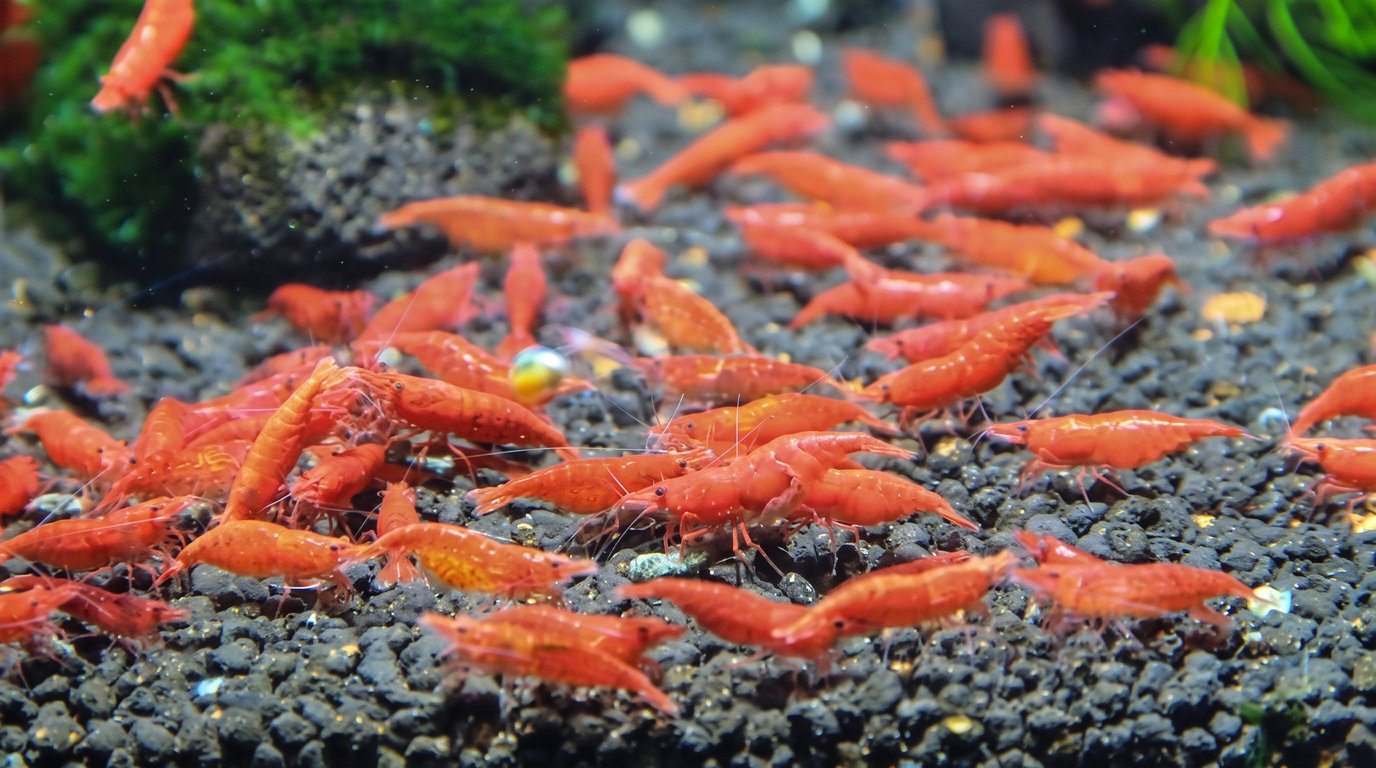
Keepers who let colonies reach several hundred shrimp in tanks of 5 to 30 gallons saw females stop carrying eggs, fewer young make it to adult size, and adults and young that stayed small. In one 5 gallon tank, about a third of the shrimp died, mostly the biggest and oldest, and the cause was never pinned down. Thinning those colonies brought the berried females back.
Other tanks didn’t follow that pattern. Colonies of about 300 in a 2.5 gallon tank and over 600 in an 8 gallon one carried on with berried females and no trouble reported. Feeding, tank layout and how often shrimp get taken out all seem to move the point where problems start.
Waste is part of the picture, though none of those keepers blamed ammonia. Work on a much larger freshwater prawn shows the general rule: in a closed tank, the ammonia a group of crustaceans gives off rises with how many there are and how much they’re fed.5 Whatever your count, ammonia and nitrite should always test 0. If berried females get rare and the young stop growing in a busy tank, thin the colony out.
How long does a starter group take to become a colony?
A starter group becomes a colony as fast as its young grow up and breed. In lab cultures that took from under two months to about five months from hatching, depending on temperature. Don’t plan on a date.
In a lab study with tanks at 75°F and at 82°F (24°C and 28°C), the first egg-carrying females appeared 50 days after hatching.6 A lab culture of Neocaridina ran slower. Its water ranged from a few degrees below the 72-77°F (22-25°C) target range up to the top of it, and the first egg-carrying females took about 5 months, then about 3 months in the next generation. Most of the young females’ first broods failed.7
Both clocks start at hatching, not on the day you add shrimp to your tank. Shrimp you buy can be any age, so your wait can come out shorter or longer than either study. And “colony” means different things to different keepers, which is one more reason the timelines you’ll read online don’t agree.
Temperature matters at every step of Neocaridina shrimp breeding. In that first study, eggs took about 21 days to hatch at 75°F (24°C) and about 15 days at 82°F (28°C).6 That isn’t a reason to run the tank warm: 72-77°F (22-25°C) is still the range to keep.
What to do when your cherry shrimp colony outgrows the tank
Move shrimp out. Set up a second tank, or give or sell the extras to other keepers or a local store.
Feeding a little less is worth trying too, since a colony can only grow on the food that goes in, but don’t let the tank go hungry.
Whatever you do with the extras, keep them and their old tank water out of ponds, streams and drains. The USGS lists aquarium release as the most common way this species has been introduced outside its native range.8
References
8 Sources
- Tropea and López Greco, Effect of social environment on sexual differentiation in the highly gregarious red cherry shrimp (Neocaridina davidi) (abstract, AGRIS record), Canadian Journal of Zoology 97(9): 791-796, 2019.
- Schoolmann and Arndt, Population dynamics of the invasive freshwater shrimp Neocaridina davidi in the thermally polluted Gillbach stream (North Rhine-Westphalia, Germany) (abstract), Limnologica 71: 1-7, 2018.
- Serezli, Atalar, Hamzacebi, Kurtoglu and Yandi, To what extent does temperature affect sex ratio in red cherry shrimp, Neocaridina davidi? The scenario global warming to offspring sex ratio (abstract), Fresenius Environmental Bulletin 26(12): 7575-7579, 2017.
- Vazquez, Delevati-Colpo, Sganga and López-Greco, Density and gender segregation effects in the culture of the caridean ornamental red cherry shrimp Neocaridina davidi Bouvier, 1904 (Caridea: Atyidae), Journal of Crustacean Biology 37(4): 367-373, 2017 (repository copy, Universidad Nacional de La Plata).
- Mendez, Morales and Merino, Ammonia Excretion Dynamics in Juvenile and Adult Freshwater Prawn Macrobrachium caementarius Reared Under Recirculating Aquaculture Conditions, Aquaculture Journal 6(3): 23, 2026.
- Tropea, Stumpf and López Greco, Effect of Temperature on Biochemical Composition, Growth and Reproduction of the Ornamental Red Cherry Shrimp Neocaridina heteropoda heteropoda (Decapoda, Caridea), PLOS ONE 10(3): e0119468, 2015.
- Levitt-Barmats, Yanai, Magory Cohen and Shenkar, Life-history traits and ecological characteristics of the ornamental shrimp Neocaridina denticulata (De Haan, 1844), recently introduced into the freshwater systems of Israel, Aquatic Invasions 14(4): 684-702, 2019.
- Neocaridina davidi (Bouvier, 1904), cherry shrimp, species profile, U.S. Geological Survey, Nonindigenous Aquatic Species program.
Ready to get started?
Shop our Neocaridina Shrimp collection
15 products available · Live Arrival Guarantee