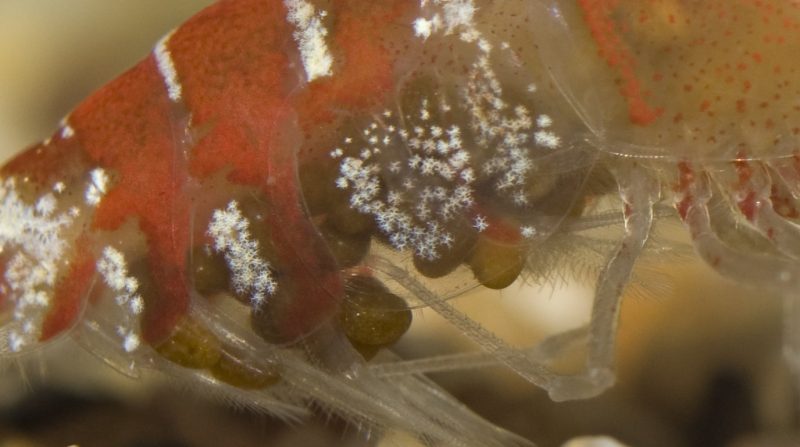
Cherry shrimp (Neocaridina davidi) carry their eggs for about three weeks before they hatch in a tank kept at 72-77°F (22-25°C), a little sooner in warmer water and longer in cooler water. In lab tanks the wait was about 21 days at 75°F (24°C) and about 15 days at 82°F (28°C).1 Home keepers count about three weeks too, anywhere from about 16 days to about a month.
One figure here comes from our own breeding tanks, and a female in your tank won’t necessarily keep to it. Shrimp Aquatics sees its females carry a clutch for about three weeks before the young hatch, well inside the span home keepers count.
If you’re still stocking a tank, our tank-bred Neocaridina shrimp leave us as juveniles to young adults, so a new colony still has some growing to do when it arrives.
Nothing in a sound Neocaridina shrimp care routine has to change once a female is carrying, and most of the work is leaving her alone.
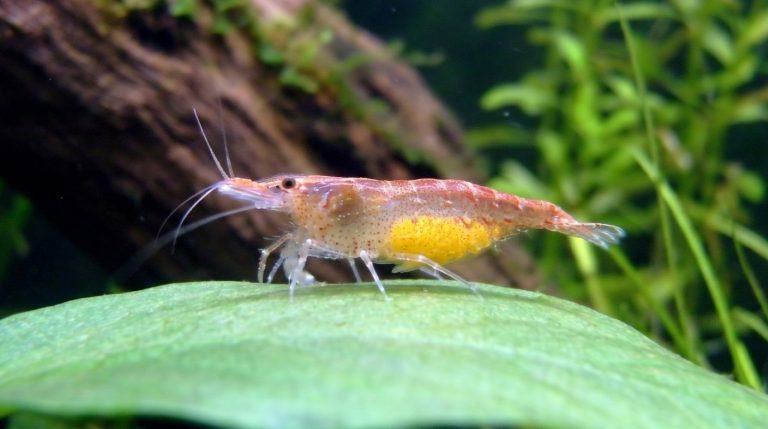
Not sure she’s carrying at all? A berried female holds her eggs as a cluster under her tail, small oval eggs stuck to the swimmerets.2 A patch on her back that shows through the shell is the saddle, her ovary seen from outside,1 and it’s the step of Neocaridina shrimp breeding that comes before the eggs.
Why does warm water shorten the wait for cherry shrimp eggs?
Cherry shrimp eggs develop faster in warm water, so the same clutch hatches sooner in a warm tank and later in a cool one. Here’s how the lab timings compare:
| Water temperature | Days to hatch | Where the number comes from |
|---|---|---|
| 75°F (24°C) | About 21 days | Lab study, eggs laid in warmer water and then carried at 75°F1 |
| 77°F (25°C) | 16-19 days | Lab culture followed from hatching3 |
| A few degrees warmer than the target range | About 15 days | Two lab studies, one of paired females4 and one of a lab culture5 |
| 82°F (28°C) | About 15 days | The same study as the 75°F row1 |
If your tank sits at the cool end of the range, expect the slow side of that table and maybe more. Home keepers’ counts stretch to about a month. A wait past three weeks in a cool tank is normal.
Don’t take any of this as a reason to warm her up. In the same study, eggs laid in warm water and then moved to 90°F (32°C) hatched in about 12 days. Yet every female raised at 90°F lost her clutch, even though her eggs were fertilized.1 Another lab study raised females at 91°F (33°C), and none of them carried eggs at all across 200 days.6 A few days saved isn’t worth that gamble. A steady Neocaridina shrimp temperature inside 72-77°F (22-25°C) keeps her well clear of it.
What do cherry shrimp eggs look like when hatching is close?
Look for two dark dots in each egg. They’re the young shrimp’s eyes, and once you can see them she’s in the last stretch of the wait.
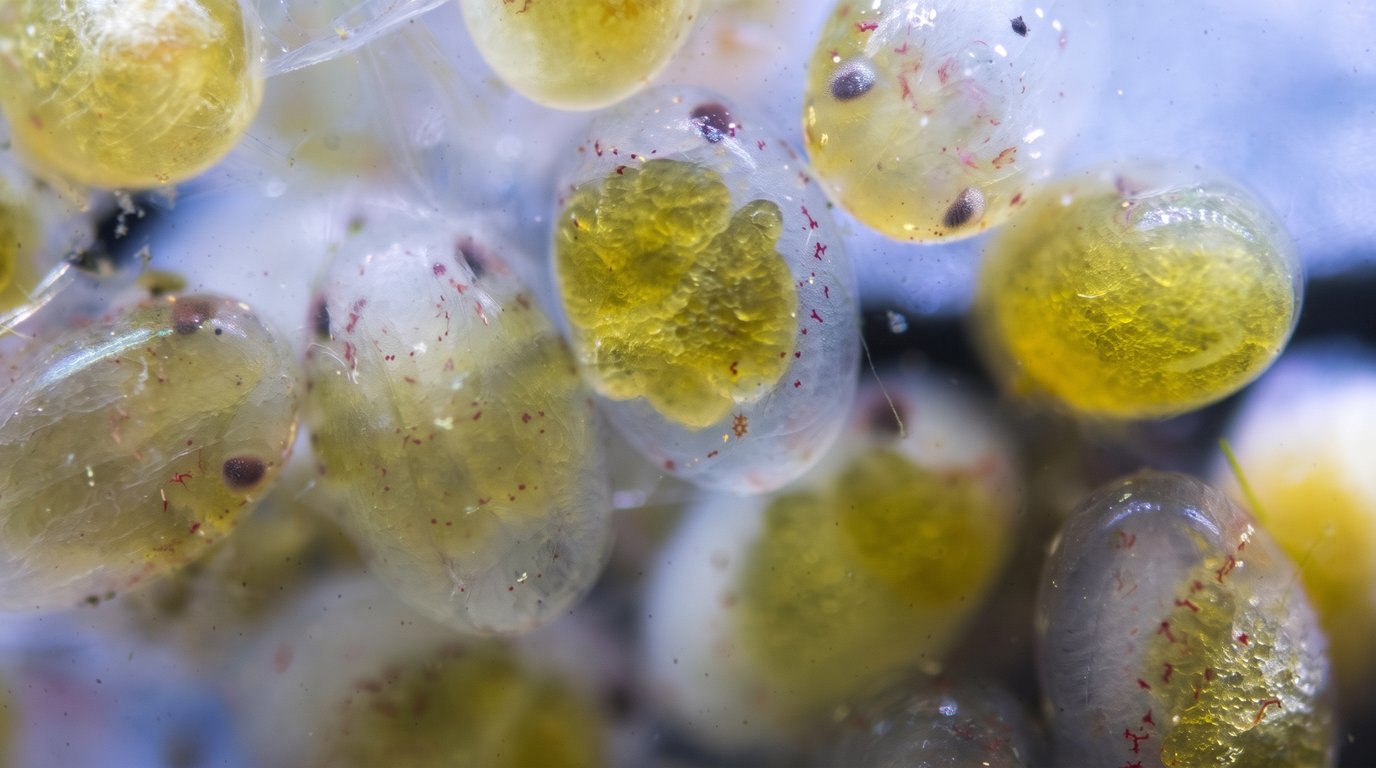
Inside each egg the embryo passes through seven stages, and the eye stage is the next to last, just before the young get ready to hatch.2 That same lab work ran a few degrees above the target range. Eggs watched outside the female started yellow-green and grew deeper in color early on, then turned yellow and see-through as the eye spots appeared.2 That was one population, so treat color as a loose guide and the eyes as the sign that counts.
The eyes start forming sooner than you might think. In a second study, at 73-77°F (23-25°C), the embryo began to form an eye and a heartbeat about a week into incubation.7 The dots you can pick out through the glass come in the later stage. No study has counted the days from visible eyes to hatching, so watch her for the dots and then for an empty tail, instead of counting down.
Do cherry shrimp eggs hatch all at once?
No, a cherry shrimp clutch hatches a few at a time, over a stretch of hours that can run to about a day. A female with only part of her clutch left may simply be partway through.
The young come out as tiny shrimp in their parents’ shape,3 with no free-swimming larval stage in between.8 Then they vanish. Shrimplets hide in moss and cover, and the first ones show up about a week to 10 days after the hatch. An empty female with no babies in sight can mean a brood that’s still hiding.
Little changes for them from here. Good baby cherry shrimp care comes down to steady water, plenty to graze and a filter they can’t be pulled into.
Why did my cherry shrimp drop her eggs?
A cherry shrimp can drop her eggs because she’s young, the water got too hot, her mate is a close relative, or she was netted or moved.
- A first clutch. Several keepers report that young or first-time females dropped some or all of their first clutch or two and held on to later ones. Others say theirs never did.
- Heat. Every female raised at 90°F (32°C) in that temperature study lost her eggs.1
- Close relatives. In a lab test, brother-sister pairs hatched fewer young than unrelated pairs, and the authors suggest more of their eggs were lost before hatching.9
- Handling. Netting or moving a berried female can cost the clutch.
One dropped clutch from a young female isn’t a reason to change anything, so give her the next one. If clutch after clutch goes missing, look at the tank and the colony. Check the temperature and how often she’s handled, and ask whether the whole group grew from a few closely related shrimp.
Should you move a berried cherry shrimp?
No. In a shrimp-only tank, leave a berried cherry shrimp where she is. Keepers who have moved or netted berried females report both outcomes: some dropped their eggs, and some held them, even through shipping. A move can cost you the clutch, and in a tank with no fish there’s little for it to gain.
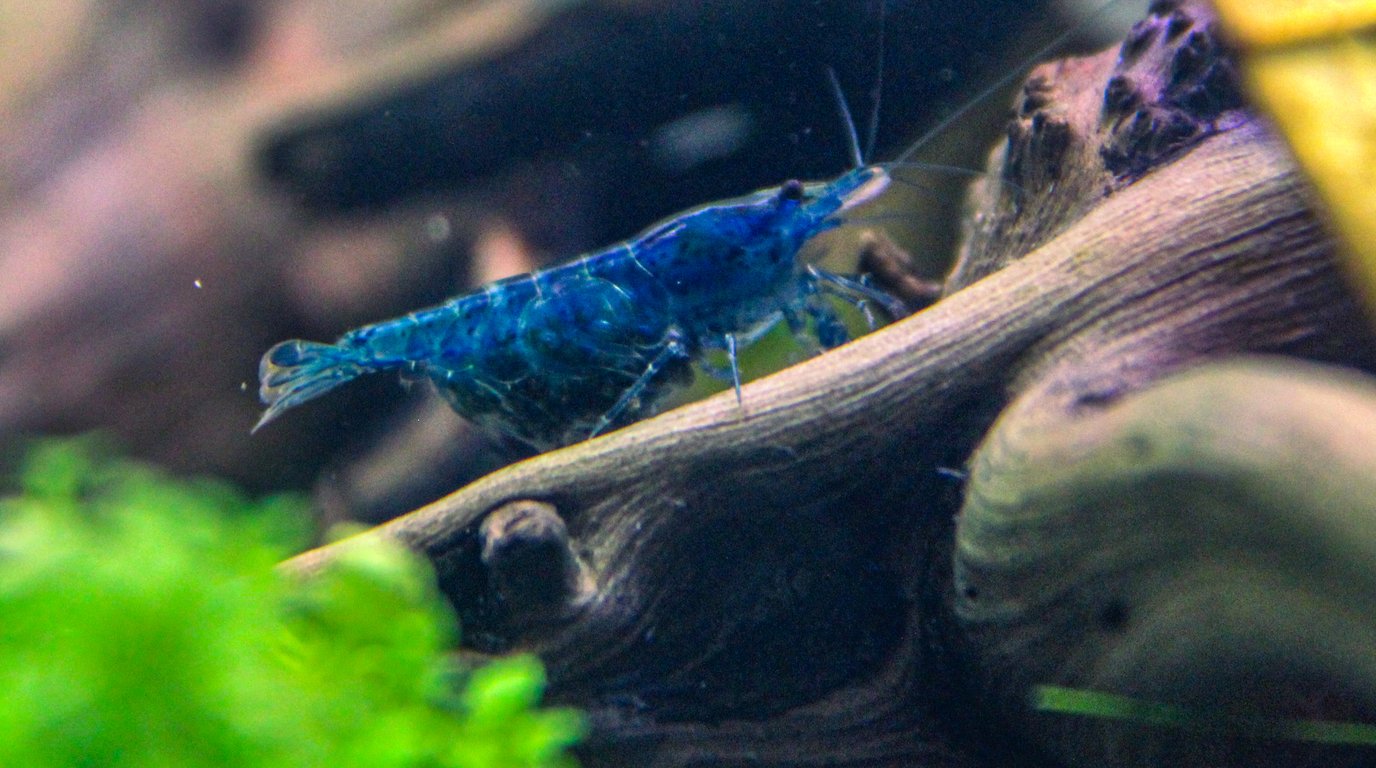
Fish change the sum. Even small fish sold as shrimp-safe may eat shrimplets. In a community tank, you may decide a breeder box or a tank of her own is worth the risk. If you go that way, the move is still a gamble with the eggs.
Keep the tank steady while your cherry shrimp carries eggs
Keep the water steady and leave the rest of the routine alone. Hold your Neocaridina shrimp water parameters inside the target range: 72-77°F (22-25°C), pH 6.8-7.6, GH 6-10 dGH and KH 2-5 dKH, with ammonia 0 and nitrite 0.
Our advice is a 10% water change every two weeks. Skipping one does no harm as long as the water values stay stable. Whatever you change, match the new water to the tank in temperature, pH and hardness, and add it slowly.
Feed the colony as usual, and leave the heater where it is. Before the hatch, fit a guard or a sponge over the filter intake, so fewer of the young get drawn inside.
Is that green growth under your cherry shrimp’s tail really eggs?
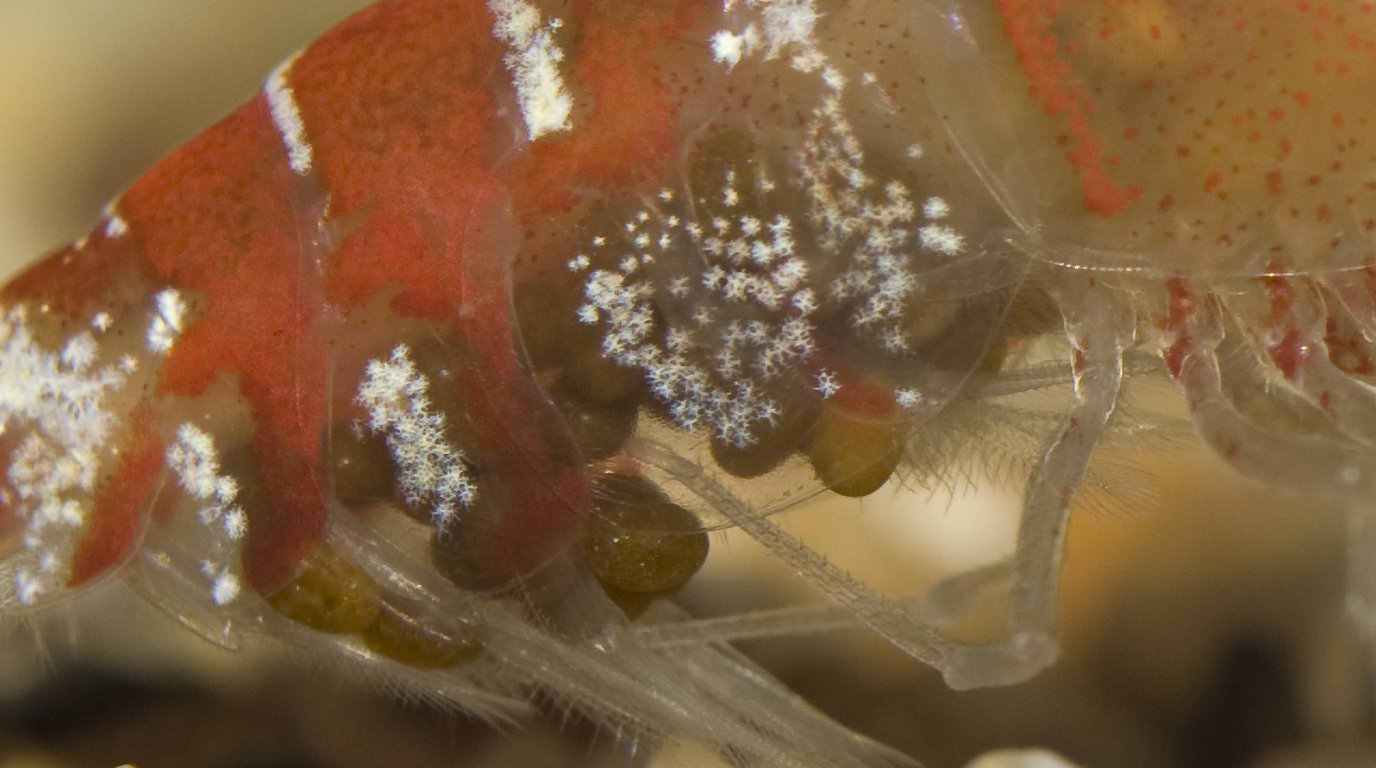
If it hatches within a few weeks, it was eggs. Cherry shrimp eggs sit in a neat cluster of oval eggs. A greenish growth on the swimmerets that stays put, or that’s still there after the eggs should have hatched, deserves a closer look. Eggs can start out yellow-green themselves, as in the lab population above,2 so color alone won’t tell you which you’re looking at.
One alga is worth knowing about. In a survey of 900 imported cherry shrimp, researchers described a new alga, Cladogonium kumaki, living on the shell, mostly among the swimmerets, and where it grew beside a female’s clutch it destroyed the eggs next to it.10 In a separate outbreak, an alga of the same genus had sent root-like threads through the shell into the tissue underneath.11 So if the green is still there well after her eggs should have hatched, look closely before you assume she’s still carrying.
References
11 Sources
- Effect of Temperature on Biochemical Composition, Growth and Reproduction of the Ornamental Red Cherry Shrimp Neocaridina heteropoda heteropoda (Decapoda, Caridea), Tropea, Stumpf and Lopez Greco, PLOS ONE 10(3): e0119468, 2015 (the paper names the species N. heteropoda heteropoda).
- Investigating the Expression and Function of HIF-1α in Neocaridina davidi During Embryo Cleavage Stage, Li et al., Turkish Journal of Fisheries and Aquatic Sciences 25(2), 2024.
- Post-hatching development of the ornamental Red Cherry Shrimp Neocaridina davidi (Bouvier, 1904) (Crustacea, Caridea, Atyidae) under laboratorial conditions, Pantaleao et al., Aquaculture Research 48(2): 553-569, 2017.
- Large mothers, but not large fathers, influence offspring number in a caridean shrimp, Sganga et al., Canadian Journal of Zoology 96(10): 1106-1113, 2018.
- Breeding and Life Cycle of Neocaridina denticulata sinensis (Kemp, 1918) (abstract), Nur and Christianus, Asian Journal of Animal and Veterinary Advances 8(1): 108-115, 2013.
- Losing Reproduction: Effect of High Temperature on Female Biochemical Composition and Egg Quality in a Freshwater Crustacean with Direct Development, the Red Cherry Shrimp, Neocaridina davidi (Decapoda, Atyidae) (abstract), Balina et al., The Biological Bulletin 234(3): 139-151, 2018.
- Post-embryonic tail development through molting of the freshwater shrimp Neocaridina denticulata, Adachi et al., iScience 28(2): 111885, 2025.
- Neocaridina davidi (Bouvier, 1904), cherry shrimp: species profile, U.S. Geological Survey Nonindigenous Aquatic Species program, updated 2026.
- Brothers are better than nothing: first report of incestuous mating and inbreeding depression in a freshwater decapod crustacean, Tropea, Marciano and Lopez Greco, Zoology 151: 125990, 2022.
- Epibiont Cohabitation in Freshwater Shrimp Neocaridina davidi with the Description of Two Species New to Science, Cladogonium kumaki sp. nov. and Monodiscus kumaki sp. nov., and Redescription of Scutariella japonica and Holtodrilus truncatus, Maciaszek et al., Animals 13(10): 1616, 2023.
- Association of the alga Cladogonium sp. with a multifactorial disease outbreak in dwarf shrimp (Neocaridina davidi) (abstract), Bauer et al., Diseases of Aquatic Organisms 146: 107-115, 2021.
Ready to get started?
Shop our Neocaridina Shrimp collection
15 products available · Live Arrival Guarantee