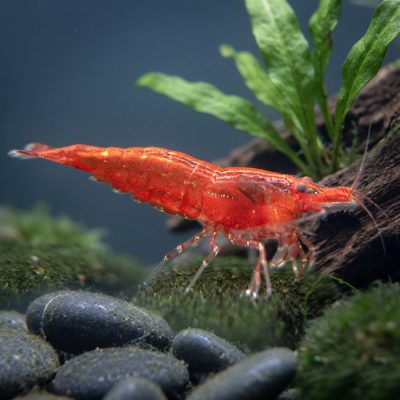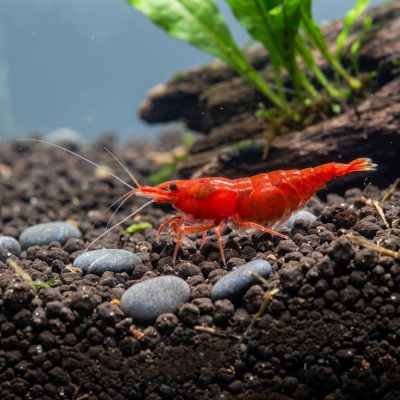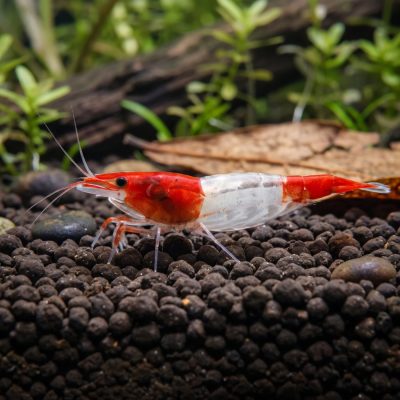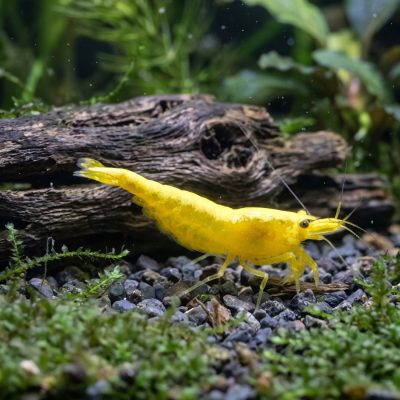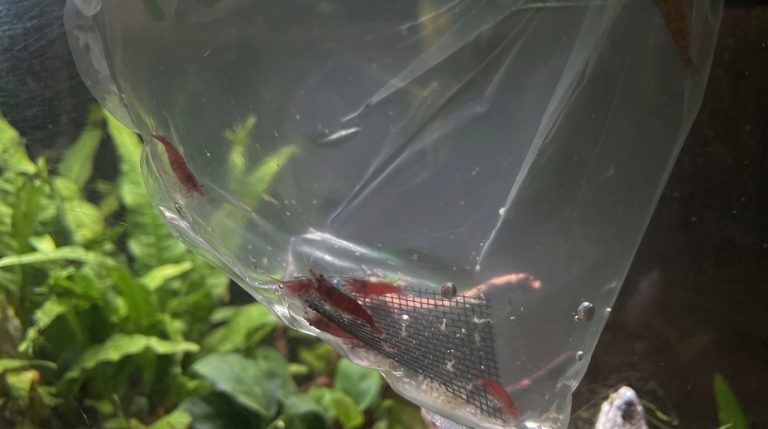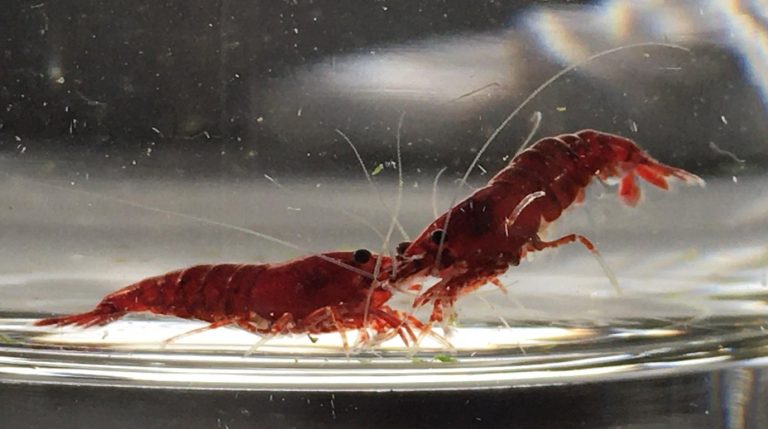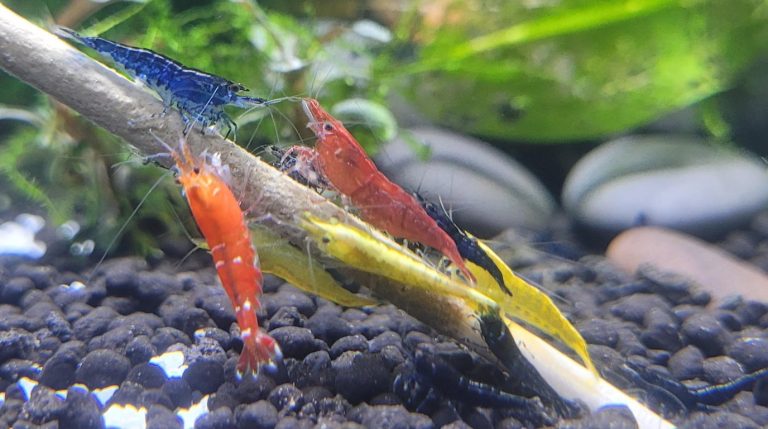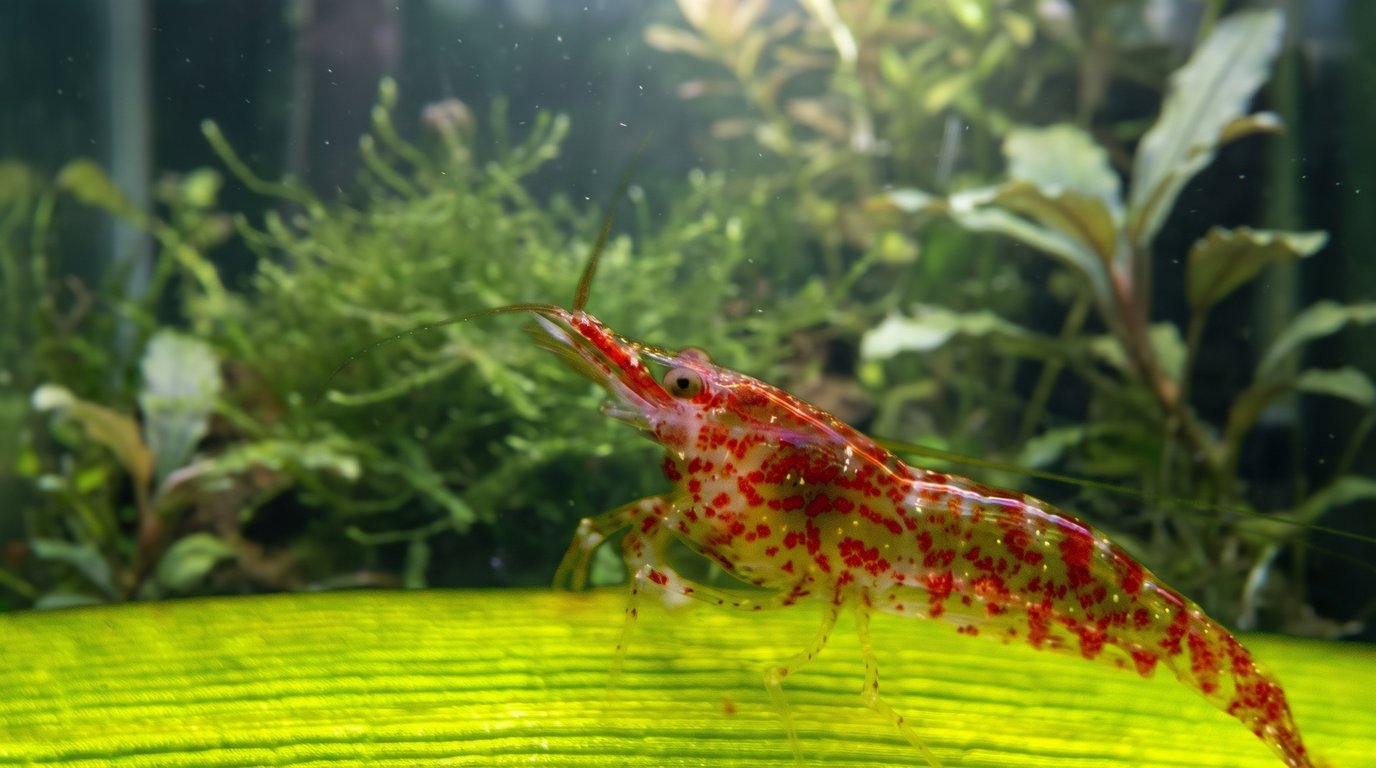
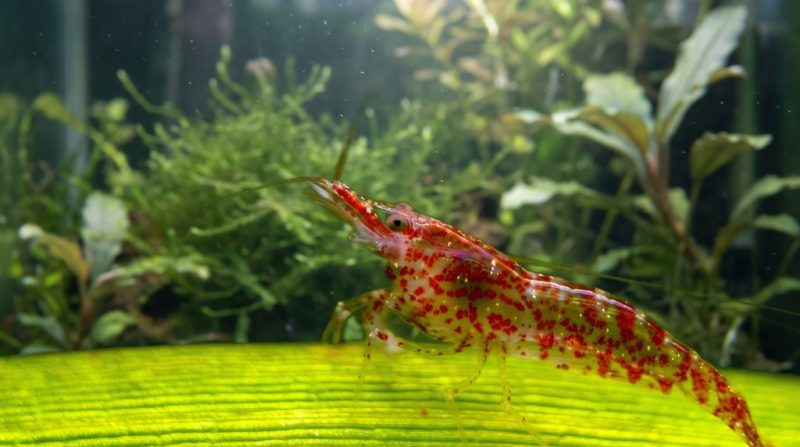
Baby cherry shrimp need very little special care. Give them a cycled, steady tank without fish, plenty of surface to graze and a filter they can’t be pulled into. Keep water changes small and gradual, and feed the colony as usual. Newborn cherry shrimp (Neocaridina davidi) graze for themselves, so most of your job is keeping the tank calm while they grow.
If you’re still planning a colony, our tank-bred Neocaridina shrimp leave us as juveniles to young adults, already past the tiny stage this page is about.
Your routine of Neocaridina shrimp care doesn’t need to change when babies arrive. You adjust a few things around them, and the first one is patience.
Why can’t you see the baby cherry shrimp yet?
You probably can’t see them because they’re tiny, pale and hiding. Expect to start spotting cherry shrimp babies about a week to 10 days after the hatch. Until then a brood can look like one or two babies while far more are tucked into moss or sitting inside the filter. If her eggs are still under her tail, how long a cherry shrimp carries her eggs depends mostly on the water temperature, so the babies may simply not be out yet.
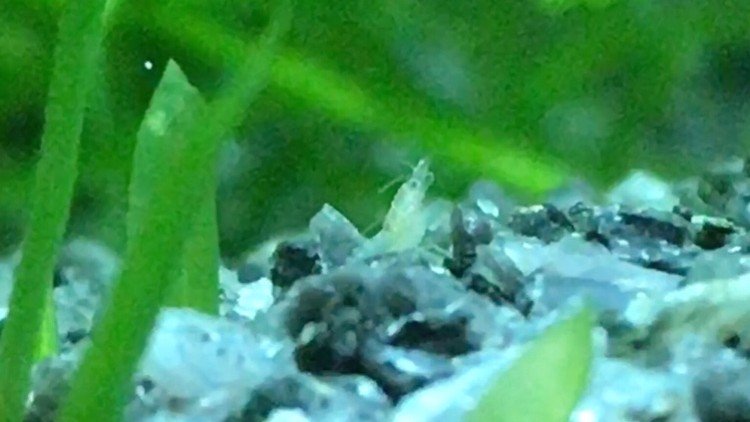
Once a berried female’s eggs are gone, the young are already loose in the tank. That’s how Neocaridina shrimp breeding works: the genus has no free-swimming larval stage,1 and the young come out already built like their parents, only far smaller.2
They’re also clear or colorless for their first days, so against moss or substrate there’s very little to see. Give a hatch those ten days before you decide it failed.
What do baby cherry shrimp eat?
Baby cherry shrimp eat what the tank grows: the biofilm and algae on plants, moss, wood and glass, plus crumbs of whatever the colony is fed. Biofilm is the thin living layer of algae and microbes on every wet surface. In one aquaculture study, biofilm grown on plastic nets and sheets was the only food. Young cherry shrimp survived and grew on it, and the shrimp completed their whole life cycle.3
Do they need food straight away? Not on day one, but within their first weeks. In a lab study, newly hatched cherry shrimp given no food at all still made their first molts on time, yet most of them had died by day 20.4 A mature tank with biofilm on every surface supplies much of that food on its own. None of this is a reason to feed the colony less.
A few notes in this guide come from how we raise young in our own shrimp-only tanks, and a home tank can turn out differently. Shrimp Aquatics gives its young nothing separate: they graze the tank and share the adults’ pellet food. Other keepers raise babies the same way, on the biofilm and moss of an established tank plus whatever the adults get, and some add a powdered baby food as well. Powder is an option you can add, not something the babies need.
Whatever you add, keep it small and lift what isn’t eaten, so leftovers don’t foul the water the babies live in. Mulberry leaves, Indian almond leaves and root vegetables can go in as extras alongside the usual food. Babies and adults share one menu, so what Neocaridina shrimp eat as adults is what the young are picking at in crumbs.
Keep baby cherry shrimp out of the filter
Make sure no filter intake can pull baby cherry shrimp in. Our advice is a sponge filter, which gives the tank plenty of oxygen without a strong current. With a hang-on-back or canister filter, a guard or sponge over the intake can cut down how many shrimplets end up inside, which is why the filter is part of Neocaridina shrimp tank setup from the start.
Babies can get in anyway, so look before you clean. Shrimp keepers find shrimp living inside canisters and hang-on-back filters, babies among them, and some find babies behind a prefilter sponge. Rinse the sponge or empty the media into a white tub or a clear container where you can see what comes out. Tip any shrimp you find back into the tank.
Change water gently in a tank with baby cherry shrimp
Keep the water steady while the babies are small: ammonia 0 and nitrite 0, and no sudden jumps in temperature, pH or hardness. Across fish and invertebrates, a review of toxicity studies reports that early life stages are often more sensitive to toxic substances than adults, though not for every species or substance.5 That’s a general pattern from other animals, not a measurement on shrimp, but it’s a good reason not to let the water slip while a brood grows.
Hold the Neocaridina shrimp water parameters where the adults already live: 72-77°F (22-25°C), pH 6.8-7.6, GH 6-10 dGH, KH 2-5 dKH, ammonia 0 and nitrite 0.
Our advice is to change 10% of the water every two weeks, and missing a change does no harm as long as the water values stay stable. Whatever the size of the change, match the new water closely to the tank in temperature, pH and hardness, and add it slowly.
Babies can end up in the water-change bucket too. One keeper found hundreds in the bottom of the bucket after noticing only a few in the tank. Look through the bucket before you pour it away, and if you like, cover the siphon end with fine mesh.
Keep copper out too: one plant supplement maker warns that high levels can be deadly to invertebrates, and traces copper’s bad name to copper medicines and old copper pipes.6
Does moss help baby cherry shrimp survive?
Moss looks like a real help to baby cherry shrimp, for the grazing and the cover it gives. In a 90-day lab culture of newly hatched cherry shrimp raised without adults, 90 percent survived with Vesicularia moss, the genus that includes Java moss. With each of the other three substrates, two other plants and a plastic net, survival was nearly 60 percent.7 That comes from the study’s abstract, and the authors only suggest why: a cleaner environment, or the algae and microbes growing on the moss.
Moss still isn’t required. Other easy plants add surface to graze and places to hide: Java fern, Anubias, many Cryptocoryne and Vallisneria are common picks, though their needs vary with the plant and your water.
What eats baby cherry shrimp, if not the adults?
In a shrimp-only tank the young can stay where they hatched. Keepers who run cherry shrimp tanks without fish say the young grow up among the adults and the colony keeps growing, and none of them report adults eating healthy babies. You don’t need a separate nursery tank. The ones to watch are fish and, possibly, planaria and hydra.
Fish change that. Even small fish sold as shrimp-safe may eat shrimplets, so if raising babies is the point, keep the colony in a tank of its own.
Two small pests are worth learning to spot: planaria, small flatworms that glide over glass and plants, and hydra, tiny freshwater relatives of jellyfish with a ring of thin tentacles. Some keepers have lost most of their babies in tanks with planaria, though none of them saw a planarian eat one. Lab work explains the worry. In small dishes, hydra and two kinds of planarian killed water fleas, a small crustacean, within a day, and hydra was the most efficient hunter of the three.8
As one hydra study sums up earlier work, hydras feed mainly on small crustaceans such as water fleas and copepods, and catch them with stinging cells on their tentacles.9 Neither study offered shrimp, so treat this as the reason for caution, and check the glass and plants for both if a brood keeps vanishing.
When do baby cherry shrimp get their color?
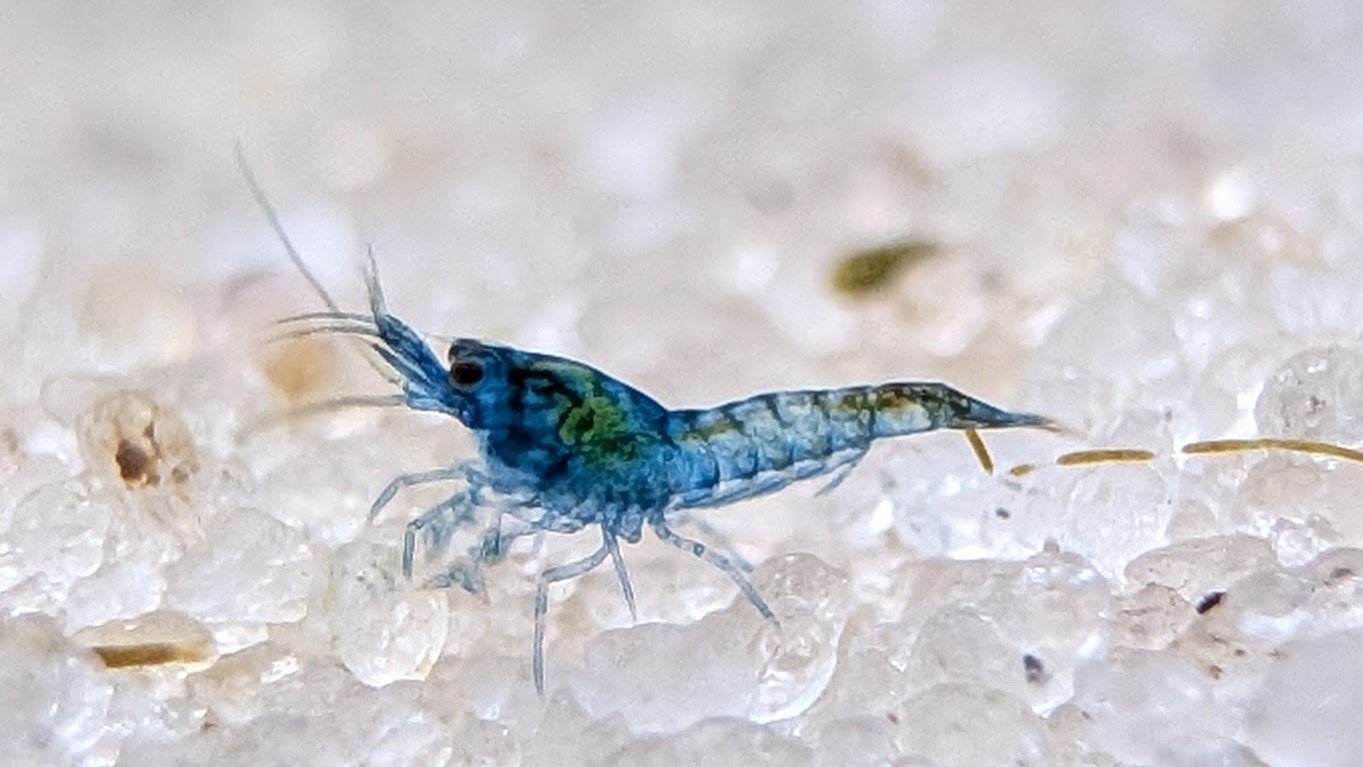
Expect color to start showing after about 1 to 3 weeks, and solid color after a few weeks. Newborns are clear, then pinkish or off-white for the first weeks before the color comes in. In the Shrimp Aquatics systems, the young start to show clear color at about two weeks old.
So a pale baby a week or two old is normal. Give it a few weeks before you worry about its color.
Growth is quick at this age. Young cherry shrimp molt often: in a lab culture the first molt came about a day after hatching and the next ones every few days, with the shrimp a little larger at each stage.2
In the same culture the first female carried eggs 49 days after hatching, so in a lab the young reach breeding size in roughly two months.2 They keep growing after that, so a two-month-old isn’t yet as big as Neocaridina shrimp get.
How many baby cherry shrimp survive?
Most of a brood grows up in the Shrimp Aquatics systems, judged by eye rather than counted. In lab trials, 87 to 93 percent of young cherry shrimp survived 90 days.10
In those trials, survival was the same at three different crowding levels. The small containers each held moss, got a full water change every week and plenty of food. So the figures show what young shrimp do in good conditions, not what your tank will do. No one has published a survival figure for babies in a home tank, so your own count over the weeks after a hatch is the measure that matters.
Why did my baby cherry shrimp disappear?
Babies that seem to have vanished may still be there. Work through these checks, starting with the most hopeful one:
- They’re still hiding. Give them about a week to 10 days after the hatch before you look hard.
- They’re in the filter. Check the sponge, the canister media or the hang-on-back box.
- Fish ate them. Even small fish sold as shrimp-safe may take shrimplets.
- Planaria or hydra are in the tank. Look over the glass and plants, front and back.
- The water moved too fast. Check whether a recent change shifted temperature, pH or hardness, and keep the next one small and matched.
If the colony ever outgrows the tank, keep shrimp, plants and tank water out of ponds and streams. Aquarium release is the most common way this species reaches the wild.1
References
10 Sources
- Neocaridina davidi (Bouvier, 1904), cherry shrimp: species profile, U.S. Geological Survey Nonindigenous Aquatic Species program, updated 2026.
- Post-hatching development of the ornamental Red Cherry Shrimp Neocaridina davidi (Bouvier, 1904) (Crustacea, Caridea, Atyidae) under laboratorial conditions, Pantaleao et al., Aquaculture Research 48(2): 553-569, 2017.
- Breeding and life cycle of the ornamental freshwater shrimp Neocaridina davidi in a biofilm-based culture system (abstract), Viau et al., Aquaculture Research 51(9): 3847-3864, 2020.
- Nutritional vulnerability in early stages of the freshwater ornamental “red cherry shrimp” Neocaridina davidi (Bouvier, 1904) (Caridea: Atyidae), Pantaleao et al., Journal of Crustacean Biology 35(5): 676-681, 2015.
- Why are Early Life Stages of Aquatic Organisms more Sensitive to Toxicants than Adults?, Mohammed, IntechOpen (review chapter), 2013.
- FAQ: Can I use Seachem Flourish in a tank where I’m keeping ______?, Seachem Laboratories (manufacturer support article), undated.
- Effect of different substrates on growth and biochemical composition of the ornamental “red cherry” caridean shrimp, Neocaridina davidi (Atyidae) (abstract), Vazquez et al., Aquaculture Research, 2022.
- Who Ate Whom – Competition and Predation in a Freshwater Microcosm, Kovacevic et al., Water, 2025.
- A search for predators and food selectivity of two native species of Hydra (Cnidaria: Hydrozoa) from Brazil, Massaro et al., Biota Neotropica, 2013.
- Density and gender segregation effects in the culture of the caridean ornamental red cherry shrimp Neocaridina davidi Bouvier, 1904 (Caridea: Atyidae), Vazquez et al., Journal of Crustacean Biology 37(4): 367-373, 2017.
Ready to get started?
Shop our Neocaridina Shrimp collection
15 products available · Live Arrival Guarantee