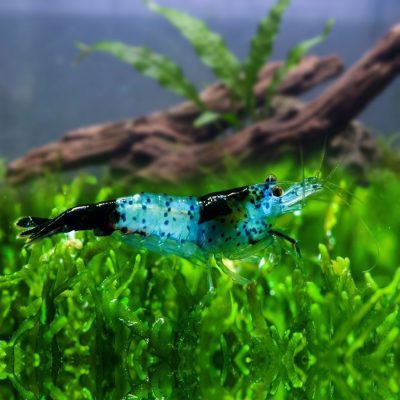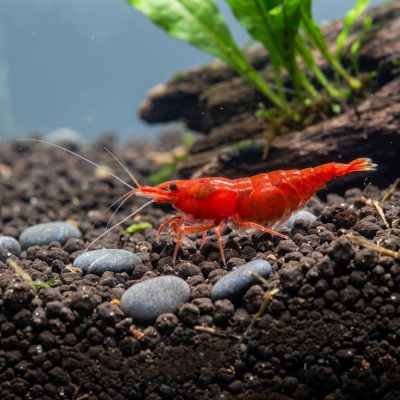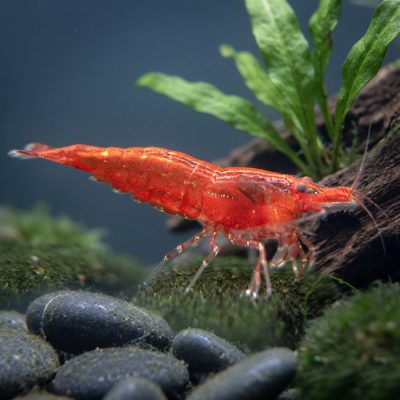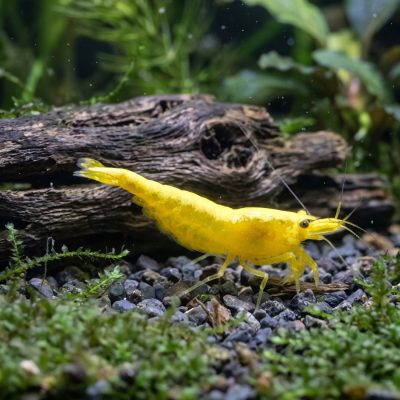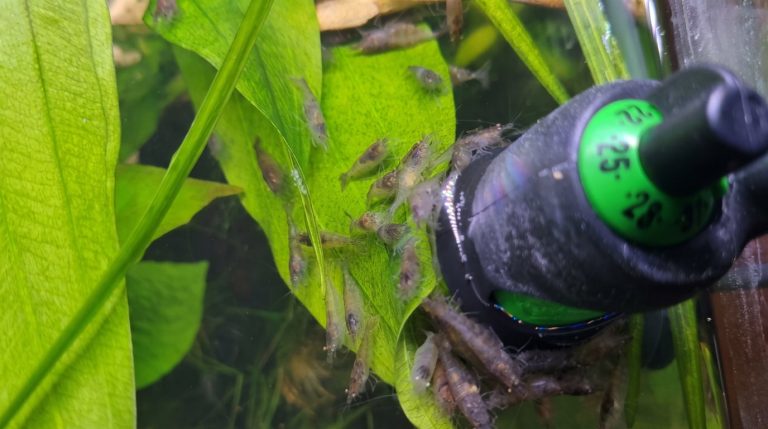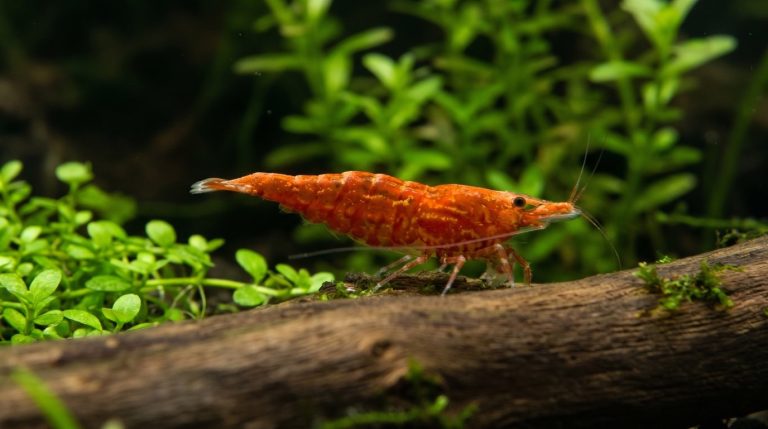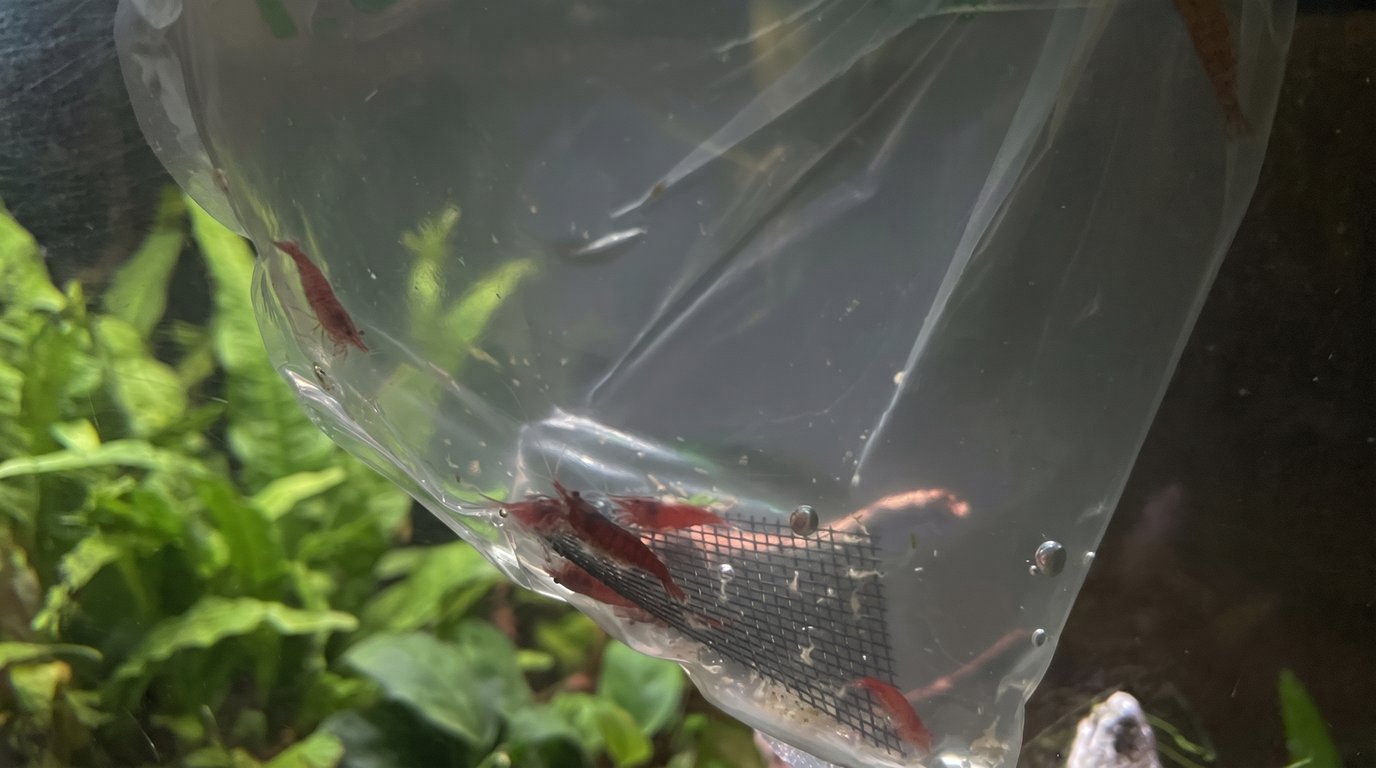
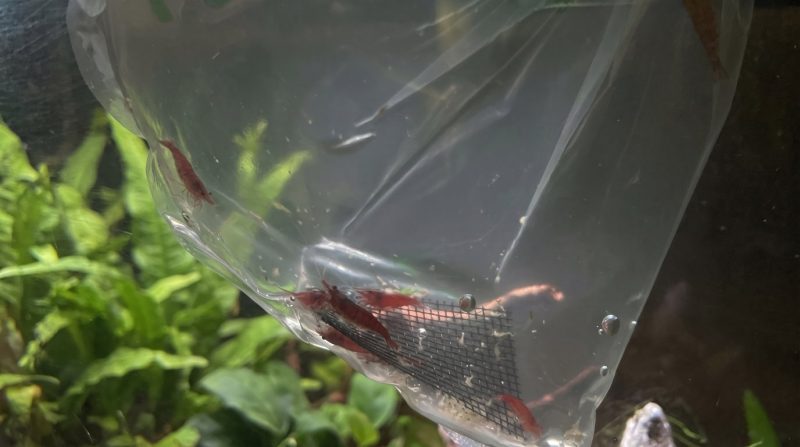
To acclimate Neocaridina shrimp, bring the bag they arrived in to your tank’s temperature, then net the shrimp into the tank and leave the bag water out. Drip acclimation, where tank water trickles into a container holding the shrimp, is a slower option many keepers use. It’s the better fit when your water is very different from the shipping water. After that, leave cherry shrimp (Neocaridina davidi) and their color lines in peace and expect paler color and a few days of hiding while they settle.
Whichever color line of our tank-bred Neocaridina shrimp is in the box, or whichever you carried home from a store, the steps below don’t change.
Moving new shrimp in is one evening of Neocaridina shrimp care, and it really starts days earlier, with a tank that’s ready before the box is.
Get the tank and the kit ready before your Neocaridina shrimp arrive
Have the tank cycled before any shrimp arrive. Ready means your test kit reads ammonia 0 and nitrite 0, whatever the calendar says. That’s why the cycle in Neocaridina shrimp tank setup comes before the shrimp order, not after it.
Then set out what you’ll need on the day:
- A fine aquarium net.
- A clean bucket or container that has never held soap or cleaning products.
- An aquarium thermometer.
- A length of airline tubing, if you plan to drip.
Open the box in dim light and check the shrimp
Open the box somewhere dim, away from a sunny window or a bright lamp, and look through each bag first. Count the shrimp, note any that aren’t moving, and lift out dead ones as soon as a bag is open.
Orders from Shrimp Aquatics come with a live arrival guarantee, so start filming before you open the box and keep the video in one take. Livestock that arrives dead is replaced free of charge, counted from the first animal, when you report it within 2 hours of the carrier’s delivery time with an uncut unboxing video.
Bring the closed bag to your tank’s temperature first
Float the closed bag in the tank until the water inside matches the tank’s temperature. This is for an ordinary sealed plastic bag, not a breather bag.
How long does that take? Keepers who named a time floated for about 20 to 30 minutes. If you’re unsure, check the bag water with the thermometer once it’s open, before the shrimp move.
Why bother? A sudden, large change can kill a decapod. In a lab study on a far bigger freshwater prawn, animals moved straight from room-temperature water into water as cold as a fridge died within 2 hours. Crayfish given the same drop survived.1 That was an extreme drop in a different animal, so it shows the risk of a big jump, not what a few degrees does to a cherry shrimp.
Should you float and net cherry shrimp or drip acclimate them?
Float and net if your tank water is close to the shipping water or your seller’s instructions say so. Drip if your water is much softer or harder, or if you’d rather go slowly. Cherry shrimp keepers use both, and either way the shrimp go into the tank by net.
Float and net is Shrimp Aquatics’ current shipment protocol for the shrimp it sends in a sealed bag. Shrimp Aquatics tells keepers to float the closed bag until it matches the tank’s temperature, then net the shrimp in and leave the bag water out of the tank. It’s the method that goes out with Shrimp Aquatics orders, not the only one that works, so with any order go by the instructions the seller packed with it.
Plenty of keepers skip the drip altogether. They float the bag to match the temperature, net the shrimp in and say their cherry shrimp did fine. It isn’t a sure thing, though. In one shipment of 8 cherry shrimp released after only a short acclimation, 2 died within hours, and their keeper felt they’d been rushed.
Not sure how close your water is? A hardness test on a little of the bag water, next to the same test on your tank, shows how far apart the two are.
| What to compare | Float and net | Drip |
|---|---|---|
| How it works | Float the closed bag to tank temperature, then net the shrimp in | Tank water trickles through airline tubing into a container of shrimp, then you net them in |
| Time it takes | As long as the bag needs to reach tank temperature | About 1-6 hours among keepers who drip, about 3 in the middle |
| Suits | Tank water close to the shipping water, or a seller’s instructions that call for it | Tank water much softer or harder than the shipping water, or a keeper who wants to go slowly |
| Bag water | Stays out of the tank | Poured away with the container water |
How to drip acclimate cherry shrimp
There’s no set recipe for a drip, but this is the usual way to run one:
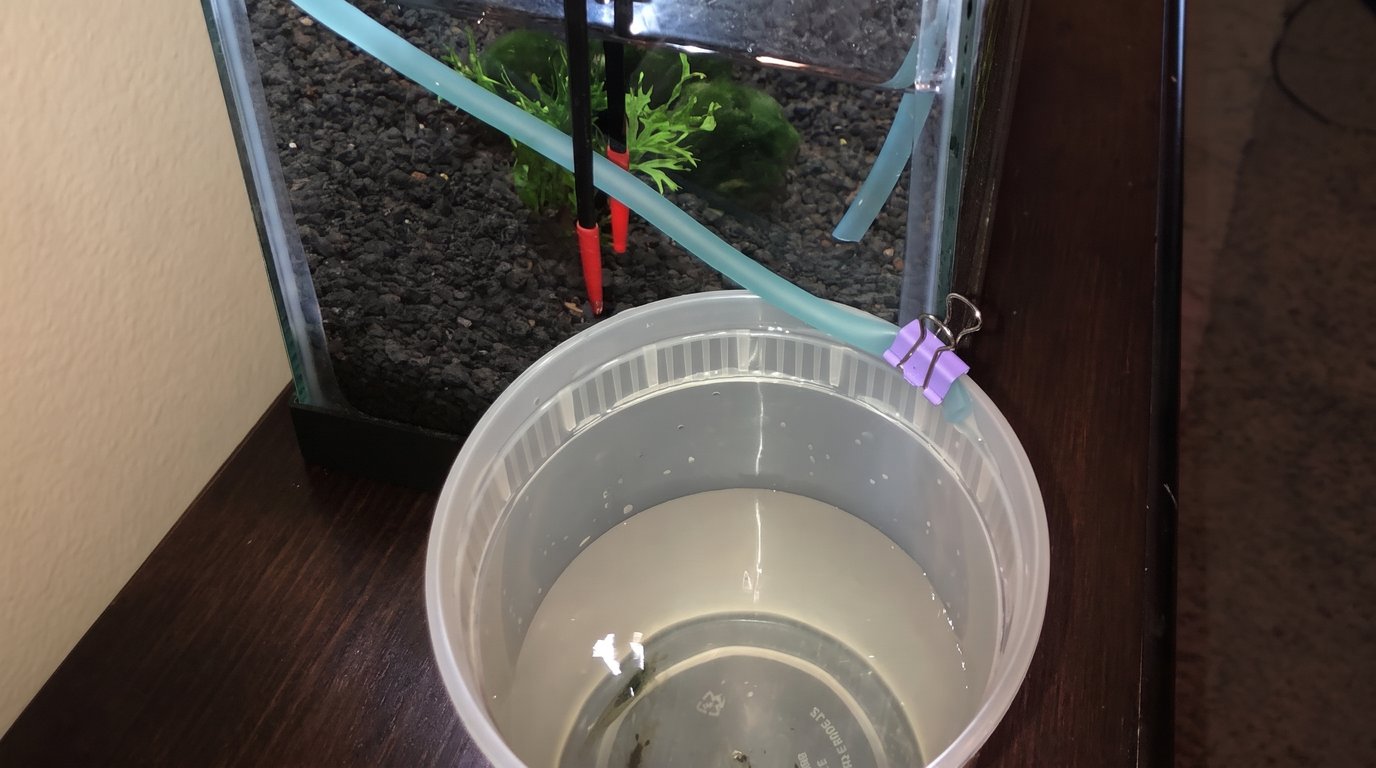
- Pour the shrimp and their bag water into the clean container and set it below the tank.
- Run airline tubing from the tank down into the container and start the siphon.
- Tie a loose knot in the tubing, or fit a small valve, and tighten it until the flow slows to a drip.
- Let the container fill slowly, and keep an eye on it so it doesn’t overflow.
- Net the shrimp into the tank and pour the container water away.
How long should you drip acclimate Neocaridina shrimp?
Keepers who drip new cherry shrimp run it for about 1 to 6 hours, with about 3 hours in the middle. The longest drips came from keepers whose tank water was far from the shipping water or who were nervous about a new tank, and going longer didn’t reliably go better. One keeper called a 6-hour drip far too long and stressful, and the shrimp hid afterwards.
No study has compared float and net with drip acclimation for Neocaridina. A 2026 review of the ornamental shrimp trade adds that species-specific guidance on preventing osmotic stress, in aquariums or in transport, doesn’t exist.2 So there’s no proven safe drip length to aim for. Pick the method that suits your water and your evening, and whichever you pick, the bag water stays out.
Keep the bag water out of the tank, whatever bag the shrimp came in
Never pour the bag water into your tank. It has spent the whole trip with the shrimp and their waste, so net the shrimp out and tip the water down a sink.
That same review lists what can happen to water in transport: ammonia and carbon dioxide can build up, and pH and temperature can swing. The list leans mostly on work with shipped fish.2 You don’t need to know what was in your own bag, because none of it goes into the tank.
If your shrimp came in a breather bag
Take a breather bag out of the box and into open air as soon as it arrives, then follow the seller’s instructions for it. These bags are made of a film that gases pass through. One maker says carbon dioxide leaves and oxygen comes in through the bag wall. As long as there’s breathable air outside the bag, it says, the animals inside won’t run out of oxygen.3
You’ll often see the advice never to float a breather bag. It fits what the maker says the film needs, but it’s sellers’ and keepers’ advice, not an instruction the maker gives. If the seller sent instructions with the bag, those come first.
Look new cherry shrimp over for hitchhikers before they go in
Look new shrimp over in the container before they go in. If you have a spare tank, hold them there for a while so you can watch them first. Shrimp can carry small animals attached to their bodies, and a holding tank keeps those away from the shrimp you already have.
Researchers checked a small batch of two kinds of ornamental shrimp imported from Indonesia into the Czech Republic. They found large numbers of the attached protozoan Vorticella, a scutariellid flatworm and a rotifer. They estimate that hundreds of thousands of these hitchhikers reach that country with ornamental shrimp every month.4
Wild cherry shrimp tell a similar story. Among feral Neocaridina davidi caught in a warm canal in Poland, about 6 percent carried the flatworm Scutariella japonica and most carried vorticellids. The authors note that small numbers of these usually don’t harm the shrimp.5 Neither tells you what a given seller’s shrimp carry, but they’re reason enough to look before you net.
Skip the dips, salt baths and medications you may see suggested for new shrimp. The 2026 review says dips and copper-based treatments are lethal to invertebrates, and many fish treatments are toxic to them. That’s why shrimp health rests on quarantine, careful water quality and a suitable diet.2
If plants came in the same order, rinse and check them too, because keepers have lost whole groups of shrimp within a day of adding new plants.
What’s normal for new cherry shrimp in the first hours and days?
New cherry shrimp often hide for a few days, look paler than they will later and molt soon after the move. All of that is part of settling in. Keep the lights low or off for the rest of the first day, a safe default, then leave them alone.
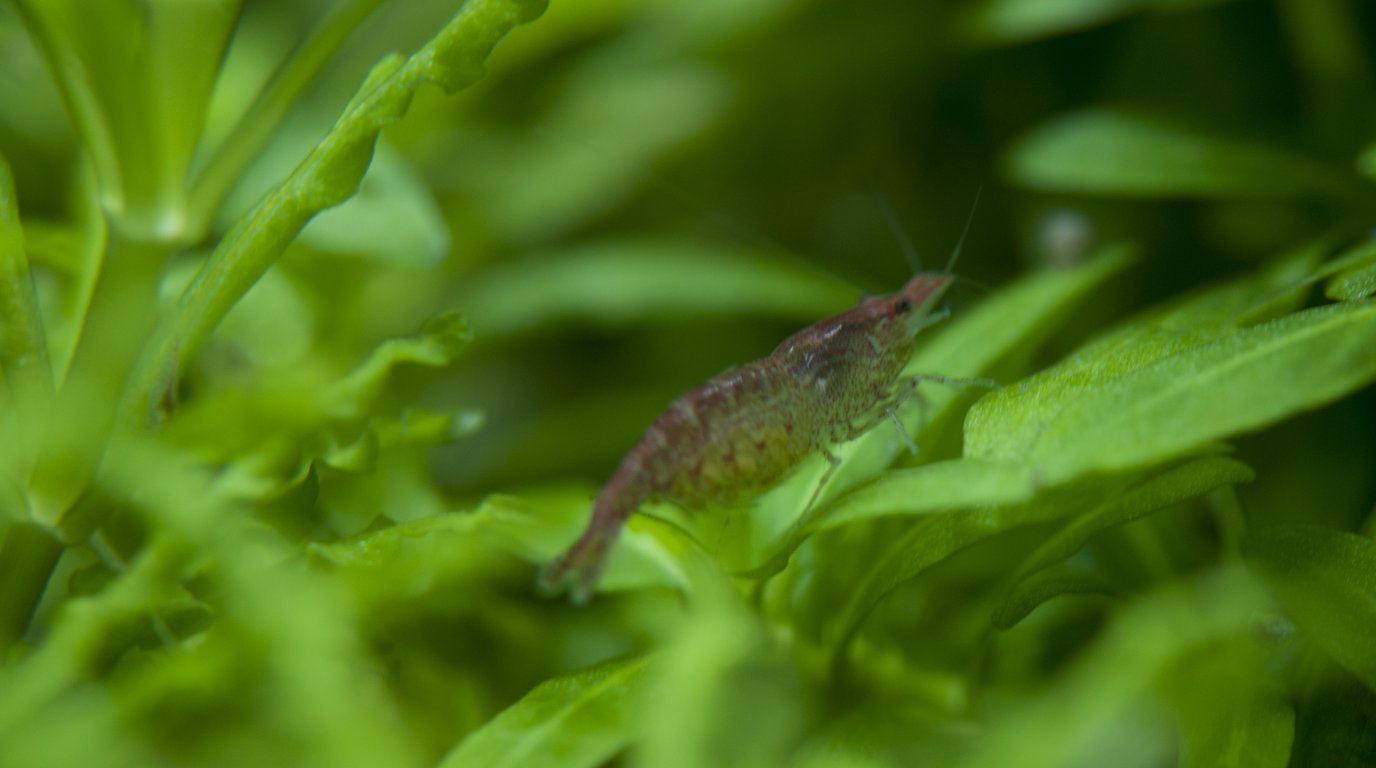
The next note comes from what Shrimp Aquatics sees with the shrimp it breeds and ships, and shrimp from another breeder or a store can settle a little differently. New arrivals often swim all over the tank, right up to the surface, for a few hours before they settle, and they can look paler for a few days before their color comes back. So don’t net them back out or start a water change because they race around on the first evening.
Keepers see the color return the same way. Shrimp that arrive grey, pale or clear color up again within a few days, though one batch of adult painted fire reds took more than a week. Keepers add that some shrimp in a batch are simply males or lower grades that stay paler.
Expect them to hide, too. New cherry shrimp often stay out of sight for about 3 days to a week, and fish in the tank make them hide longer. A few go straight out to graze.
Keepers often find a molt within about 2 to 5 days of adding new shrimp. At first glance a cast shell can pass for a dead shrimp, and finding one or two in the first week is nothing to act on.
Once you know how often cherry shrimp molt, a shell on the bottom stops being a worry. A stuck molt looks different: keepers describe a white split behind the head that never opens up.
How can you tell new shrimp are settling in?
Over the first few days to a week, shrimp that are settling in come out and pick at the glass, plants and substrate. Their color comes back, and what turns up on the bottom is empty shells, not bodies. None of that is a health check, so keep testing the water if anything looks off.
When should you feed new cherry shrimp?
We advise leaving new shrimp overnight and giving them a little food the next day. In the meantime they graze the biofilm on the tank’s surfaces, a big part of what Neocaridina shrimp eat.
Keepers don’t agree on when to give the first feed, so treat the next-day timing as a starting point and keep that first portion small.
When do first-week losses point to a problem with the tank?
A single loss in the first days is common, but shrimp that keep dying, several a day, point to the tank more than to the trip. Keepers report anything from no deaths at all to about 1 to 3 of a batch of 8 to 26 in the first days. They tie those losses to shipping stress, a short acclimation or a tank that wasn’t ready.
In the reports where nearly a whole batch died, the tank had a problem of its own, such as new soil or a cycle that hadn’t finished. That’s why the next step after a loss is a test, not a new acclimation routine.
If you find a dead shrimp, take it out, then test ammonia and nitrite, which should both read 0. Check the rest against Neocaridina shrimp water parameters of 72-77°F (22-25°C), pH 6.8-7.6, GH 6-10 dGH and KH 2-5 dKH.
Treat these numbers as a guide, not a pass-fail test. Neocaridina are easy shrimp, and a tank that sits a little outside one of them can still work, as long as it isn’t far off. Ammonia and nitrite are the exception: anything above 0 needs fixing, and any change you make to the water goes in gradually.
References
5 Sources
- The acute and chronic effect of low temperature on survival, heart rate and neural function in crayfish (Procambarus clarkii) and prawn (Macrobrachium rosenbergii) species, Chung, Cooper, Graff and Cooper, Open Journal of Molecular and Integrative Physiology 2: 75-86, 2012.
- An ecophysiological approach to improving health outcomes of ornamental shrimp during aquarium trade and transportation, Conway Holroyd, Spicer, Ellis and Turner, Conservation Physiology 14: coag046, 2026.
- Breathing Bags (product description), Kordon LLC, undated.
- Aquarium hitchhikers: attached commensals imported with freshwater shrimps via the pet trade (abstract), Patoka et al., Biological Invasions 18: 457-461, 2016.
- First report of Scutariella japonica (Matjasic, 1990), a temnocephalid epibiont from South-East Asia, found on introduced ornamental freshwater shrimp in European waters, Maciaszek et al., Knowledge and Management of Aquatic Ecosystems 422: 19, 2021.
Ready to get started?
Shop our Neocaridina Shrimp collection
15 products available · Live Arrival Guarantee