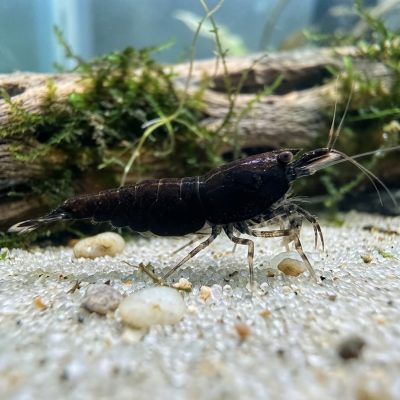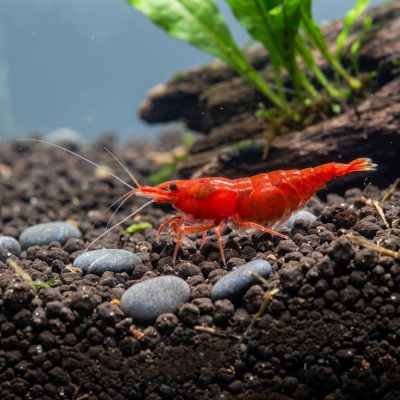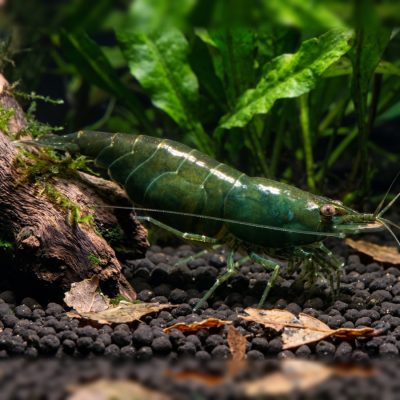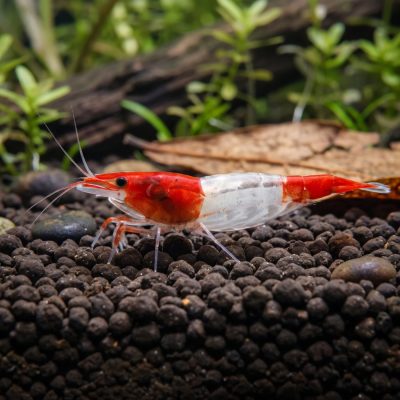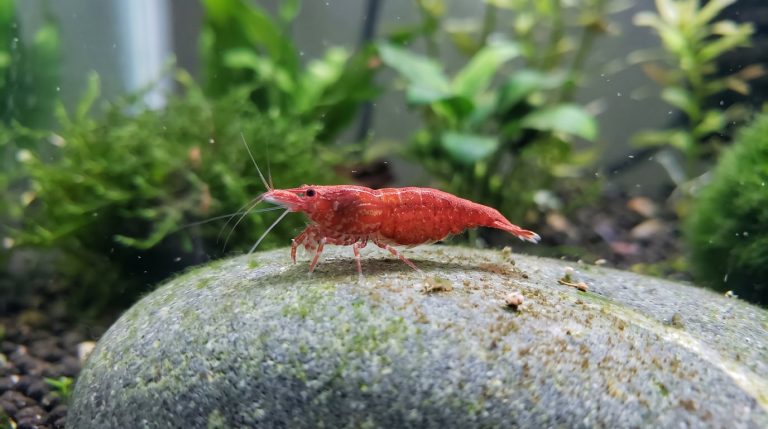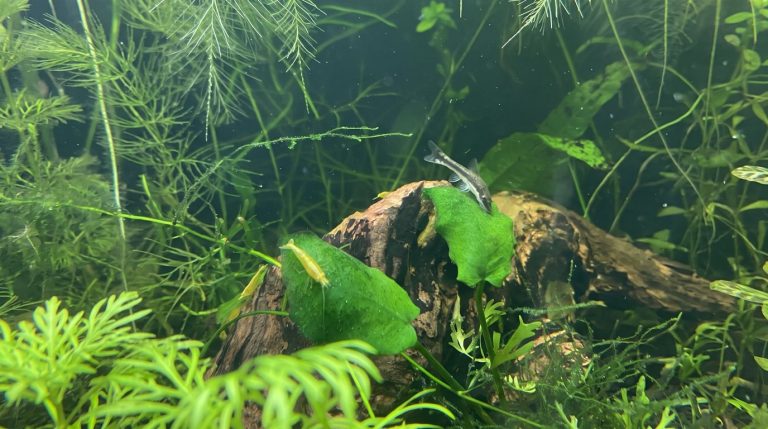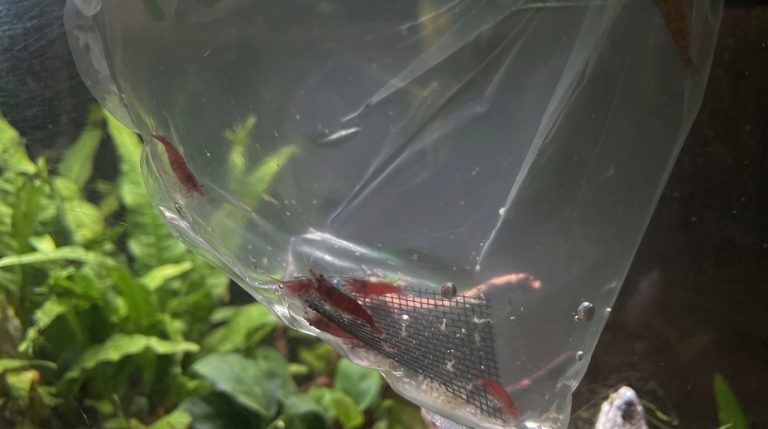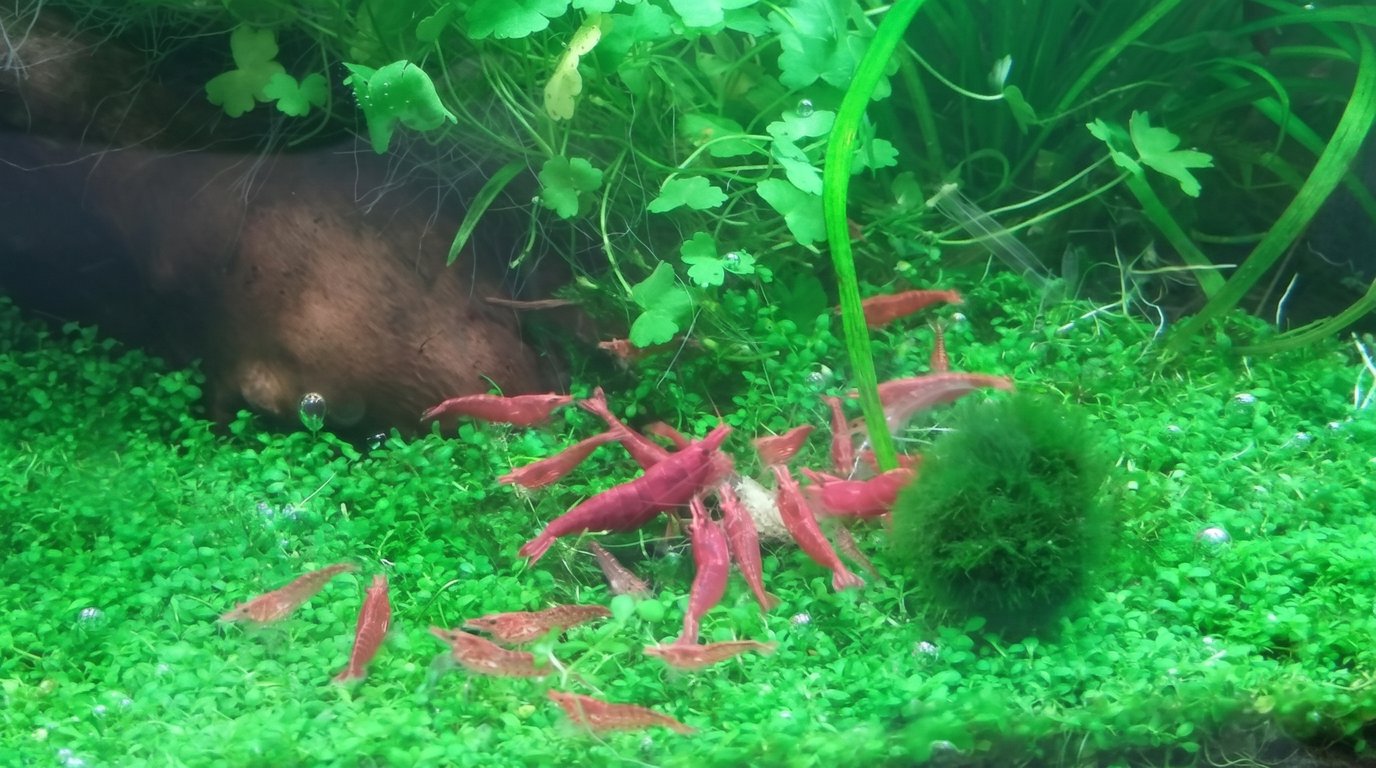
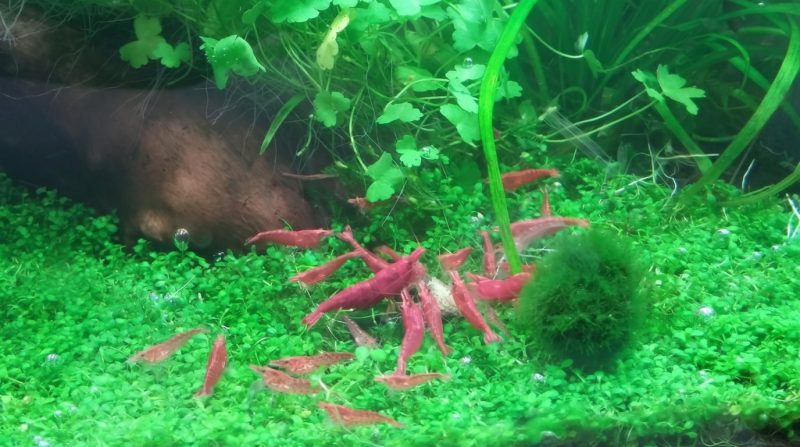
Neocaridina shrimp, the cherry shrimp (Neocaridina davidi) and its color lines, are omnivorous grazers that eat the biofilm and algae on every surface of the tank, decaying plant matter and tiny animals. In an aquarium they also take prepared shrimp food, softened vegetables and leaves. The US Geological Survey’s database of species living outside their native range files them as opportunistic omnivores of detritus, algae and tiny animals.1 In an outdoor tank experiment, Neocaridina cut the film of algae and microbes on a submerged plant’s leaves by about 46 percent, and the plants grew faster with them in the tank. The authors put the drop down to the shrimp eating that film.2
Color doesn’t change the menu, so whichever line of our tank-bred Neocaridina shrimp you’re stocking, the feeding routine below is the same.
Once the basics of Neocaridina shrimp care are in place, with a cycled tank and plenty of surface to graze, the shrimp do much of their own feeding.
Can cherry shrimp live on the algae and biofilm in their tank?
A small group of cherry shrimp in an established, planted tank can get much of its food from the tank itself, and a few keepers almost never feed at all. A new tank or a growing colony needs food added.
Biofilm is the thin, slippery layer of algae, bacteria and other microbes on the glass, wood, stones, plants, moss and filter sponge. Watch a cherry shrimp for a minute and you’ll see it picking at that film. It also works over fallen and rotting leaves, scraps of plant and whatever the last feeding left behind.
How far can that film go? In an aquaculture system built to grow it, cherry shrimp with no other food still reached breeding condition and the females incubated eggs.3 That was a culture setup designed around biofilm, not a home tank, so it shows what the film is worth without telling you to stop feeding.
Fallen leaves feed shrimp too. In a lab trial with Caridina cantonensis, a related stream shrimp from Hong Kong, leaves lost mass wherever the shrimp were. The shrimp also gained more weight when they shared the leaves with a snail and a caddisfly larva than when they had the leaves to themselves.4 That’s a different genus, so it tells you leaves are food for this kind of shrimp without testing a cherry shrimp itself.
Plants, moss, wood and rock all add surface for that film, so the grazing a colony gets starts with Neocaridina shrimp tank setup. A brand-new tank has had little time to grow any, which is why it needs feeding from the start.
Shrimplets graze the same surfaces, so a tank with plenty of moss and plants is where baby cherry shrimp care starts.
What’s the best food for cherry shrimp besides what they graze?
No single food is best. A sinking pellet or granule made for shrimp or small fish makes a sound staple on top of the grazing, and softened vegetables and leaves add variety.
Which prepared foods did cherry shrimp grow best on in trials?
In a 16-week trial of four aquarium feeds with the same protein level, red cherry shrimp grew best on a spirulina granule and least on a pond stick made for fish. More of them survived on the two granules than on the stick.5
That doesn’t crown spirulina. The winning granule also differed from the stick in form, and the water ran a few degrees warmer than the 72-77°F (22-25°C) target range. The shrimp were fed all they’d eat twice a day, with the leftovers siphoned out. That’s a lab routine, not a home schedule.
A second trial fed five commercial diets made for ornamental animals for 90 days. Survival stayed above 80 percent on all of them, and the authors judged every one adequate for growth.6 So a sinking food made for shrimp or small fish works as the staple, and in a home tank how much goes in matters more than which tub it comes from.
How should you prepare vegetables for cherry shrimp?
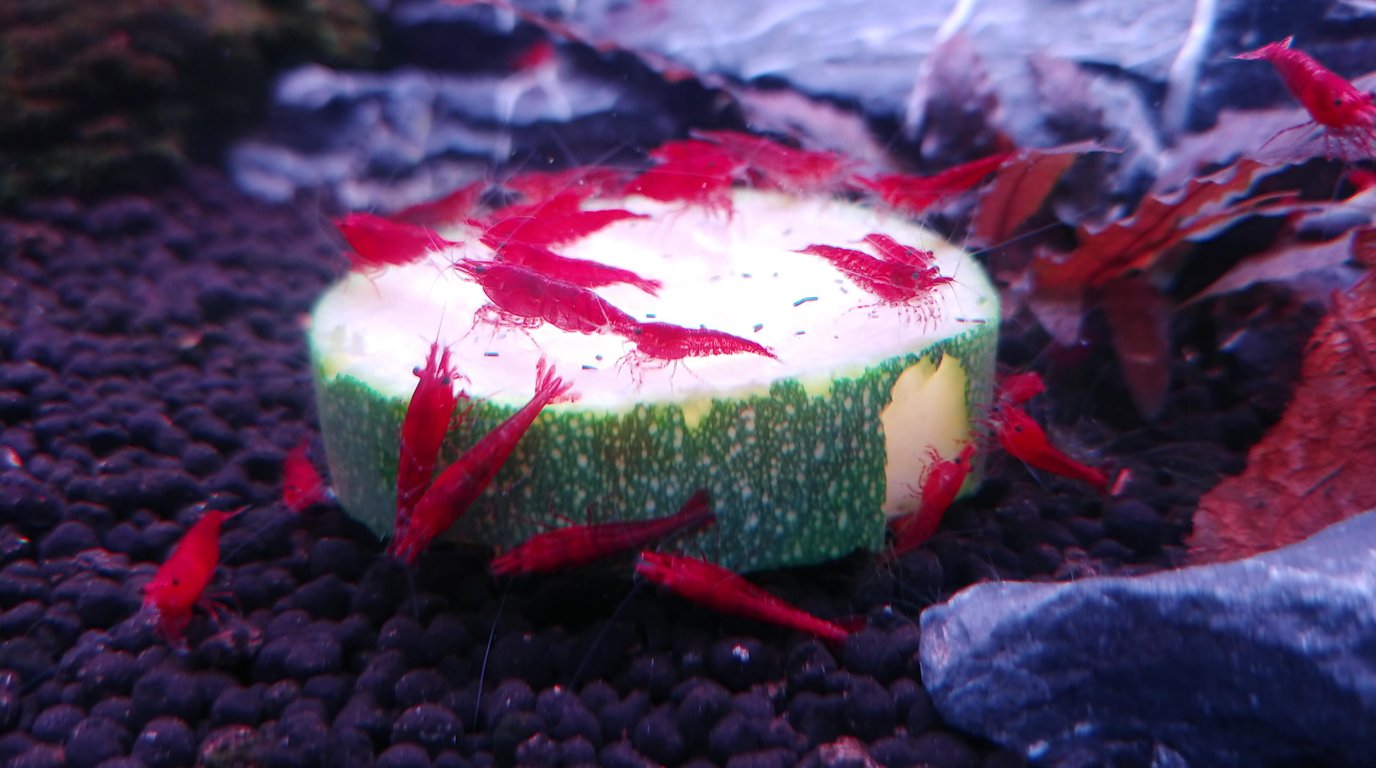
Wash vegetables, peel what you can, and soften them before they go in. Spinach and zucchini are the vegetables keepers name most, and kale, peas and cucumber get eaten too. Colonies differ, though, and some ignore one vegetable or another. Most keepers blanch, steam or microwave the pieces until soft. Some freeze and thaw them, and shrimp given raw pieces take longer to work through them.
Softening a vegetable doesn’t clean it. In food-safety studies on kale, long beans and spinach, washing and blanching removed some pesticide residues and left others largely in place, with very different results from one pesticide to the next.7 In the spinach study, a longer blanch even left two pesticides higher than washing alone had.8
That matters because shrimp can be sensitive to pesticides. In a lab test, Neocaridina placed in water carrying the insecticide imidacloprid slowed down sharply even at low concentrations.9 That was the chemical dissolved in their water, not residue on a vegetable, but it’s reason enough to buy produce you trust, organic if you can get it.
For extras, we recommend mulberry leaves, Indian almond leaves and root vegetables. A few notes on this page come from how Shrimp Aquatics feeds its own breeding tanks, and a home tank with fewer shrimp can need less. Shrimp Aquatics boils or blanches root vegetables before they go in, so soften yours the same way first.
How often should you feed cherry shrimp?
Most keepers feed cherry shrimp somewhere between about once a week and once a day, with about every other day in the middle. Keepers with older planted tanks feed less, and a few almost never feed at all.
No study gives a feeding amount or schedule for a home tank, so the schedule comes from keepers and from watching your own shrimp. As a starting point, feed a new tank or a large, growing colony more often, and a small group in a mature, planted tank less.
Shrimp Aquatics feeds its Neocaridina breeding tanks pellet food made for fish and shrimp once a day, every day, with no skipped days. Each feeding is small enough for the shrimp to finish within a few hours, so nothing is left to take out. That’s a routine for tanks full of breeding shrimp, not a minimum, and skipping days in your own tank isn’t wrong.
The part worth borrowing is the portion test. If the food is gone within a few hours, the amount is about right. If it’s still sitting there, give less next time.
Does the whole colony pile onto every pellet as if it hasn’t eaten in days? Don’t let that talk you into more. In most keepers’ tanks, cherry shrimp go for new food within minutes, even when the tank is fed every day or full of things to graze, so a crowd on a pellet doesn’t mean they’re starving.
What are the signs you’re overfeeding cherry shrimp?
Food still sitting there hours later, a sudden crop of planaria or hydra, or ammonia on a test can all mean the shrimp are getting more than they eat. Start by feeding less, and test the water.
| What you see | What it can mean | What to do |
|---|---|---|
| Food still there hours after feeding | More went in than the shrimp wanted | Take it out and give less next time |
| Planaria or hydra appear suddenly | Keepers have seen them follow daily or heavy feeding | Feed less, as the keepers who cleared them did |
| Ammonia above 0 on a test | Overfeeding is a major cause of high ammonia in fish tanks10 | Cut back or stop feeding, then test again |
Keepers take leftovers out anywhere from about an hour to about a day after feeding, so there’s no single right time. What matters is that uneaten food comes out rather than sitting for days.
Why does it matter? More food in means more waste in the water, eaten or not. A University of Florida extension guide written for fish calls overfeeding a major cause of high ammonia, and says the first step when ammonia shows up is to cut back or stop feeding.10 Tiny shrimp don’t make a tank hard to overfeed, because whatever they leave still breaks down in the same water.
A shrimp tank should read ammonia 0 and nitrite 0, within Neocaridina shrimp water parameters of 72-77°F (22-25°C), pH 6.8-7.6, GH 6-10 dGH and KH 2-5 dKH.
Several keepers report that daily or heavy feeding was followed by planaria, hydra or ammonia trouble that cleared once they cut back to every other day or less. Others feed every day with no trouble, so it’s a pattern to watch for, not a sure thing.
How long can cherry shrimp go without food?
In an established, planted tank, adult cherry shrimp have come through one to three weeks without being fed, with no losses their keepers noticed.
A lab study shows where the hard limit sits. Adults were kept alone in small containers with no food and nothing to graze, in water a little cooler than the target range. The authors put the point of no return, after which starved shrimp can no longer recover, at about 25 days. Shrimp starved for two or three weeks still recovered once they were fed again.11 That’s how long a lone shrimp lasts in a bare dish, not a safe gap to plan around.
Away for a week or two? A mature, planted tank sits inside what keepers’ tanks have handled unfed, so you don’t need a feeder or a sitter for the food alone. Don’t feed extra before you leave, either. Anything the shrimp don’t finish sits in the water while you’re gone, which is the overfeeding problem all over again.
A new tank, or one crowded with shrimp, has less to graze for each shrimp. There a short trip is better covered by someone who drops in a very small portion.
Which algae and plants do cherry shrimp eat?
Cherry shrimp graze the soft film on algae and on plant leaves, but keepers report that they leave living black beard algae alone. On live plants, most keepers see them eat only leaves that are already dying or damaged.
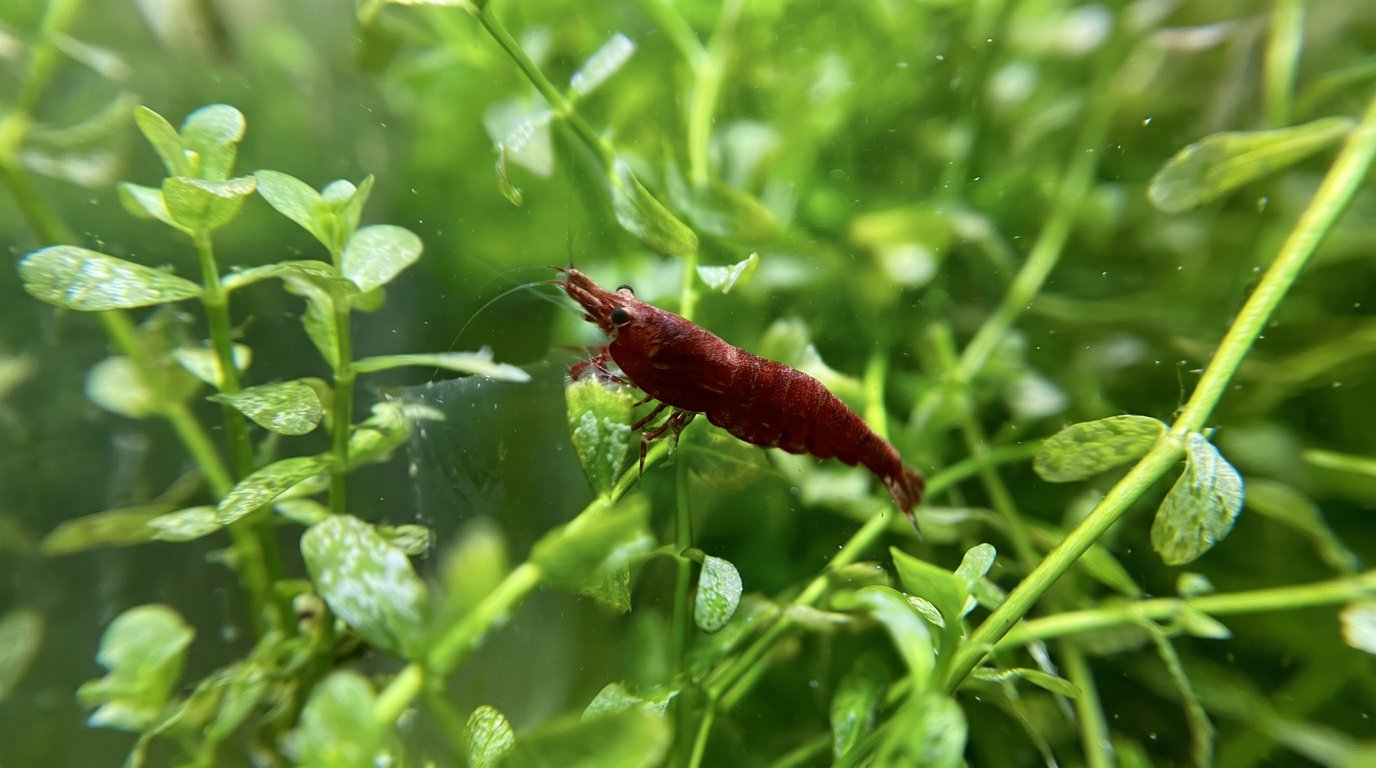
Hair algae is a toss-up. Keepers disagree on whether cherry shrimp eat it, so don’t stock them to clear it. Green spot algae stays put too, so whether Neocaridina shrimp eat algae in your tank comes down to which kind is growing there.
A few keepers have watched theirs strip leaves from hygrophila or mayaca that didn’t look sick, one of them after the shrimp went more than five days without food. In the outdoor experiment mentioned at the top, the plants grew faster with shrimp grazing their leaves.2
Does food change cherry shrimp color?
Diet can change how bright cherry shrimp look, but it isn’t the only thing that does. In the 90-day trial of five commercial diets, the shrimp on the diet richest in carotenoids carried the most carotenoid in their bodies and showed the brightest color.6
In another trial, red cherry shrimp fed astaxanthin, a red pigment, showed more color than shrimp fed without it. Shrimp kept over darker gravel also showed more color than those over white.12
Those were lab trials with set diets, so they show that food can matter, not that one tub will color up the shrimp in your tank. If color is what you’re after, a food with carotenoids is a reasonable pick, fed in the same small portions as any other.
References
12 Sources
- Neocaridina davidi (Bouvier, 1904), cherry shrimp: species profile, U.S. Geological Survey Nonindigenous Aquatic Species program, updated 2026.
- Omnivorous shrimp Neocaridina denticulata sinensis enhances the growth of submerged macrophyte Vallisneria denseserrulata, Ye et al., Knowledge and Management of Aquatic Ecosystems 420: 32, 2019 (the paper names the shrimp N. denticulata sinensis).
- Breeding and life cycle of the ornamental freshwater shrimp Neocaridina davidi in a biofilm-based culture system (abstract), Viau et al., Aquaculture Research 51(9): 3847-3864, 2020.
- Biodiversity and ecosystem functioning in a species-poor guild: a test using tropical stream detritivores, Dudgeon and Gao, Hydrobiologia 652: 329-336, 2010.
- Effects of different aquarium feeds on growth performance and survival rate of red cherry shrimp (Neocaridina denticulata), Bingol, Turkmen and Karadal, Ege Journal of Fisheries and Aquatic Sciences 33(3): 217-222, 2016.
- Effect of diets on carotenoid content, body coloration, biochemical composition and spermatophore quality in the “red cherry” shrimp Neocaridina davidi (Caridea, Atyidae) (abstract), Tomas et al., Aquaculture Nutrition 26(4): 1198-1210, 2020.
- Boiling, Blanching, and Stir-Frying Markedly Reduce Pesticide Residues in Vegetables, Phopin et al., Foods 11(10): 1463, 2022.
- The Effect of Washing, Blanching and Frozen Storage on Pesticide Residue in Spinach, Flamminii et al., Foods 12(14): 2806, 2023.
- Exploiting the Freshwater Shrimp Neocaridina denticulata as Aquatic Invertebrate Model to Evaluate Nontargeted Pesticide Induced Toxicity by Investigating Physiologic and Biochemical Parameters, Siregar et al., Antioxidants 10(3): 391, 2021.
- Ammonia in Aquatic Systems (FA031), Francis-Floyd, Watson, Petty and Pouder, UF/IFAS Extension (EDIS), 2022.
- The effect of starvation and re-feeding on mitochondrial potential in the midgut of Neocaridina davidi (Crustacea, Malacostraca), Wlodarczyk et al., PLOS ONE 12(3): e0173563, 2017.
- Effect of Dietary Astaxanthin and Background Color on Pigmentation and Growth of Red Cherry Shrimp, Neocaridina heteropoda, Laohavisuti and Ruangdej, Journal of Fisheries and Environment 38(1): 1-7, 2014.
Ready to get started?
Shop our Neocaridina Shrimp collection
15 products available · Live Arrival Guarantee