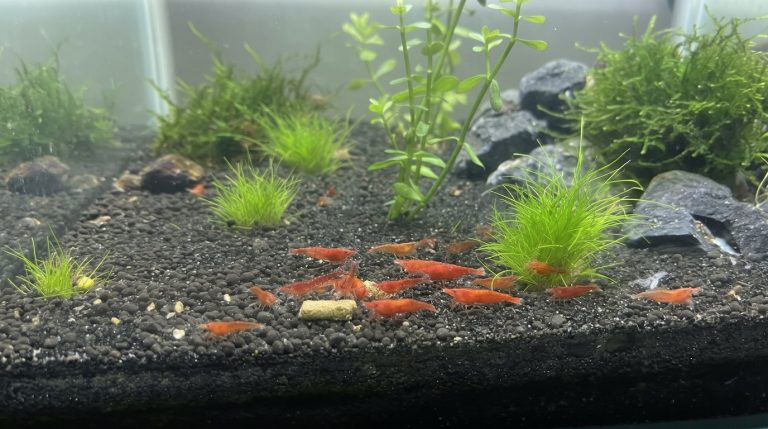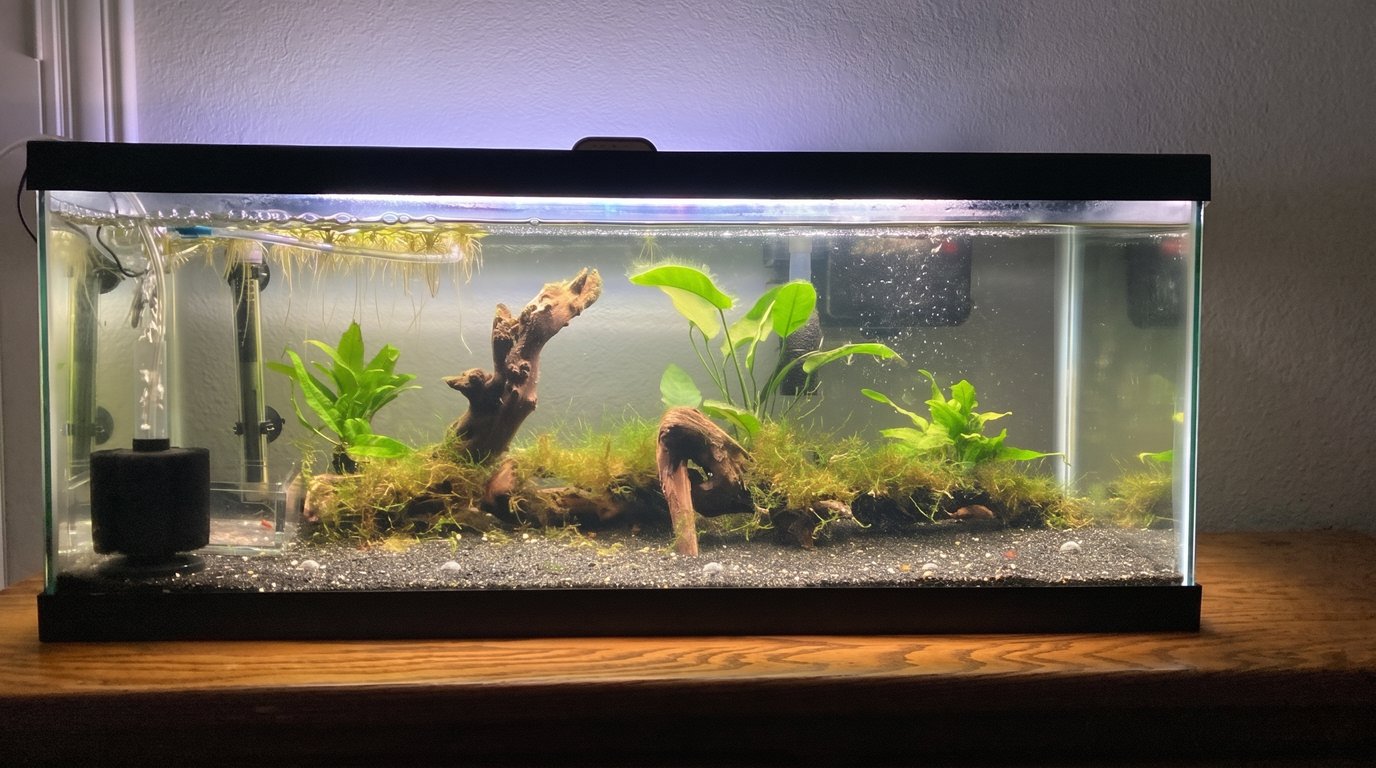
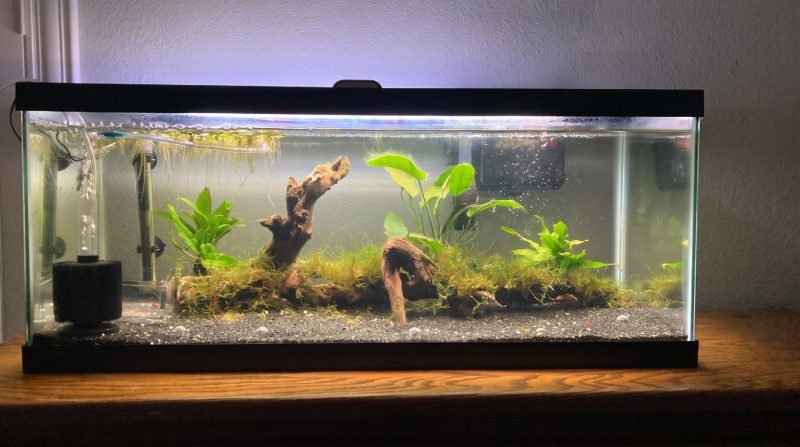
To set up a Neocaridina shrimp tank, fit the tank, lid, filter, substrate and plants, fill it with dechlorinated water and cycle it. Add the shrimp only once your test kit reads ammonia 0 and nitrite 0. Putting the tank together is quick. The cycle is the slow part, and it’s the one step cherry shrimp (Neocaridina davidi) can’t do without.
Build and cycle the tank first, and time your order of our tank-bred Neocaridina shrimp for when the water tests ready, not before. Here’s the whole job in order:
- Set up the tank with a lid that closes without gaps.
- Fit the filter, with a guard over any intake.
- Add the substrate.
- Place rock or wood, then the plants.
- Fill with dechlorinated water and test pH, GH and KH.
- Cycle the tank with no animals in it.
- Test until ammonia and nitrite read 0 more than once.
- Add the shrimp.
Setup is the part of Neocaridina shrimp care where patience pays off most, because a problem is far easier to fix before there are shrimp in the water.
What do you need to set up a cherry shrimp tank?
You need a tank of about 5 gal (19 L) or larger, a lid, a filter, substrate, plants with a light, a test kit and a water conditioner. Add a heater only if your room runs cool.
| Item | What to look for | Why it matters |
|---|---|---|
| Tank | About 5 gal (19 L) or larger | Steady water counts for more than the exact size |
| Lid | Closes with no gaps around cords and tubing | Cherry shrimp can climb out and dry up on the floor |
| Filter | A sponge filter, or any filter with a guard over the intake | Newly hatched shrimp are small enough to be pulled into an open intake |
| Substrate | One that keeps pH steady, or a soil made for planted tanks | Some soils change pH and KH, so you test after it goes in |
| Plants and moss | Java fern, Anubias, Java moss, many Cryptocoryne, Vallisneria | Surface to graze and places to hide |
| Light | Suited to the plants you choose | Plants need it to grow |
| Test kit | Reads ammonia, nitrite, pH, GH and KH | Tells you when the cycle is done and whether the water fits |
| Water conditioner | Label says it removes chloramine as well as chlorine | Chloramine can take weeks to clear from water left to stand |
| Heater | Only if the tank won’t hold 72-77°F (22-25°C) on its own | A thermometer in the water tells you |
About 5 gal (19 L) holds a small breeding colony, and you’ll get more from a tank that stays steady than from a few extra gallons. A starting group breeds and fills out over the months that follow, so the count of cherry shrimp per gallon in the tank keeps rising long after the first shrimp go in.
Don’t skip the lid. Cherry shrimp have turned up dried out on the floor beside tanks left open or with a gap in the cover, and some climb up a hang-on-back filter’s return. The keepers who lost shrimp this way closed the gap or kept the water a little below the rim.
Put a thermometer in the water for a few days before you buy a heater. If the Neocaridina shrimp temperature holds at 72-77°F (22-25°C) without help, you may not need one.
Pick a filter that won’t pull in Neocaridina shrimplets
Our advice is a sponge filter: it gives the tank plenty of oxygen and doesn’t push a strong current through it. A hang-on-back or canister filter can work too, with a guard or sponge over the intake. That can cut the number of shrimplets it takes in. Whether a filter suits the tank still depends on its flow and how much waste it handles.
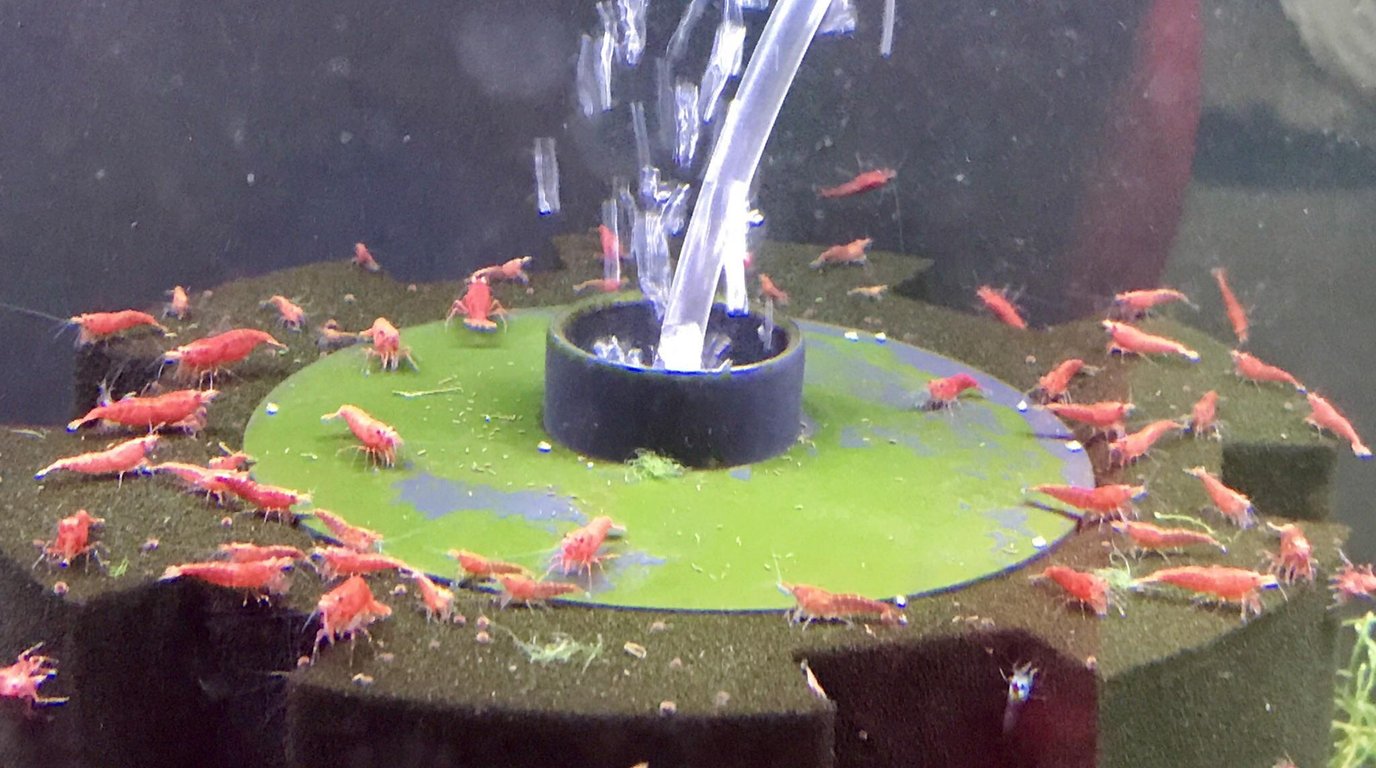
Why does the intake matter? Because of the babies. A newly hatched cherry shrimp has a carapace only about 0.8 mm long in a laboratory culture,1 small enough to be pulled through an open intake. Keepers who breed them find shrimp living inside canister and hang-on-back filters, babies included, and some find babies behind a prefilter sponge. So check the media for shrimp each time you clean it, and tip any you find back into the tank.
Do cherry shrimp need active soil, or will plain sand do?
Our advice for the bottom of a cherry shrimp tank is a substrate that holds pH steady, or a soil made for planted tanks. Keepers also report cherry shrimp colonies breeding freely on plain sand or small gravel.
If you pick a soil, know what it does to the water. One soil maker’s manual says its soil makes the water acidic, lowering both pH and KH, and tells you not to rinse it before use.2 The same maker says its original soil may do little to pH in hard, high-KH tap water, and that ammonia is generally present right after setup.3 That early ammonia is one more reason the cycle comes first.
Whatever goes in, test pH, GH and KH once the tank is filled and again before the shrimp go in.
Plant a cherry shrimp tank without bringing in pesticides
Plant a cherry shrimp tank with easy species and clean every plant before it goes in. Neocaridina get on well with live plants and moss, so a planted tank suits them. Java fern, Anubias, Java moss, many Cryptocoryne and Vallisneria are easy picks, though needs vary with the species and your water. Anubias and Java fern grow from a rhizome that has to stay above the substrate, so tie them to rock or wood instead of burying them.
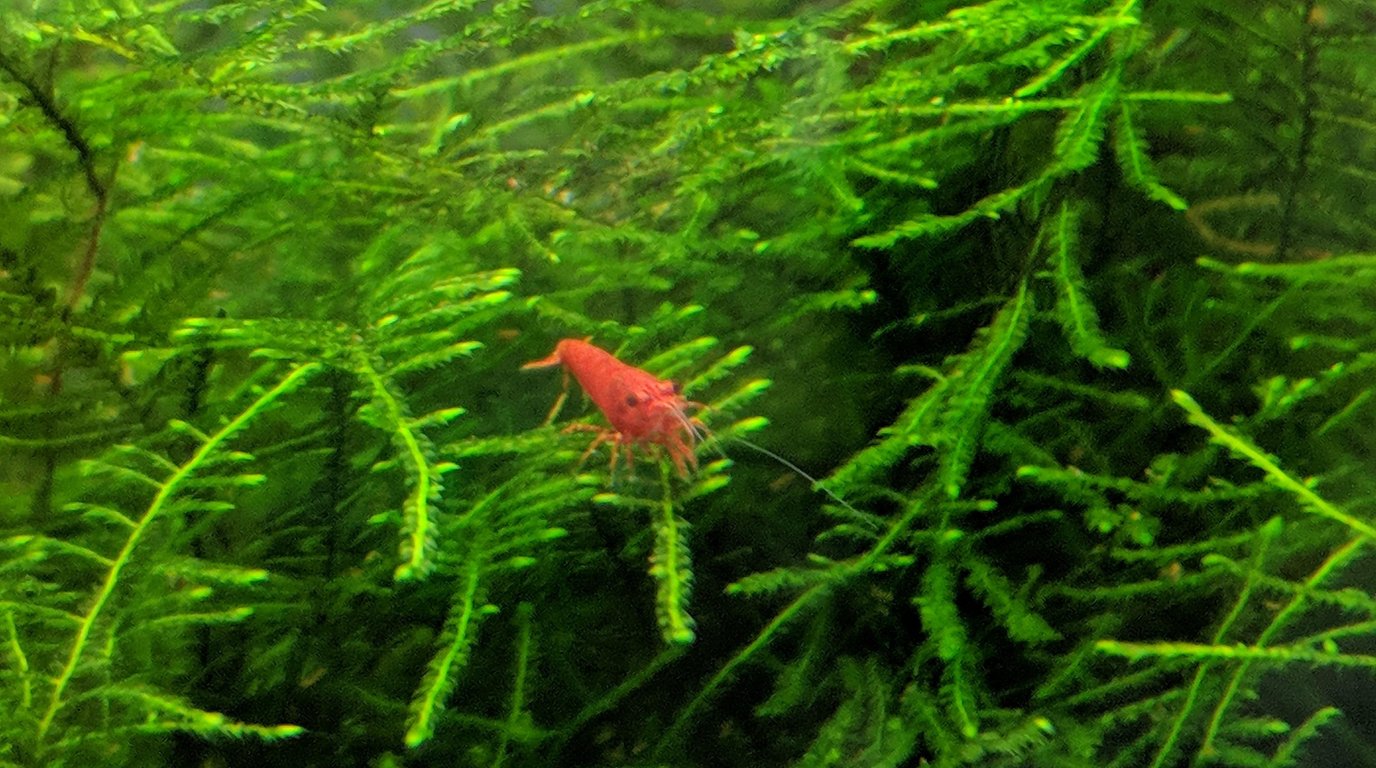
Plants, wood and rock also grow biofilm, the thin film of algae and microbes that shrimp graze. In an aquaculture study, cherry shrimp given nothing but biofilm grew, matured and carried eggs.4 You’ll still feed them, but every extra surface is more to graze.
New plants are the risky part. Whole groups of shrimp have died within an hour to a day of new plants going in, while the fish and snails in the same tanks were fine. Going by the timing, the keepers blamed a chemical on the plants. An insecticide can harm these shrimp at low levels: in a lab exposure, imidacloprid, a neonicotinoid, impaired Neocaridina shrimp at every concentration tested, the lowest 0.03125 ppm.5 That test put the chemical in the water, so it doesn’t tell you how much stays on a plant.
So rinse each new plant well. If you don’t know who grew a plant or how, park it in a tub of its own for a while before it joins the shrimp.
Fill the tank with dechlorinated water that suits Neocaridina
Fill a Neocaridina tank with water that’s free of chlorine and chloramine, then test it against the range the shrimp will live in. If your supply uses chloramine, standing the water for a few days won’t clear it the way it clears chlorine, because chloramine can take weeks to go.6 Treat it with a conditioner whose label says it removes chloramine.
The filter bacteria need that step too. In a lab test on a pure culture of ammonia-oxidizing bacteria, both chlorine and chloramine stopped the bacteria working at once, and they hadn’t recovered twelve days later.7 An aquaculture guide to starting a biofilter puts it in practical terms: begin with water free of chlorine.8
Can you use tap water? Yes, once it tests inside the range and has been dechlorinated, but no tap water is fine everywhere without that test. Easy as Neocaridina are, our advice is RO water with minerals added back. Tap water varies from one area to the next, and RO makes the numbers easier to hold.
Test against the target Neocaridina shrimp water parameters: 72-77°F (22-25°C), pH 6.8-7.6, GH 6-10 dGH and KH 2-5 dKH. Ammonia and nitrite read 0 once the cycle is done. Read those as a guide, not a pass-fail test. These are easy shrimp, and a tank that sits a little outside one of them can still work, as long as it isn’t far off. Ammonia and nitrite get no such leeway.
Keep copper out from day one. High levels can be deadly to invertebrates, and one supplement maker traces copper’s bad name to copper-based medications and old copper plumbing.9 Check the ingredients of anything you add.
How to cycle a cherry shrimp tank without fish
Cycle a cherry shrimp tank by feeding it ammonia with no animals inside and testing until ammonia and nitrite have each risen, fallen and settled at 0. Cycling grows the bacteria that turn ammonia into nitrite and then into nitrate, and they live on the filter media and every wet surface in the tank.8 Ammonia and nitrite are toxic to aquatic animals.8 In a laboratory test both damaged the gills of young cherry shrimp,10 so the shrimp wait until the job is done.
A fishless cycle is the gentler route. Starting a tank with live animals in it makes them sit through the ammonia and nitrite while the bacteria grow.8 Here’s the order:
- Run the filter in the filled, dechlorinated tank, with no shrimp, fish or snails in it.
- Add an ammonia source and follow the directions on the product. Don’t guess a dose.
- Seed the filter if you can. Media or a sponge from an established, healthy tank is the most effective way to bring the bacteria in.8
- Test ammonia and nitrite regularly, at the same time of day.8
- Watch the order of events: ammonia climbs and then falls, and after a lag nitrite climbs, peaks and falls until it levels off.8
How long will it take? In a study of three new home aquariums, ammonia and nitrite dropped to undetectable levels by week 3 in two of them and by week 8 in the third.11 Those tanks had fish from the start and no ammonia was added, so read the weeks as the spread you might see, not a schedule. The same study notes that seeding can speed things up.11 Keepers have waited anything from a couple of days to three months before their first cherry shrimp. The ones who say how they decided went by ammonia and nitrite readings. There’s no set number of weeks for a cycle, so the test kit decides when yours is done.
When is a Neocaridina tank ready for shrimp?
A Neocaridina tank is ready when ammonia and nitrite both read 0 on more than one test after the nitrite peak, and the rest of the water sits in range. Check every line before the shrimp go in:
- Nitrite has climbed, fallen and leveled off.8
- Ammonia reads 0 and nitrite reads 0, and both stay there on more than one test.
- The temperature holds steady inside 72-77°F (22-25°C).
- pH, GH and KH read inside the range on a fresh test, now that the substrate has had time to work.
- The lid closes without gaps and the filter intake is covered.
How long the tank has been running isn’t on the list. Two clean readings in a row say more than any date.
How to add the first cherry shrimp to a new tank
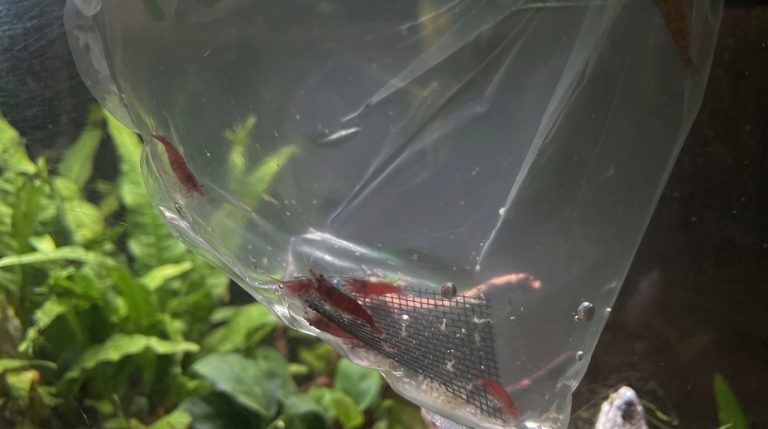
When the first cherry shrimp arrive by courier, follow the instructions that come with the order, and keep the transport water out of the tank. Start with a group, not one or two shrimp: about 10 is a typical start for a colony that goes on to breed.
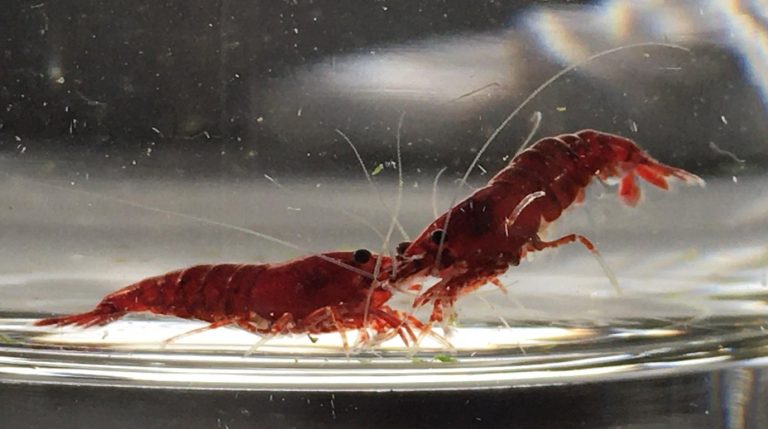
Expect a cherry shrimp molt or two in the first days. New shrimp often shed within 2 to 5 days of going into a new tank, so check whether a shell is empty before you count a loss.
For the first day or two, watch more than you do. Count heads, look for shrimp picking at surfaces, and leave the water alone unless a test tells you otherwise. Some hiding and paler color for a few days are common after you acclimate Neocaridina shrimp to a new tank, whether you floated and netted them or dripped.
Keep a new Neocaridina tank steady through the first weeks
Keep a new Neocaridina tank steady by making small, gradual changes and testing now and then. Once the shrimp are in, our advice is a 10% water change every two weeks, and skipping one does no harm as long as the water values hold steady. Make any adjustment slowly, over days, not in one go.
The shrimp graze the biofilm and algae on every surface of the new tank, and a little prepared food tops that up. If the colony outgrows the tank one day, keep shrimp, plants and tank water out of ponds and streams. Aquarium releases are the main way this species reaches the wild.12
References
12 Sources
- Post-hatching development of the ornamental Red Cherry Shrimp Neocaridina davidi (Bouvier, 1904) (Crustacea, Caridea, Atyidae) under laboratorial conditions, Pantaleao et al., Aquaculture Research 48(2): 553-569, 2017.
- Aqua Soil Amazonia Pro instruction sheet, Aqua Design Amano (manufacturer’s manual), undated.
- Aqua Soil Amazonia, Initial Stage Maintenance, Aqua Design Amano (manufacturer’s news page), undated.
- Breeding and life cycle of the ornamental freshwater shrimp Neocaridina davidi in a biofilm-based culture system (abstract), Viau et al., Aquaculture Research 51(9): 3847-3864, 2020.
- Exploiting the Freshwater Shrimp Neocaridina denticulata as Aquatic Invertebrate Model to Evaluate Nontargeted Pesticide Induced Toxicity by Investigating Physiologic and Biochemical Parameters, Siregar et al., Antioxidants, 2021.
- Monochloramine Information for Pet Stores and Fish Aquarium Owners, Tampa Bay Water, undated.
- The Effect of Chlorine and Chloramines on the Viability and Activity of Nitrifying Bacteria, Zaklikowski, MS thesis, Virginia Tech, 2006.
- How to Start a Biofilter (SRAC Publication No. 4502), DeLong and Losordo, Southern Regional Aquaculture Center, 2012.
- FAQ: Can I use Seachem Flourish in a tank where I’m keeping ______?, Seachem Laboratories (manufacturer support article), undated.
- Efeito de compostos nitrogenados no camarao Neocaridina davidi e na ra Aquarana catesbeiana (doctoral thesis), Melo, Universidade Federal de Minas Gerais, 2023.
- Microbial community succession of home aquarium biofilters associated with early establishment of comammox Nitrospira, McKnight et al., ISME Communications, 2025.
- Neocaridina davidi (Bouvier, 1904), cherry shrimp: species profile, U.S. Geological Survey Nonindigenous Aquatic Species program, updated 2026.
Ready to get started?
Shop our Neocaridina Shrimp collection
15 products available · Live Arrival Guarantee