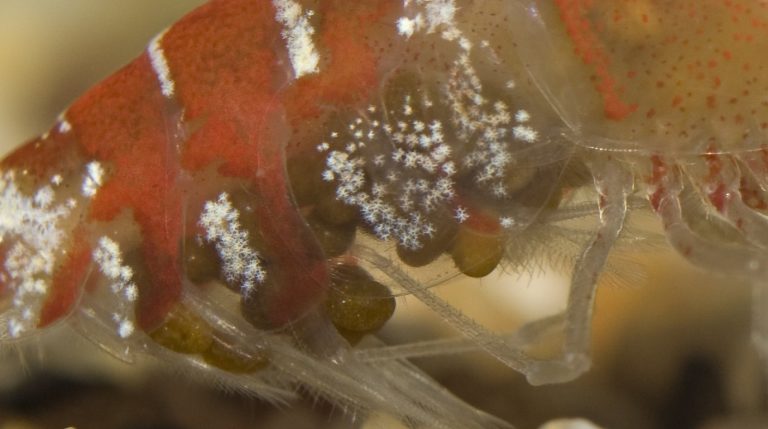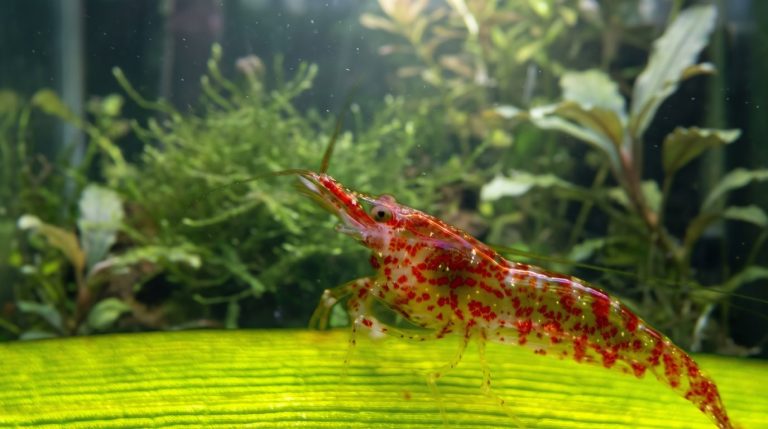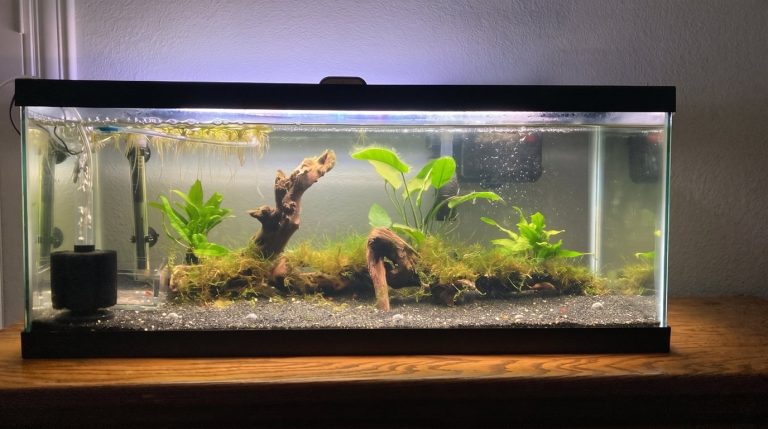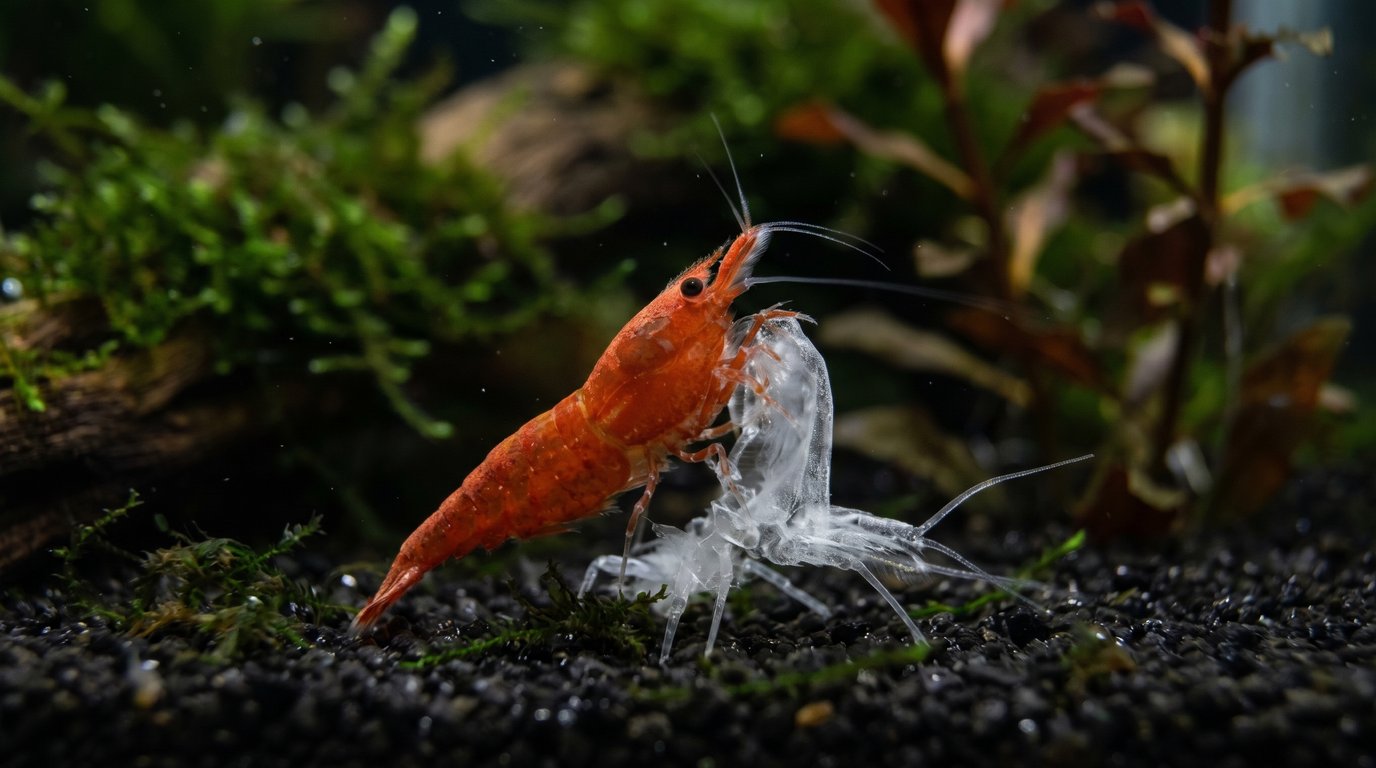
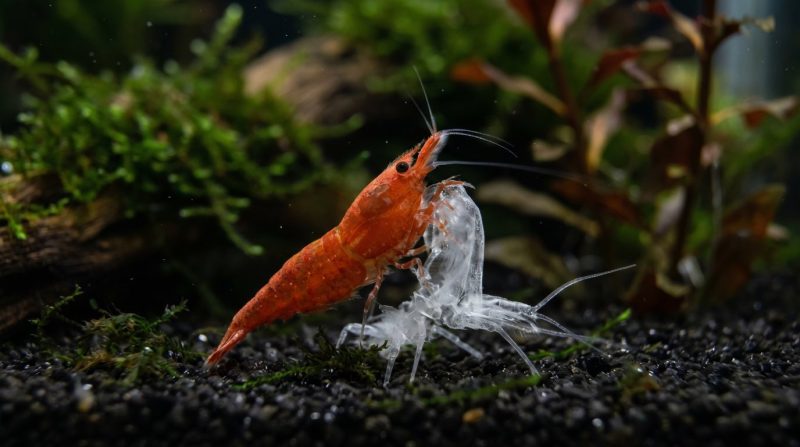
Cherry shrimp molt every few days while they’re young and less often as they grow. In one lab culture at 77°F (25°C), newly hatched cherry shrimp molted after about a day, then every 2 to 3 days for their first two weeks. By five to seven weeks old, the gap had stretched to about 5 to 6 days.1 Adult males in another lab, kept at 73°F (23°C), molted about every 10 days, a figure that comes from a conference abstract.2 Females keep their own schedule, because their molts follow breeding. Each molt leaves the old shell lying in the tank, so a clear, shrimp-shaped husk in the moss is an ordinary part of Neocaridina shrimp care, and it doesn’t mean you’ve lost a shrimp.
How often do Neocaridina shrimp molt from hatching to adult?
Neocaridina shrimp molt most often in their first days and weeks, and the gap between molts grows through their first weeks. The clearest numbers come from a lab that followed newly hatched cherry shrimp (Neocaridina davidi) one molt at a time at 77°F (25°C).1
| Age | Time between molts |
|---|---|
| Hatching to first molt | About 1 day |
| First two weeks | About 2 to 3 days |
| Weeks 3 and 4 | About 3 to 4 days |
| Weeks 5 to 7 | About 5 to 6 days |
Other labs saw the same fast start. In a lab kept a few degrees warmer than the typical 72-77°F (22-25°C) tank range, young cherry shrimp housed one to a container made their first molt about a day after hatching, then molted about 7 times in 20 days.3 In a third lab, at 73-77°F (23-25°C), most hatchlings made their first molt 40 to 50 hours after hatching.4 So even that first step differs by up to about a day from one culture to the next. A closely related Neocaridina went through 14 molts between hatching and fully formed swimming legs at 77°F (25°C), going by the study’s abstract.5
Why does the gap get longer? A shrimp only gets bigger by shedding its shell. As it grows, it puts on size more slowly, so it needs a new shell less often. That’s how a shrimplet reaches full cherry shrimp size, a little more with every molt.
For adults, the one measured figure is about every 10 days, from adult males kept at 73°F (23°C) in a lab and published as a conference abstract.2 You’ll often read that adult cherry shrimp molt every 3 to 4 weeks. That’s the figure many care sheets repeat, and it’s more than twice the 10 days timed in those males.
Each of these figures comes from one lab at one temperature. None of them can tell you how much faster or slower your own shrimp will molt in a warmer or cooler tank. Use them as a sense of scale: a few days for babies, about 10 days for adult males.
Is it normal to find molts after new Neocaridina shrimp arrive? Keepers report that cherry shrimp often molt within about 2 to 5 days of going into a new tank. A few empty shells in the first days aren’t a worry on their own, so count heads before you assume the worst.
Why do female cherry shrimp molt on a different schedule?
A female cherry shrimp’s molts follow her breeding cycle. In the 77°F (25°C) lab culture, young females stopped molting while their ovaries developed, and when the ovaries were ripe they molted once more and then mated.1
So a female getting ready to breed can go a while without molting. The molt that ends that wait is the one right before mating. That pre-mating molt opens Neocaridina shrimp breeding: she mates right after it.
What happens during a cherry shrimp molt?
A cherry shrimp grows by shedding its exoskeleton, the hard outer shell, and coming out in a new one.6 Researchers studying a closely related Neocaridina split the cycle into four stages: postmolt just after the shed, intermolt between molts, premolt while the next shell gets ready, and the molt itself.5 In the adult males timed at 73°F (23°C), a 10-day cycle split into about 4 days of premolt, about 1 day of postmolt and about 5 days of intermolt.2
How long does the molt itself take? In newly hatched cherry shrimp filmed under a microscope, the tail took its new shape within a few minutes of the first molt.4 That’s a hatchling, not an adult. Read it as a hint that the shedding is quick, and that premolt and intermolt take up nearly all of the cycle.
Can you tell when a cherry shrimp is about to molt? Not easily. In the lab, premolt was tracked by imaging the tail fan every day under magnification.2 The one molt the studies tie to something you can predict is a female’s molt before mating, once her ovaries are ripe.
A shrimp that has just molted is soft, which is reason enough for it to keep out of the way for a while. The new shell is hardened with calcium. Crustaceans that live in water get most of theirs through the gills, straight from the water around them, a pattern described across the group.7 GH, the hardness reading that includes calcium, is one of the Neocaridina shrimp water parameters worth holding steady for exactly that reason.
Is it a molt or a dead cherry shrimp?
A molt is an empty, see-through shell in the full shape of a cherry shrimp, and a dead shrimp still has its body inside. Look closely and a molt is hollow. Lift it with a net or a pipette and there’s nothing in it.
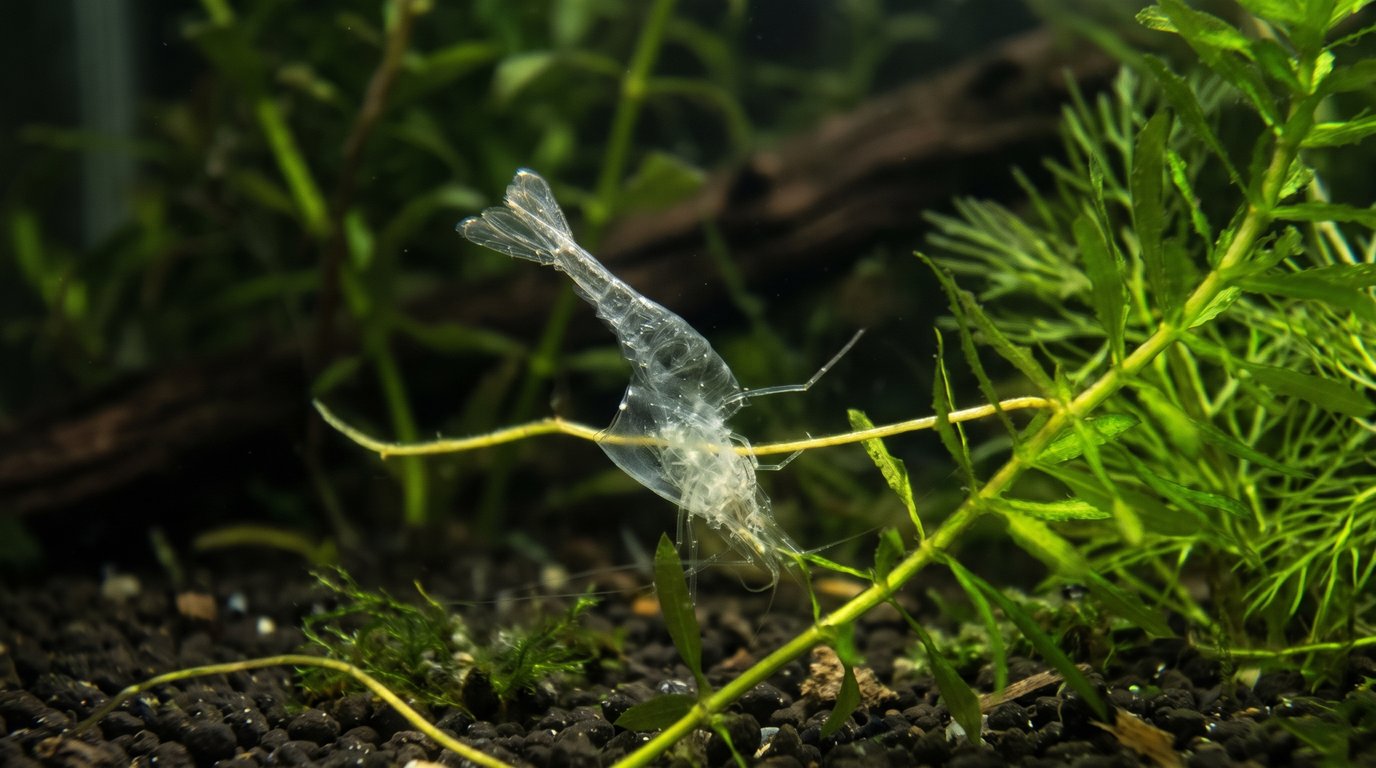
Then count heads. If you find a shell and every shrimp is still there, that shell was a molt. Count at feeding time, and count again the next day before you decide one is missing.
Are your cherry shrimp hiding or dead? If the count comes up short and you find no body, give it a day and count again. A shrimp that has just molted is soft and may stay out of sight. If you do find a body, take it out. If more than one shrimp dies in a short time, go straight to the water tests further down this page.
Should you remove cherry shrimp molts from the tank?
No, leave cherry shrimp molts in the tank. The University of Florida’s extension publication on cherry shrimp says the shrimp feed on their molted exoskeleton to take back valuable nutrients.6 Crayfish do something similar: they make up a calcium shortfall after the molt partly by eating the old shell.7
A shell doesn’t have to disappear overnight. If one is still lying there after several days and it bothers you, lifting it out is your call. There’s no need to net out every molt the moment you see it.
What does a failed molt look like in cherry shrimp?
A failed molt is a cherry shrimp that can’t get all the way out of its old shell. Keepers call the pale band between the head and the tail section of a shrimp in that state the “white ring”, or the “white ring of death” (WROD). Those are hobby names, not a diagnosis, and a pale band on its own doesn’t tell you what will happen to that shrimp.
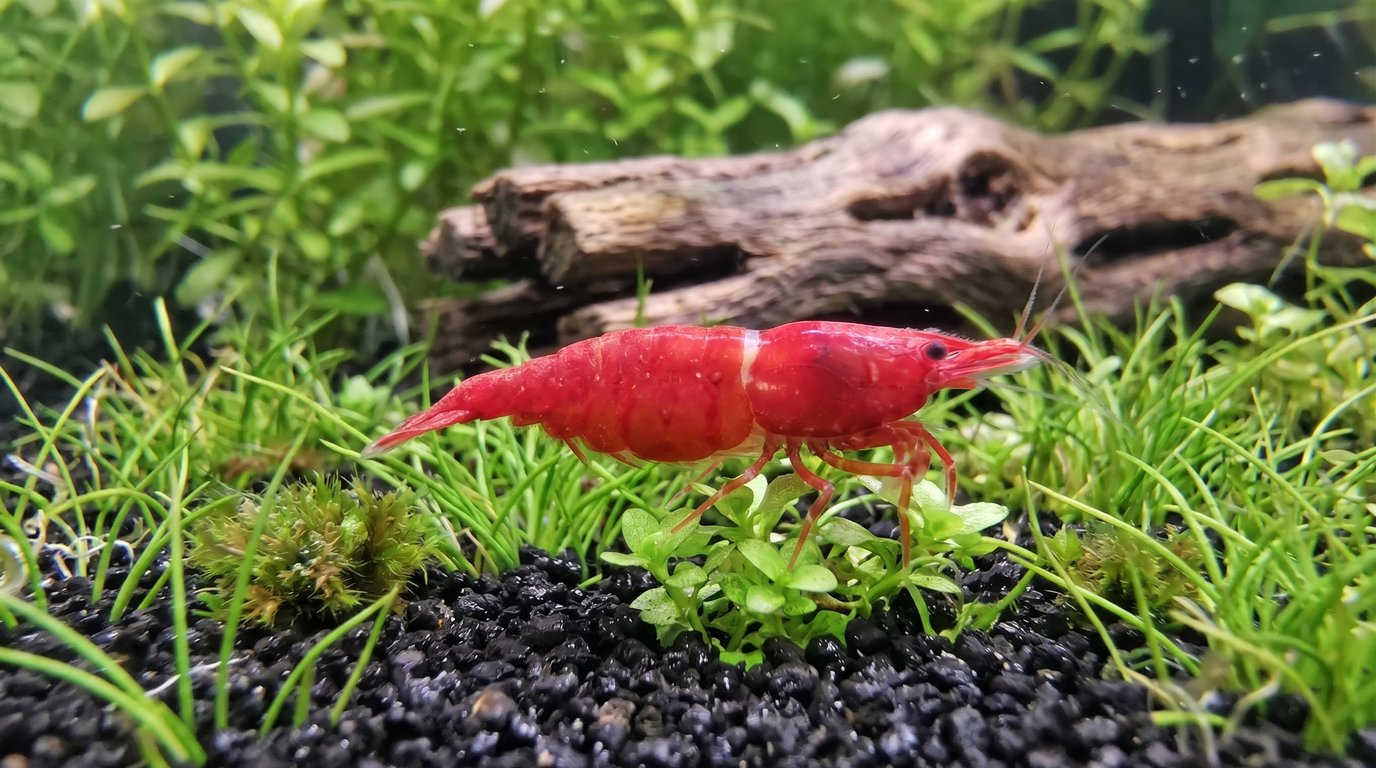
Can a cherry shrimp survive a failed molt? It may or may not, and nothing you can see from outside the glass tells you which.
Don’t try to pull the old shell off. The shrimp underneath is soft, and the most useful thing you can do now is check the water the rest of the colony lives in.
What to test after a cherry shrimp dies in its molt
Test the water before you change or add anything. A failed molt is a reason to look hard at the tank, and a test result tells you more than a guess.
- Ammonia and nitrite both read 0. Any reading above 0 is the first thing to fix.
- GH sits in 6-10 dGH and KH in 2-5 dKH.
- Temperature sits in 72-77°F (22-25°C).
- Any new water matches the tank in temperature and hardness before it goes in, and goes in gradually.
- Nothing containing copper has gone into the tank, including some fish medications.
Treat these numbers as a guide, not a pass-fail test. Neocaridina are easy shrimp, and a tank that sits a little outside one of them can still work, as long as it isn’t far off.
No study has tied GH, calcium or magnesium levels to failed molts in Neocaridina. So a test result is a better guide than a mineral product added on a hunch.
Copper earns its place on that list. Elevated copper is toxic in aquatic environments and can harm invertebrates.8 In a related shrimp from the same family, just-molted shrimp were more sensitive to copper than shrimp at other stages, but copper didn’t make them molt more often.9
Timing can hint at where to look. Some keepers report shrimp dying stuck in a molt within days of a water change or of a move to a new tank. Some had a white split behind the head. Those accounts show when the trouble turned up, not what caused it. The practical step is the one in the list: new water that matches the tank, added slowly.
Don’t read a steady run of molts as proof your shrimp are eating enough, either. In the lab study of newly hatched cherry shrimp kept one to a container, young kept without food molted about as often as fed ones for 20 days. Yet by day 20, 65 percent of the youngest starved group and every shrimp in the slightly older one had died, against none and 10 percent of the fed shrimp.3 So keep the colony fed even when you’re finding plenty of shells.
If the tests come back clean and shrimp keep dying, a local aquatic specialist or vet can look at what a home test kit can’t.
References
9 Sources
- Pantaleão, Gregati, da Costa, López Greco and Negreiros-Fransozo, Post-hatching development of the ornamental Red Cherry Shrimp Neocaridina davidi (Bouvier, 1904) (Crustacea, Caridea, Atyidae) under laboratorial conditions, Aquaculture Research 48(2): 553-569, 2017.
- Kelleher and Mykles, Characterization of the molt cycle of the cherry shrimp, Neocaridina davidi (meeting abstract), Society for Integrative and Comparative Biology.
- Pantaleão, Barros-Alves, Tropea, Alves, Negreiros-Fransozo and López-Greco, Nutritional vulnerability in early stages of the freshwater ornamental “red cherry shrimp” Neocaridina davidi (Bouvier, 1904) (Caridea: Atyidae), Journal of Crustacean Biology 35(5): 676-681, 2015 (repository copy, CONICET Digital).
- Adachi, Moritoki, Shindo and Arakawa, Post-embryonic tail development through molting of the freshwater shrimp Neocaridina denticulata, iScience 28(2): 111885, 2025.
- Wang, Cui and colleagues, Characterization of the moult cycle in Neocaridina denticulata sinensis Kemp, 1918: the moulting frequency, moulting stages, and haemolymph ecdysteroid levels (abstract), Crustaceana 95(4): 439-455, 2022.
- Suen and Gillett-Kaufman, Cherry Shrimp Neocaridina davidi (Bouvier 1904) (Crustacea: Decopoda: Atyidae), EENY-751, UF/IFAS Extension, University of Florida, 2020.
- Wheatly, Calcium Homeostasis in Crustacea: The Evolving Role of Branchial, Renal, Digestive and Hypodermal Epithelia, Journal of Experimental Zoology 283(7): 620-640, 1999.
- Supplementary Training Materials for Aquatic Life Criteria, Copper, Background, U.S. Environmental Protection Agency.
- Daly, Hart and Campbell, Copper toxicity to Paratya australiensis. IV. Relationship with ecdysis (abstract), Environmental Toxicology and Chemistry 11(6), 1992.
Ready to get started?
Shop our Neocaridina Shrimp collection
15 products available · Live Arrival Guarantee