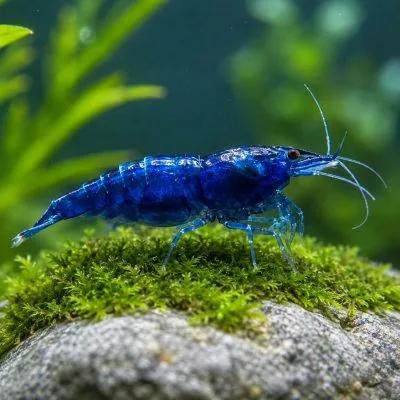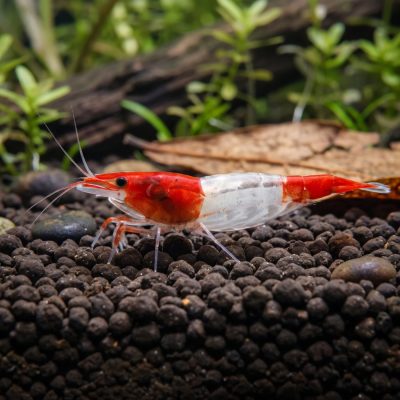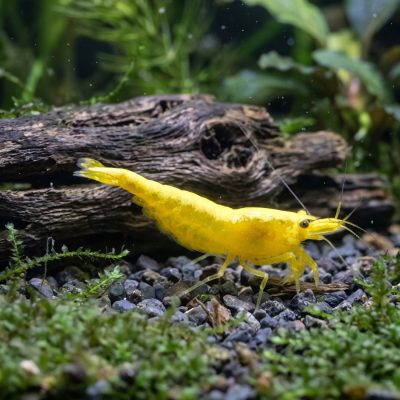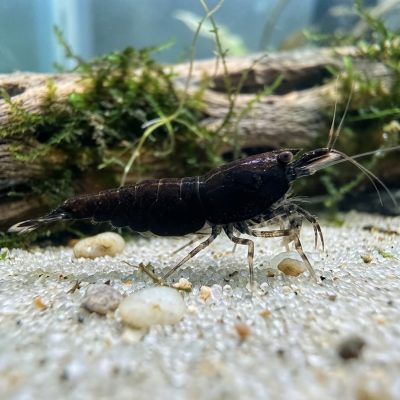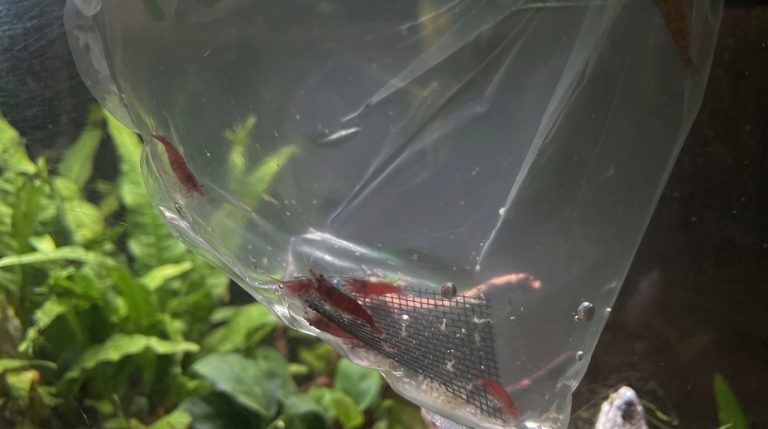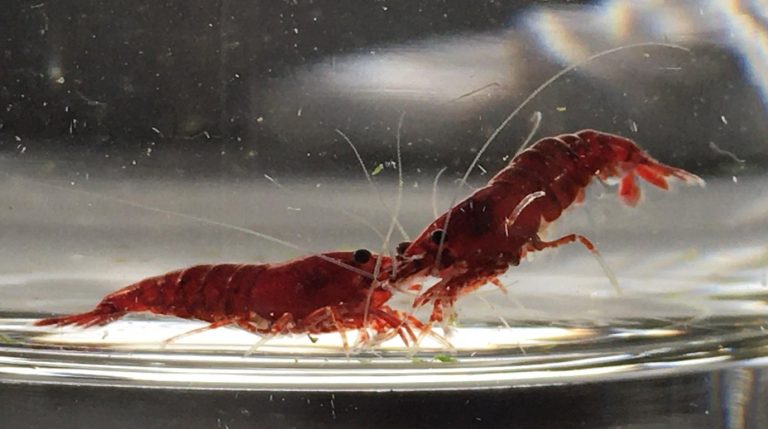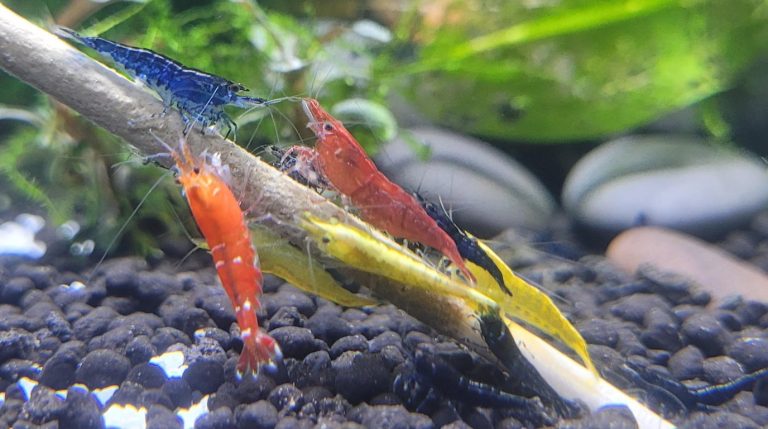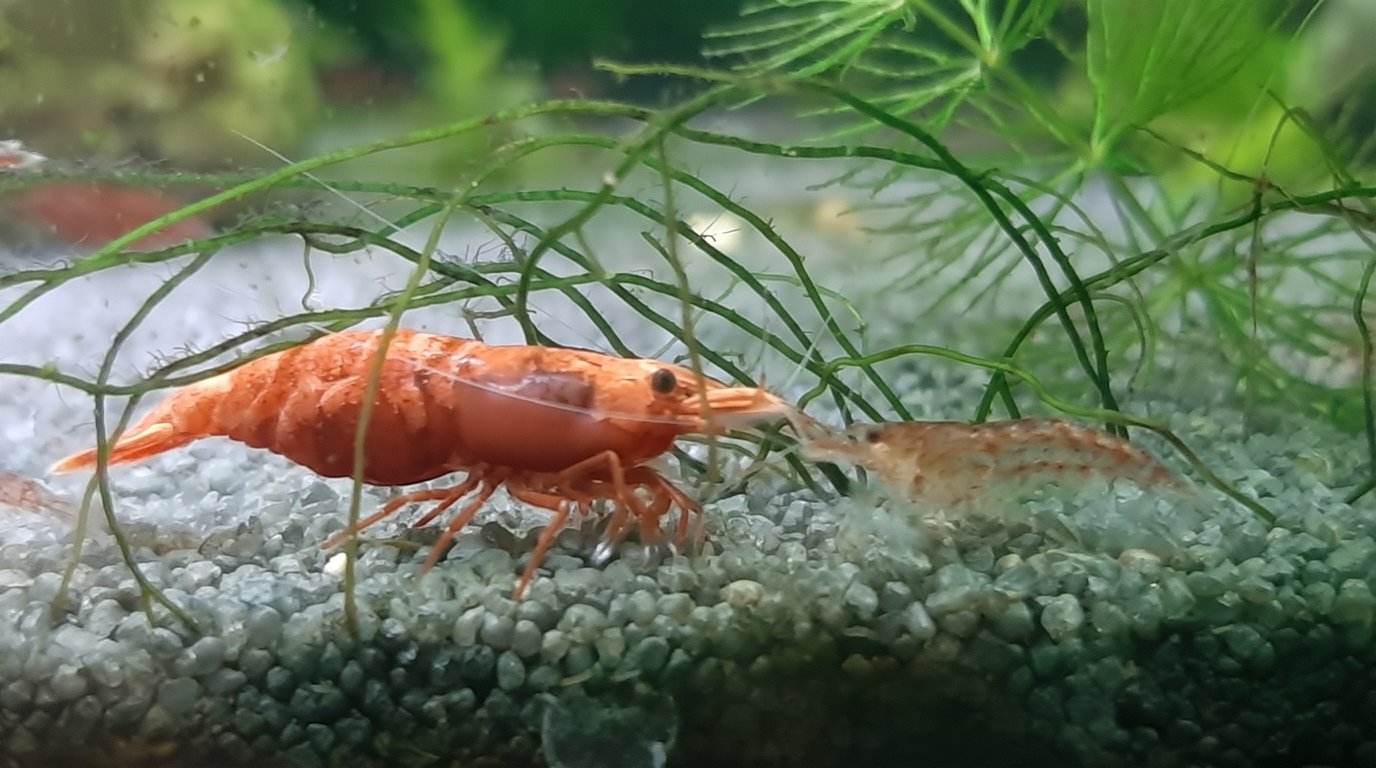
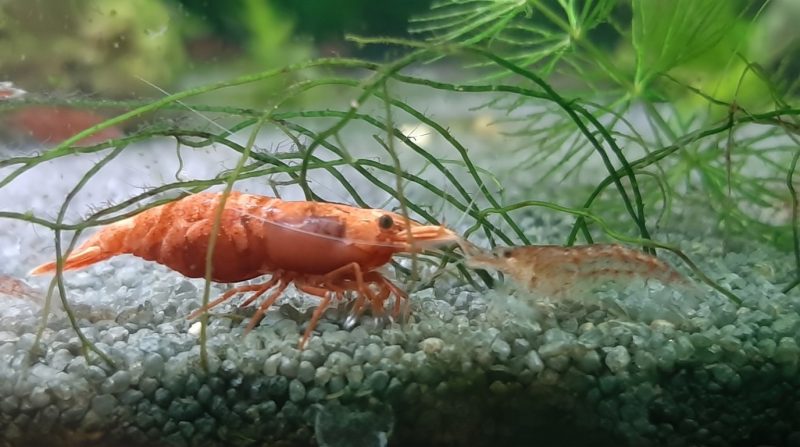
An adult cherry shrimp (Neocaridina davidi) is about an inch long (2.5 cm), and females end up a little bigger than males. The 1.6 inch (40 mm) figure you’ll see quoted is a top figure, not what a typical adult reaches. In lab cultures at 75°F (24°C) and above, young shrimp reached breeding size in roughly two months and kept growing more slowly after that. So a shrimp of about an inch is an ordinary adult.
How big is a full grown cherry shrimp?
A full grown cherry shrimp is about an inch (2.5 cm) long, and the biggest females run a little past that. The published figures behind that answer measure different things, so it’s worth knowing what each one is.
The 1.6 inch (40 mm) figure comes from a German field description of feral cherry shrimp. The same paper gives average sizes of about 1 inch (25 mm) for females and 0.8 inch (20 mm) for males.1 That paper doesn’t say how the shrimp were measured or how many the averages rest on. So 40 mm is a stated top figure, not a measured shrimp.1 The USGS species profile repeats it and names that paper as its source.2 It’s the same top figure our Neocaridina shrimp care guide gives.
Measured shrimp come out smaller. In a Japanese river study of 1,235 wild shrimp, the largest female was 1.2 inches (30.0 mm) long and the largest male about 1 inch (25.5 mm).3 A University of Florida extension publication gives 1.2-1.6 inches (3-4 cm) as the maximum adult length.4
| Figure | Size | What it is |
|---|---|---|
| German field description | Females about 1 inch (25 mm) and males about 0.8 inch (20 mm) on average; up to 1.6 inches (40 mm) | Averages and a top figure for feral shrimp, with no measuring method or sample size stated |
| Japanese river study | Largest female 1.2 inches (30.0 mm); largest male about 1 inch (25.5 mm) | The biggest of 1,235 wild shrimp measured |
| University of Florida publication | 1.2-1.6 inches (3-4 cm) | A maximum adult length, not a typical adult |
| Home-tank adults | About 1 inch (2.5 cm); males about 3/4 inch; the biggest about 1.25 inches | Keepers’ estimates by eye, not measurements |
The next figure comes from the shrimp we breed ourselves, and shrimp in someone else’s tank can end up a little different. Adult Neocaridina in the Shrimp Aquatics tanks reach about 1-1.25 inches (2.5-3.2 cm), inside the published range and well short of the 1.6 inch top figure. So if yours have reached about an inch, you’re looking at ordinary adults, not shrimp that stopped short.
Shrimp Aquatics ships its tank-bred Neocaridina shrimp as juveniles to young adults, 0.75-1 inch (1.9-2.5 cm) long, so they still have some growing to do once they settle in.
Are female cherry shrimp bigger than males?
Yes, female cherry shrimp grow bigger than males. Feral shrimp sampled in Israeli streams had an average carapace length of 5.1 mm for females and 4.4 mm for males.5 In a European survey, females averaged 5.09 mm against 4.38 mm for males.6 In a 90-day lab trial, females also grew heavier than males.7
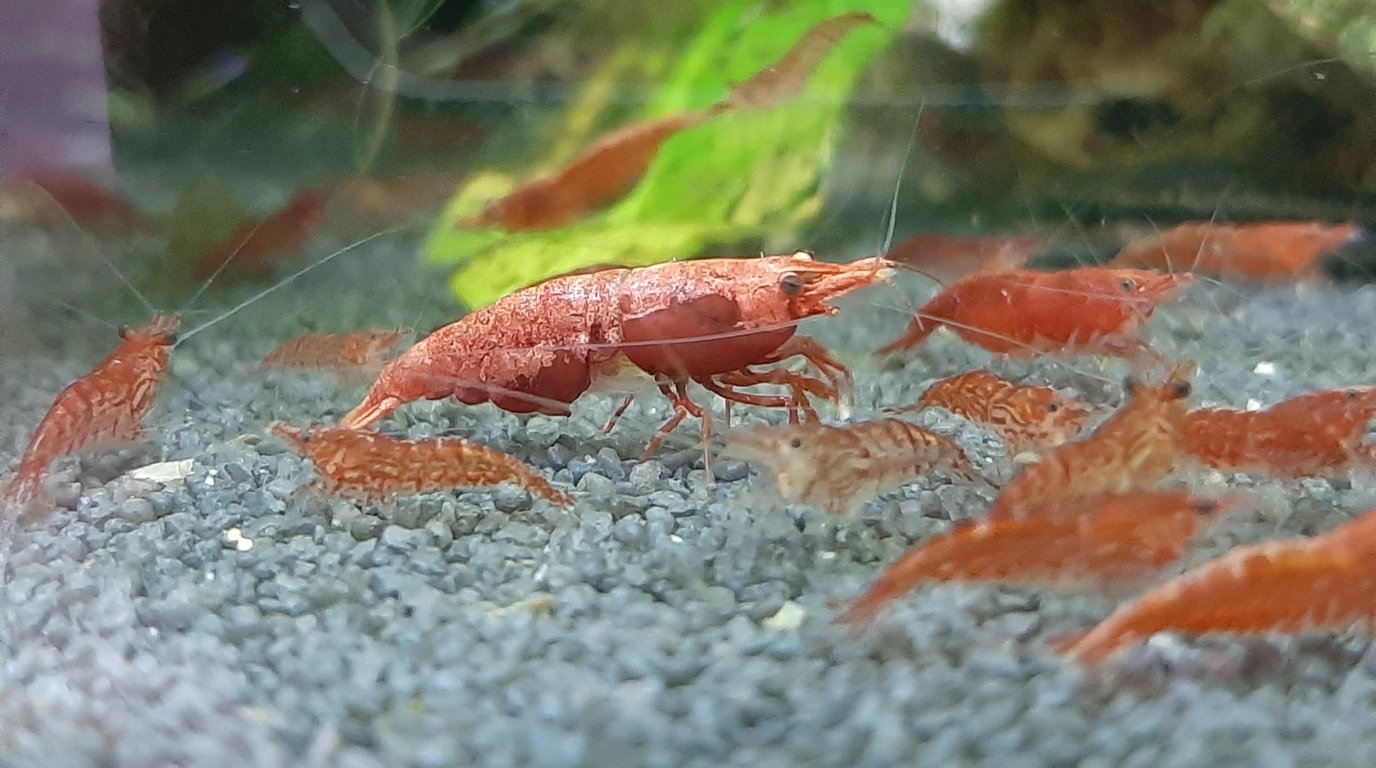
Why are those numbers so small for an inch-long shrimp? Those papers measure the carapace, the shell behind the eyes, and leave out the rest of the body. In the Japanese river study, the largest male had a 6.4 mm carapace on a 25.5 mm body. The largest female had a 7.7 mm carapace on a 30.0 mm body. In that study, then, the carapace was roughly a quarter of the body length.3
Keepers see the same difference by eye in home tanks: females look visibly bigger, about 1 inch to a male’s 3/4 inch. Size on its own is still only a rough hint of which shrimp is which. The shape of the underside and a saddle are better signs to check when you want to tell male and female cherry shrimp apart.
The size gap matters for Neocaridina shrimp breeding, too. In the Israeli study, bigger females carried more embryos.5
How long do cherry shrimp take to reach full size?
In lab cultures at 75°F (24°C) and above, cherry shrimp reached breeding size in roughly two months and kept growing more slowly after that. There’s no single day when one becomes full grown. They start tiny: a newly hatched shrimplet has a carapace under a millimeter long.8 Shrimp grow in steps, one molt at a time,4 and the gaps between molts lengthen as a shrimplet gets older, so how often cherry shrimp molt depends a lot on their age.8
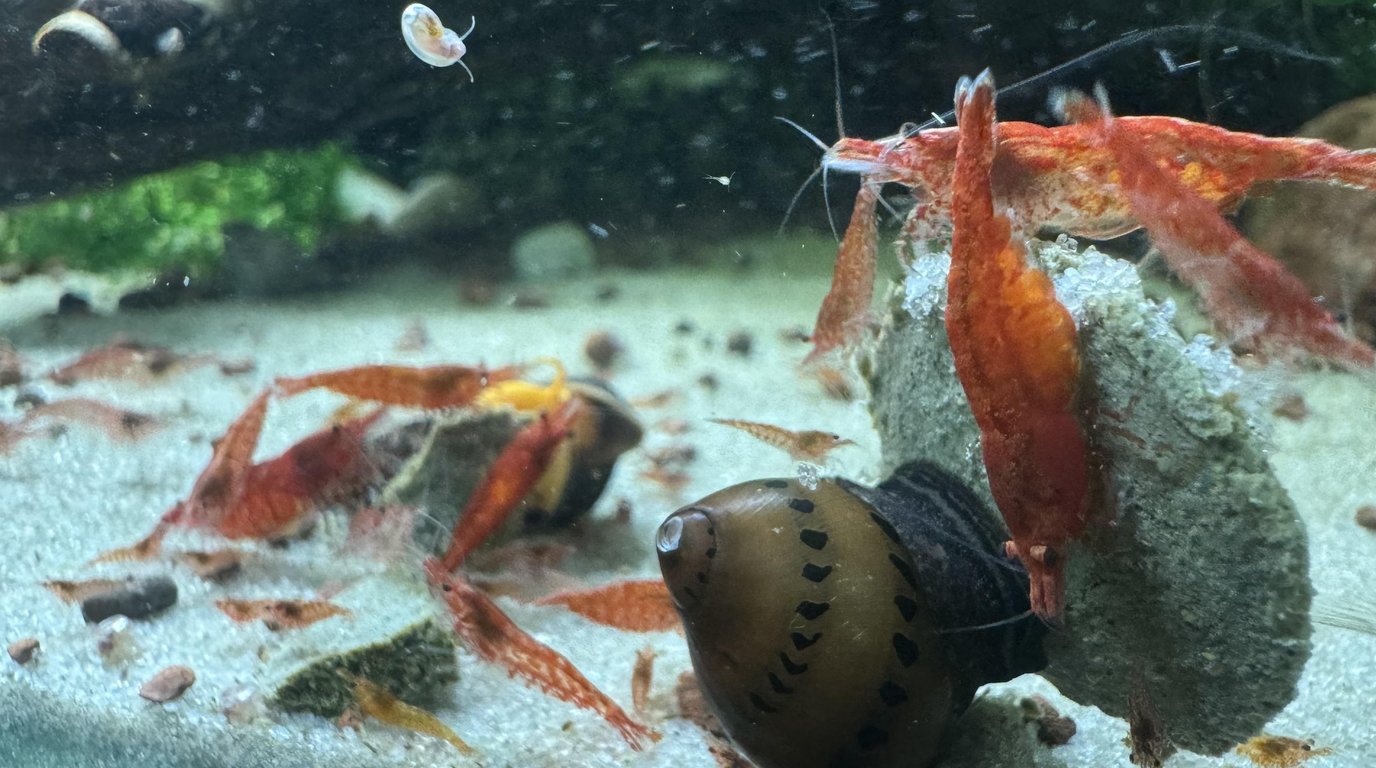
In a lab culture at 77°F (25°C), the first female carrying eggs appeared 49 days after hatching, with a carapace of 4.6-4.9 mm.8 In a 90-day study at 75, 82 and 90°F (24, 28 and 32°C), egg-carrying females appeared from day 50.9
Growth doesn’t stop there. In one lab culture, 18 shrimp were reared one to a jar, at temperatures from a few degrees below the target range up to its top end. They grew fast at first, slowed to one or two molts a month by week 32 and carried on well past breeding age. The males ended up smaller than the females.5
Those shrimp each had a jar to themselves. A crowded tank can slow growth, so shrimp in a packed colony may run behind that pace.
What can you change about how big your cherry shrimp get?
You can’t grow a cherry shrimp past the size adults of its species reach, but you can keep it from falling short. Crowding and food can both change how fast shrimp grow. The starting point for all of it is a cycled tank with ammonia and nitrite at 0 and steady water.
Does warmer water make cherry shrimp bigger?
Warmer water didn’t make cherry shrimp bigger in a 90-day lab study that compared three temperatures. Shrimp at the coolest setting, 75°F (24°C), were lighter at 30 and 60 days than those at 82°F (28°C) and 90°F (32°C). By day 90, the paper reports similar final size at all three.9 At 90°F, every young female in the growth trial that carried eggs lost them.9 There’s no size to gain by running warm, so keep the Neocaridina shrimp temperature in the 72-77°F (22-25°C) target range.
Does crowding keep cherry shrimp small?
It can. In 90-day trials, juveniles were kept at 2.5, 5 and 10 shrimp per liter. Females at the lowest density ended up about 45 percent heavier than those at the highest, and survival stayed the same.7 That’s far denser than any home tank, and the trial weighed the shrimp without measuring length, so it isn’t a stocking rule.
Keepers describe something similar in home tanks. When colonies reached several hundred shrimp in 5-30 gallon tanks, they report shrimp staying small, fewer young reaching adulthood and females no longer carrying eggs. Thinning the colony brought breeding back. It’s easier to settle how many cherry shrimp per gallon your tank should hold before it gets to that point.
Does food change how fast cherry shrimp grow?
Food changes how fast cherry shrimp grow: on five test feeds, adults of 0.6-0.7 inch (1.5-1.8 cm) all kept growing for 60 days, but by different amounts.10 A study abstract reports that a lab culture fed only on biofilm, the film of algae and microbes on tank surfaces, grew and bred through a full life cycle.11
Do color lines grow to different sizes?
There’s no reason to expect a Blue Dream, a Rili or any other color line to end up bigger or smaller than a red cherry shrimp. No published study has compared adult size across the lines. The red, blue, yellow, green and striped Rili types of Neocaridina shrimp are all color lines of one species, produced by selective breeding.4
How big can an unusually large cherry shrimp get?
Now and then a single cherry shrimp, usually a female, grows well past her tank mates, to about 1.5-1.8 inches (4-4.5 cm) by keepers’ own estimates. That’s around the 1.6 inch (40 mm) top figure in the German field description.1 It’s also well above the 1.2 inch (30.0 mm) female, the largest in the Japanese river study.3 Treat a shrimp like that as an exception, not a sign of where the rest of your colony is heading.
References
11 Sources
- Klotz et al., Two Asian fresh water shrimp species found in a thermally polluted stream system in North Rhine-Westphalia, Germany, Aquatic Invasions 8(3): 333-339, 2013.
- Neocaridina davidi (Bouvier, 1904), cherry shrimp, Nonindigenous Aquatic Species fact sheet, U.S. Geological Survey.
- Mitsugi et al., Life history of an invasive freshwater shrimp Neocaridina davidi (Bouvier, 1904), (Decapoda: Caridea: Atyidae) in the Tomoe River, the Boso Peninsula, eastern Japan, Crustacean Research 47: 9-16, 2018.
- Suen and Gillett-Kaufman, EENY-751: Cherry Shrimp Neocaridina davidi (Bouvier 1904), UF/IFAS Extension, University of Florida, March 2020.
- Levitt-Barmats, Yanai, Magory Cohen and Shenkar, Life-history traits and ecological characteristics of the ornamental shrimp Neocaridina denticulata (De Haan, 1844), recently introduced into the freshwater systems of Israel, Aquatic Invasions 14(4): 684-702, 2019.
- Prati et al., Invisible invaders: range expansion of feral Neocaridina davidi offers new opportunities for generalist intracellular parasites, Biological Invasions, 2024.
- Vazquez et al., Density and gender segregation effects in the culture of the caridean ornamental red cherry shrimp Neocaridina davidi Bouvier, 1904 (Caridea: Atyidae), Journal of Crustacean Biology 37(4): 367-373, 2017 (repository copy, SEDICI).
- Pantaleão, Gregati, da Costa, López Greco and Negreiros-Fransozo, Post-hatching development of the ornamental Red Cherry Shrimp Neocaridina davidi (Bouvier, 1904) (Crustacea, Caridea, Atyidae) under laboratorial conditions, Aquaculture Research 48(2): 553-569, 2017.
- Tropea, Stumpf and López Greco, Effect of Temperature on Biochemical Composition, Growth and Reproduction of the Ornamental Red Cherry Shrimp Neocaridina heteropoda heteropoda (Decapoda, Caridea), PLOS ONE 10(3): e0119468, 2015.
- Azhar et al., Growth, reproduction and pigmentation performances of red cherry shrimp (Neocaridina davidi) fed with black soldier fly larvae (Hermetia illucens) meal, Planetary Sustainability 3(2): 56-76, 2025.
- Viau, Pérez, Tomas, Fracas, Veira, Vatnick and López Greco, Breeding and life cycle of the ornamental freshwater shrimp Neocaridina davidi in a biofilm-based culture system (abstract), Aquaculture Research 51(9): 3847-3864, 2020.
Ready to get started?
Shop our Neocaridina Shrimp collection
15 products available · Live Arrival Guarantee