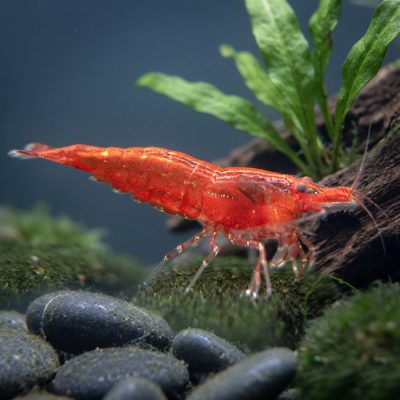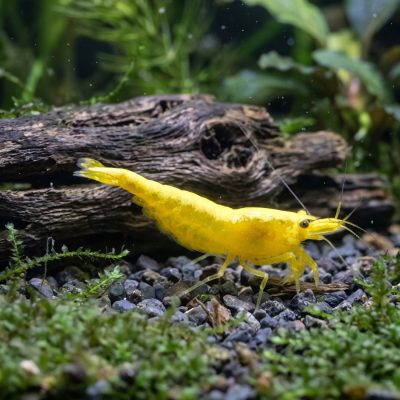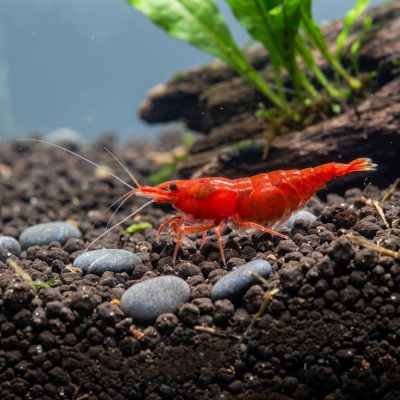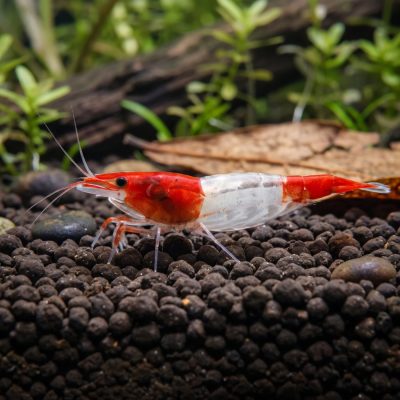
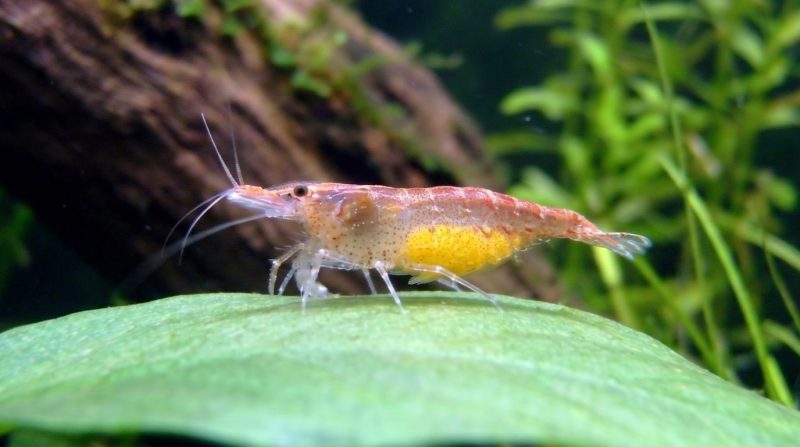
Healthy, grown Neocaridina shrimp in a stable, cycled tank usually breed on their own. A female’s ovary shows through her shell as the saddle. She molts and mates, carries the eggs under her tail, and the young hatch as tiny shrimp with no larval stage. Nothing can promise it will happen in your tank, but the groundwork is ordinary Neocaridina shrimp care: a cycled tank, steady water and time.
How do cherry shrimp mate and carry their eggs?
Cherry shrimp (Neocaridina davidi) mate right after the female molts, and she then carries the eggs under her tail until they hatch. In most shrimp, mating takes place at the female’s molt.1
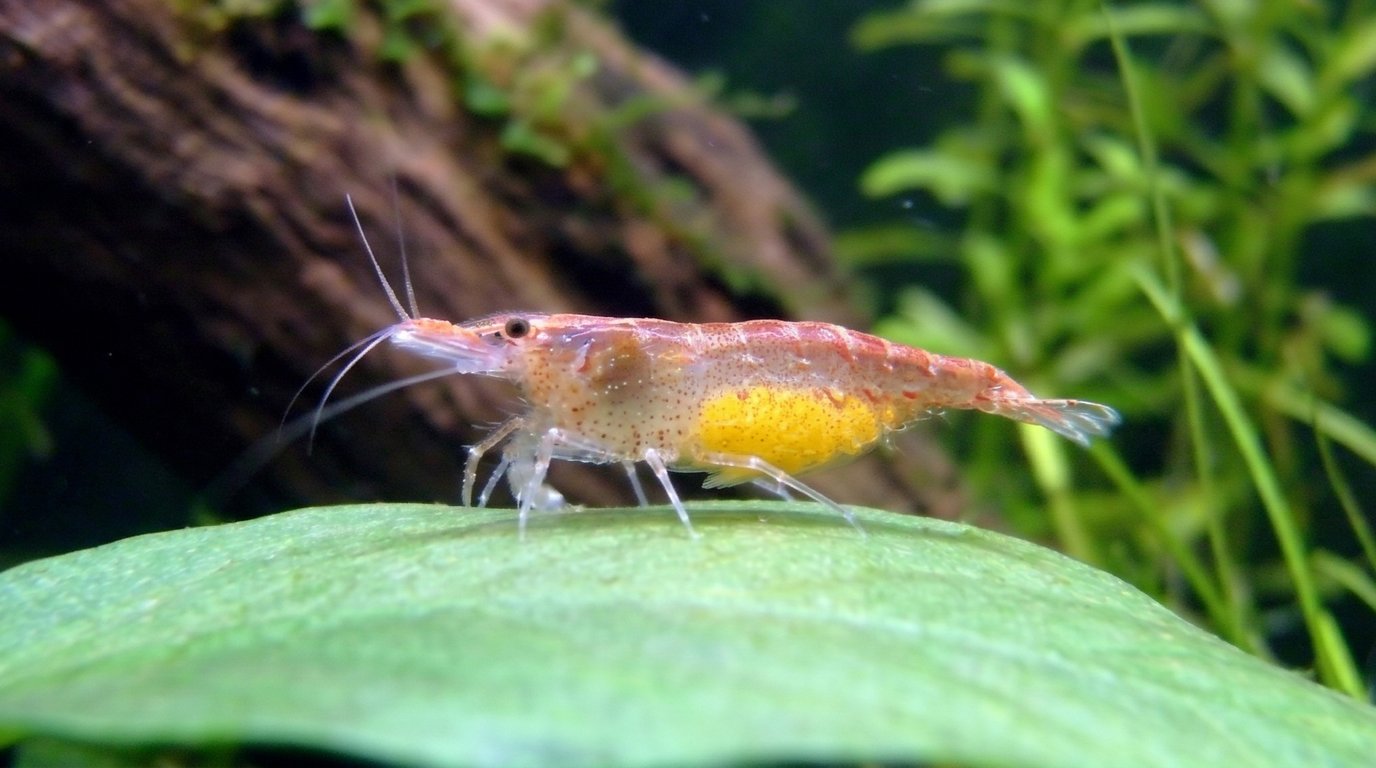
- The saddle shows. Her ovary fills out and you can see it through the shell behind her head.2
- Males go looking. Males climb on females and touch them with their walking legs again and again, even before she molts.2 Keepers call the busy swimming that goes with it the mating dance.
- She molts and mates. The researchers who measured cherry shrimp bodies think small males simply search for a ready female, pass her a sperm packet and move on to keep searching.3
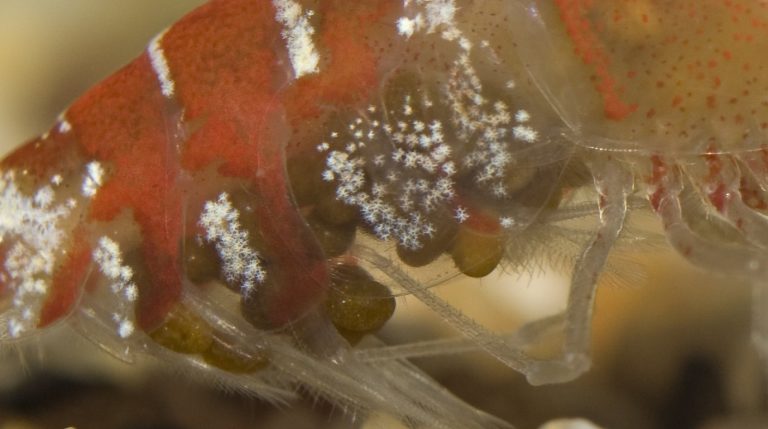
- She’s berried. The eggs sit under her tail, and you’ll see them as a cluster under her belly. That’s where Neocaridina keep their eggs until they hatch.
- The young hatch. Tiny shrimp leave her tail, already shaped like the adults.
You’ll often read that the female gives off a scent that sets the males off. Researchers suspect something like it, as in other shrimp. In cherry shrimp, though, the clearest cue they found was touch: males sped up a young female’s ovary only when they could reach her.2
All the types of Neocaridina shrimp breed this way, and the color lines breed with each other. Keep one line per tank if you want the young to hold their color.
What does the saddle on a cherry shrimp mean?
A saddle means a female’s ovary is maturing. It’s the ovary itself, seen through the shell just behind the head, and it stays visible the whole time it develops.2 It’s often described as a clutch of unfertilized eggs, but the researchers who follow it describe an ovary that grows before she mates. That’s also why a saddle marks a female, one of the clearer signs when you’re sorting Neocaridina shrimp male vs female.
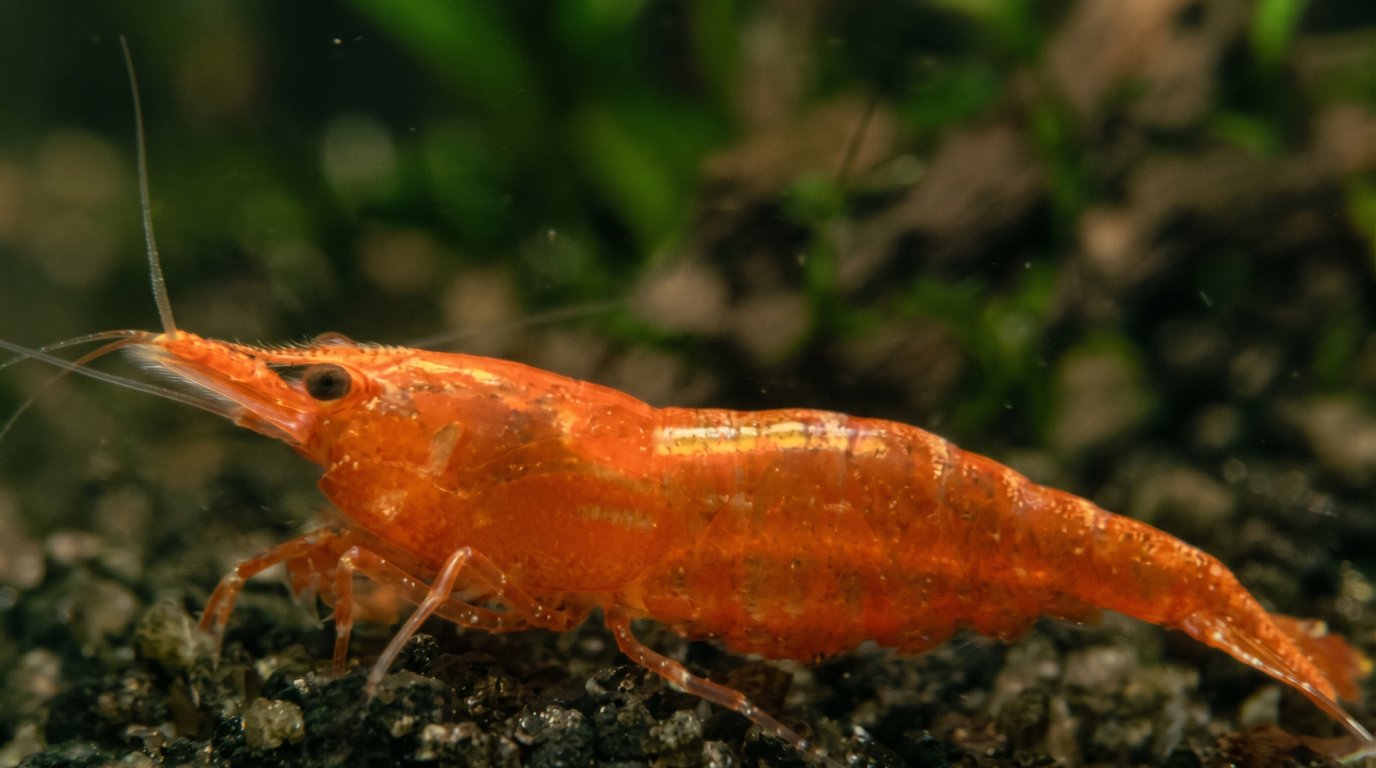
In the lab, researchers sort it into four stages by color and size. It starts clear or whitish, turns cream, then yellow, and ends a strong yellow that reaches back into the third segment of the tail.2 A full, strong yellow saddle means she’s ready, and the next step is a molt and mating.
Do you need males for a saddle? No. A female’s ovary matures without them, but in the lab it grew faster when males could reach and touch her, and slower when she shared space with older females.2
What to expect once your cherry shrimp is berried
A berried cherry shrimp carries her eggs for about two to three weeks before they hatch. One brood gives somewhere around 15 to 30 young.
How long depends on the water. Two lab studies kept their tanks a few degrees warmer than the 72-77°F (22-25°C) target range for a home tank. There the eggs hatched after about 15 days,4 or 14 to 16 days across several broods in a row.5 A third study timed about 21 days at 75°F (24°C) and about 15 days at 82°F (28°C), so the cooler the water, the longer she carries them.6 A USGS species profile gives 16 to 19 days, without a temperature.7 Inside the target range, a wait of about three weeks is closer to the mark. Temperature can move how long cherry shrimp carry eggs by several days either way, and dark eye dots in the eggs mark the last stretch.
Don’t turn up the heater to hurry the eggs. In that third study, which ran 90 days, every female that carried eggs at 90°F (32°C) lost them, even though they were fertilized.6 In another study, no female raised at 91°F (33°C) carried eggs at all in 200 days.8
How many babies? In one of those warmer lab studies, an average of about 29 young hatched per brood.4 In another, females laid about 33 eggs in their first brood, and unrelated pairs hatched about 31 young from their second.9 A clutch can run to 60 eggs.7 Counted in home tanks, a brood comes to about 15 to 30 shrimplets, and a female’s first brood can be much smaller. Shrimplets hide, so a count can miss a few.
Bigger females carry more eggs.5 Whether they also hatch more young is still open: one study found they did,4 and an earlier study by the same group found no link.5 Relatedness matters as well. Brother-sister pairs in the lab laid as many eggs as unrelated pairs but hatched fewer young, about 25 against 31 per female. The authors think that points to more eggs being lost along the way.9
These breeding notes come from the Neocaridina lines as we breed them, and shrimp in another tank can run a little differently. In the Shrimp Aquatics tanks, females carry their eggs for about three weeks before they hatch, and a female usually gives about 20 to 30 young per brood.
Neocaridina young hatch as tiny shrimp, not larvae
Baby Neocaridina hatch looking like small copies of their parents. There’s no larval stage to raise.7 The larval phase is almost skipped: the first stage after hatching is already shaped like a shrimp, and the tail fan only appears at the next stage.10
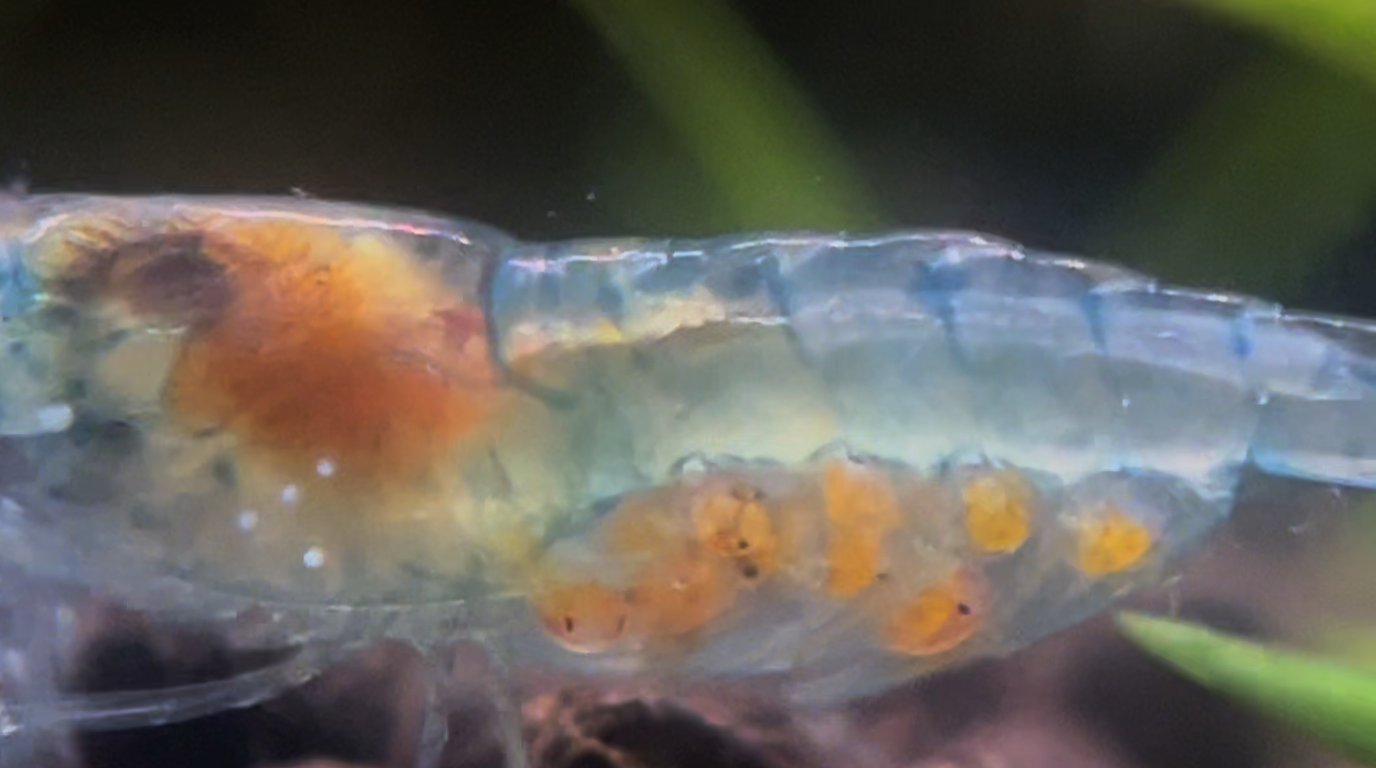
They’re very small. In one lab study, the shell behind the eyes of a newly hatched shrimplet measured about 0.83 mm, and that’s only the front part of the body.9 Don’t worry if you can’t find them at first. At that size they’re easy to miss among plants and moss. From there, baby cherry shrimp care comes down mostly to steady water, a covered filter intake and plenty of surface to graze.
How fast do cherry shrimp breed?
Cherry shrimp breed fast once they’re grown. A female can carry her first eggs two to three months after hatching, and she can be berried again within days to a few weeks of her young hatching.
Young shrimp in the warmer lab water reached maturity within 60 days.4 In a 90-day study at 75, 82 and 90°F (24, 28 and 32°C), the first females carried eggs from about day 50.6
Keepers report that a female can be berried again within about 11 days to 3 weeks after her young hatch. That works out to roughly one brood a month for a healthy female. In the lab, some females had nearly matured a new ovary while still carrying eggs, and others did so a few days after hatching. Over 210 days, 7 of 20 females spawned six or more times.5 The gap between broods stayed about the same over a female’s first six broods.11
It costs her, though. Females that bred ended the 210 days with lower energy content and lower body weight than females that never mated. Breeding drew on what would have gone into growth.5
In the Shrimp Aquatics tanks, females carry their first eggs at about three months old, counted from the day they hatched. A female there usually carries eggs again within a few days to a week after her young hatch, after her next molt. A newly stocked group can be any age when it goes in, though, so the wait for the first berried female varies a lot from tank to tank.
How to get your Neocaridina shrimp to breed more
To get more young, keep the water in range and steady, and give the group more females than males.
Steady water does most of the work. Keep the Neocaridina shrimp water parameters in range: 72-77°F (22-25°C), pH 6.8-7.6, GH 6-10 dGH and KH 2-5 dKH, with ammonia and nitrite at 0. Make every change slowly. You may read that a cool water change sets off breeding. Skip it: a quick drop in temperature is the kind of swing a shrimp tank should avoid.
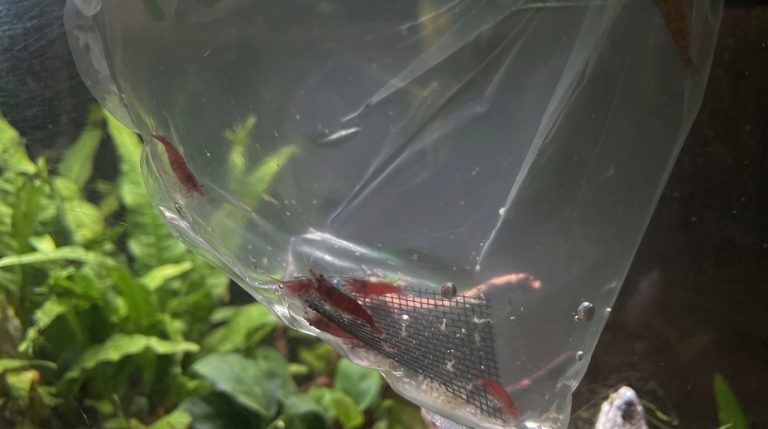
Our advice for a breeding tank is to take some of the males out and keep about seven or eight females for every two or three males. Move the extra males to another tank.
What about food? In a trial of three commercial foods, the diet changed how much carotenoid pigment went into the eggs, but not how many eggs the females laid.12 In a culture system where biofilm was the only food, females still matured their ovaries and carried eggs.13 No study gives a feeding amount or schedule for breeding Neocaridina, so feed lightly and let them graze between meals.
Do cherry shrimp babies need protecting from adults or fish?
Not from the adults. In a shrimp-only tank the young grow up beside the adults and the colony keeps growing, so there’s no need to move them out.
Fish are another matter. Even fish sold as shrimp-safe may eat shrimplets, and sometimes adult shrimp too. In a field study of related shrimp in Guam streams, pools given one or two jungle perch held no visible shrimp a day or two later. Pools without the fish kept theirs.14 For the most young, give the colony a tank without fish.
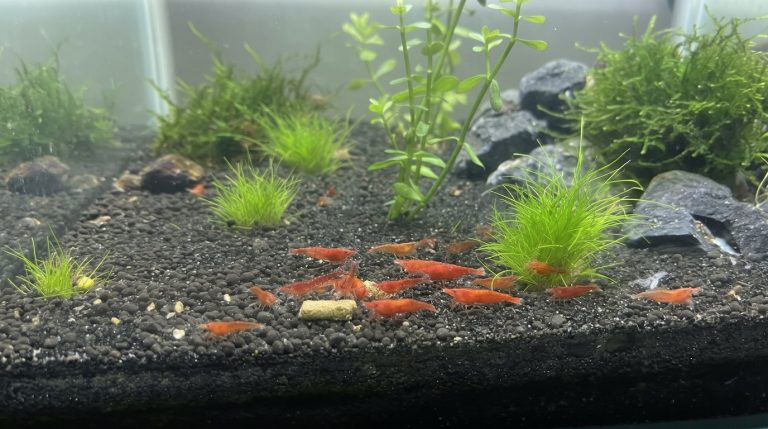
Neocaridina go well with live plants and moss, so a planted tank works. Texture may help the young, too: in the biofilm-only culture study, juveniles survived better in the tanks given plastic netting or a non-woven fabric as extra surface.13
What to check when your Neocaridina shrimp aren’t breeding
If your Neocaridina aren’t breeding, check these five things before you change anything.
- Are the females grown? Look for a saddle behind the head. Young females need time before one shows.
- Do you have both sexes? A small group is far more likely to include males and females than two or three shrimp. So when you choose tank-bred Neocaridina shrimp, order a group and not a pair.
- Is the water in range and steady? Test it against the numbers above, and think back to any sudden change.
- Is the tank too warm? Heat costs eggs first. Bring a warm tank back into range slowly.
- Are there fish? They may be eating the young before you ever see them.
If all five check out, give them time. Healthy groups usually get there on their own.
References
14 Sources
- Bauer, Mating Behavior and Strategies (research page), Raymond T. Bauer, University of Louisiana at Lafayette.
- Tropea, Lavarias and López Greco, Getting ready for mating: The importance of male touching as an accelerator of ovarian growth in a caridean shrimp, Zoology 130: 57-66, 2018.
- Sganga, Piana and López Greco, Sexual dimorphism in a freshwater atyid shrimp (Decapoda: Caridea) with direct development: a geometric morphometrics approach, Zootaxa 4196(1), 2016.
- Sganga, Tropea, Valdora, Statti and López Greco, Large mothers, but not large fathers, influence offspring number in a caridean shrimp, Canadian Journal of Zoology 96(10): 1106-1113, 2018.
- Tropea and López Greco, Female Growth and Offspring Quality over Successive Spawnings in a Caridean Shrimp Neocaridina davidi (Decapoda, Atyidae) with Direct Development, The Biological Bulletin 229(3): 243-254, 2015.
- Tropea, Stumpf and López Greco, Effect of Temperature on Biochemical Composition, Growth and Reproduction of the Ornamental Red Cherry Shrimp Neocaridina heteropoda heteropoda (Decapoda, Caridea), PLOS ONE 10(3): e0119468, 2015.
- Neocaridina davidi (Bouvier, 1904), cherry shrimp, species profile, U.S. Geological Survey, Nonindigenous Aquatic Species program.
- Balina, Temperoni, López Greco and Tropea, Losing Reproduction: Effect of High Temperature on Female Biochemical Composition and Egg Quality in a Freshwater Crustacean with Direct Development, the Red Cherry Shrimp, Neocaridina davidi (Decapoda, Atyidae) (abstract), The Biological Bulletin 234(3): 139-151, 2018.
- Tropea, Marciano and López Greco, Brothers are better than nothing: first report of incestuous mating and inbreeding depression in a freshwater decapod crustacean, Zoology 151: 125990, 2022.
- Pantaleão, Gregati, da Costa, López Greco and Negreiros-Fransozo, Post-hatching development of the ornamental Red Cherry Shrimp Neocaridina davidi (Bouvier, 1904) (Crustacea, Caridea, Atyidae) under laboratorial conditions (abstract), Aquaculture Research 48(2): 553-569, 2017.
- Marciano, Tropea and López Greco, Effect of multiple spawning on female reproductive output and offspring quality in a freshwater caridean shrimp with direct development (abstract), Invertebrate Biology, 2018.
- Sganga and López Greco, Effect of commercial diets on female reproductive performance and offspring quality in the red cherry shrimp Neocaridina davidi (Caridea, Atyidae) (abstract), Aquaculture Research 51(12): 5029-5039, 2020.
- Viau, Pérez, Tomás, Fracas, Veira, Vatnick and López Greco, Breeding and life cycle of the ornamental freshwater shrimp Neocaridina davidi in a biofilm-based culture system (abstract), Aquaculture Research 51(9): 3847-3864, 2020.
- Leberer and Nelson, Factors Affecting the Distribution of Atyid Shrimps in Two Tropical Insular Rivers, Pacific Science 55(4): 389-398, 2001.
Ready to get started?
Shop our Neocaridina Shrimp collection
15 products available · Live Arrival Guarantee