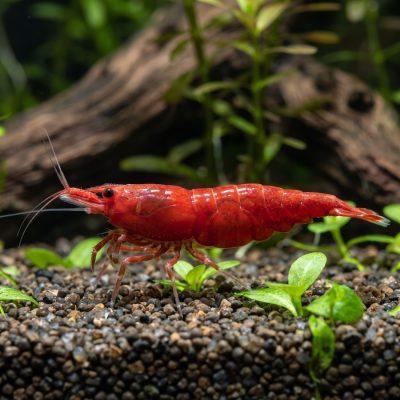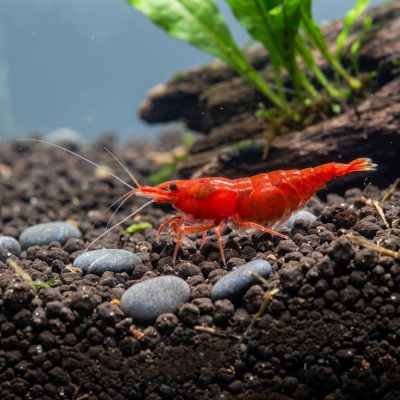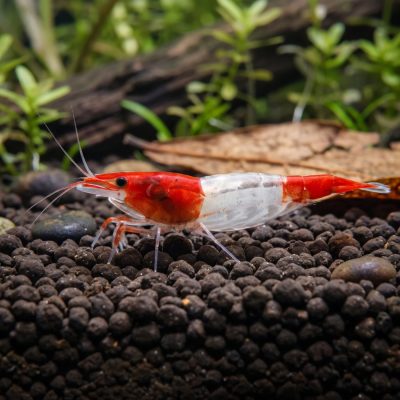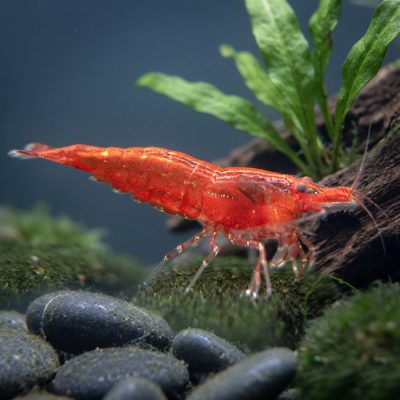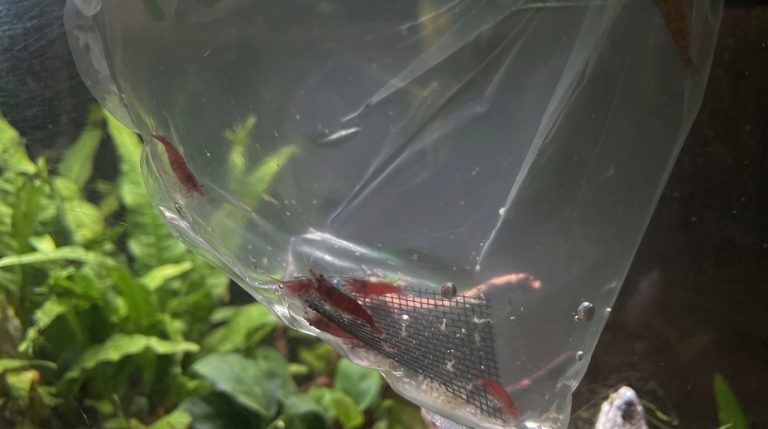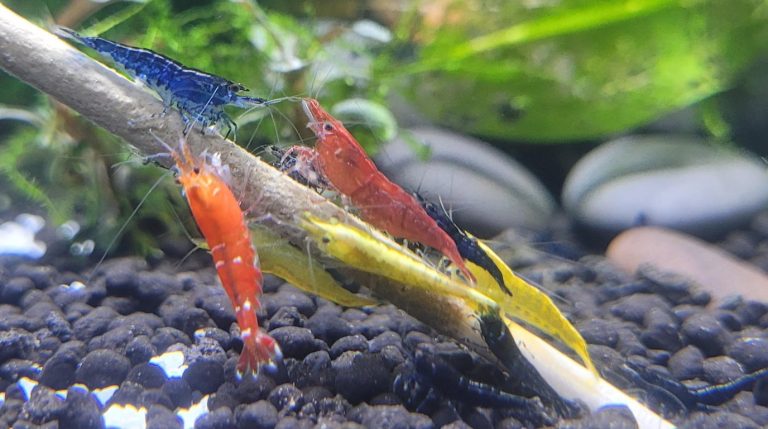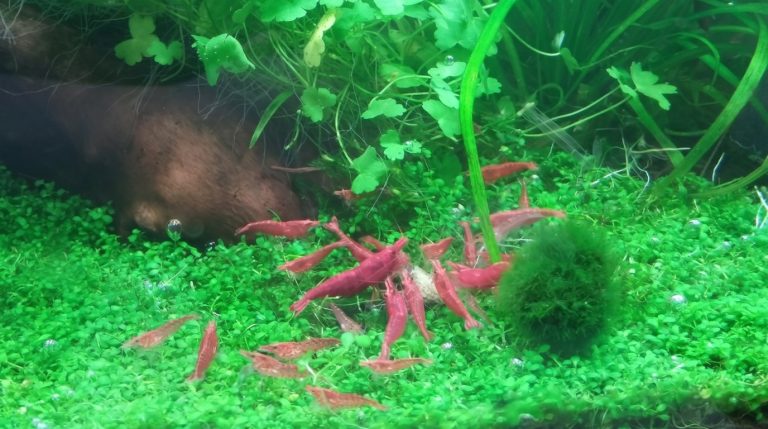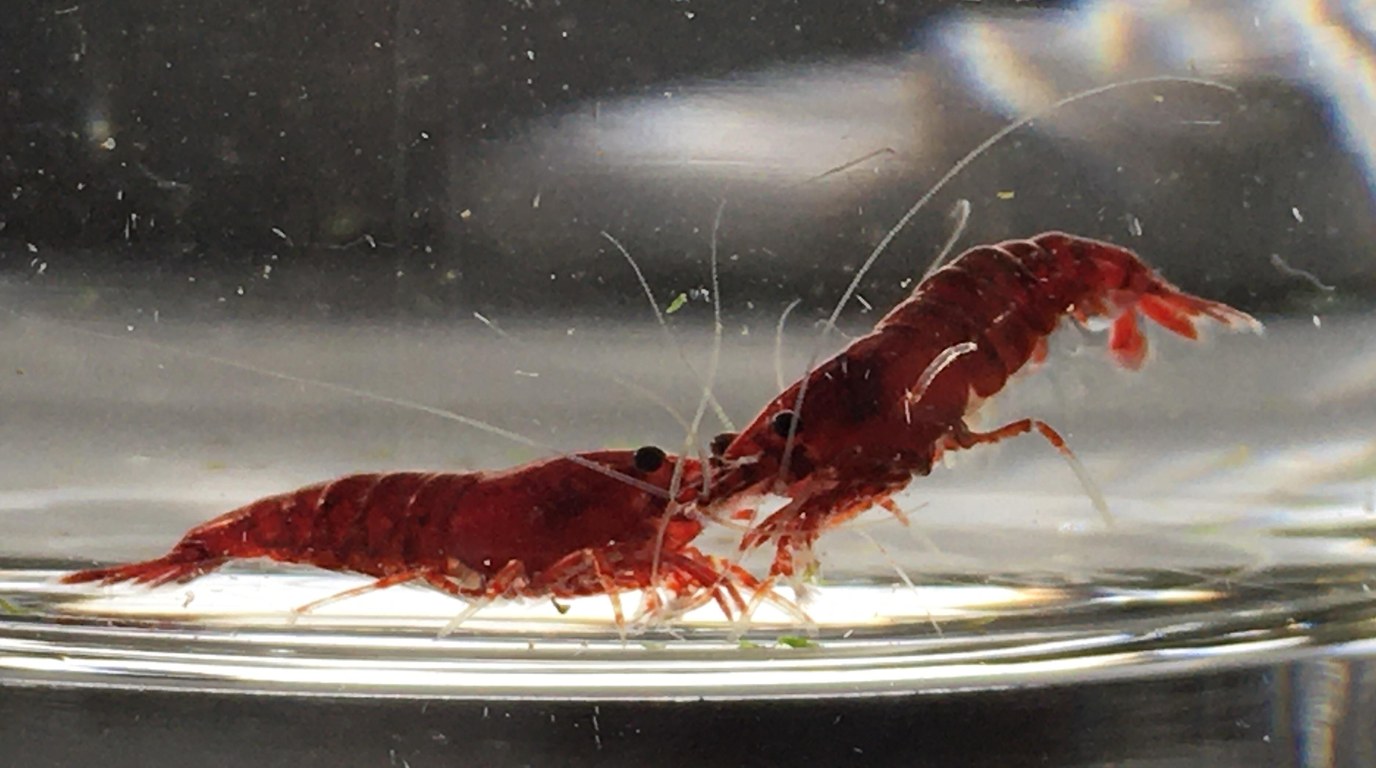
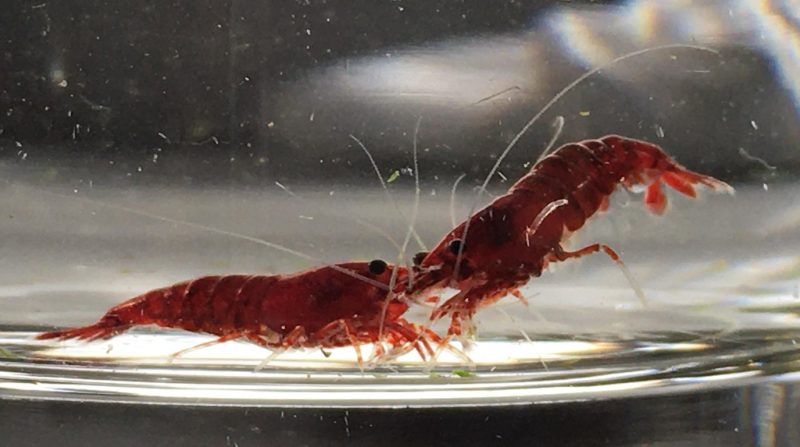
Female Neocaridina shrimp, the cherry shrimp (Neocaridina davidi) and its color lines, are bigger than males and rounder underneath. The side plates of a female’s tail flare into a skirt, and she may show a saddle behind the head. Males are smaller and slimmer, with a straighter underside, and in regular-grade cherries they tend to be paler. A shrimp carrying eggs under its tail is female for certain. Apart from eggs and a saddle, no single sign settles it, so judge several together and give young shrimp time to grow.
If you’re still choosing a group, orders of our tank-bred Neocaridina shrimp are packed with more females than males when the shrimp are large enough to be sexed reliably, and no ratio applies to smaller juveniles.
Knowing who’s male and who’s female won’t make a group breed by itself. That still rests on the basics of Neocaridina shrimp care, starting with a cycled tank and stable water.
How do you tell male and female cherry shrimp apart?
Look at the underside and the back. A grown female has a rounder underside, with the side plates of the tail flaring out into a skirt, and she may carry a saddle behind the head. A male is slimmer, and his underside runs straighter.
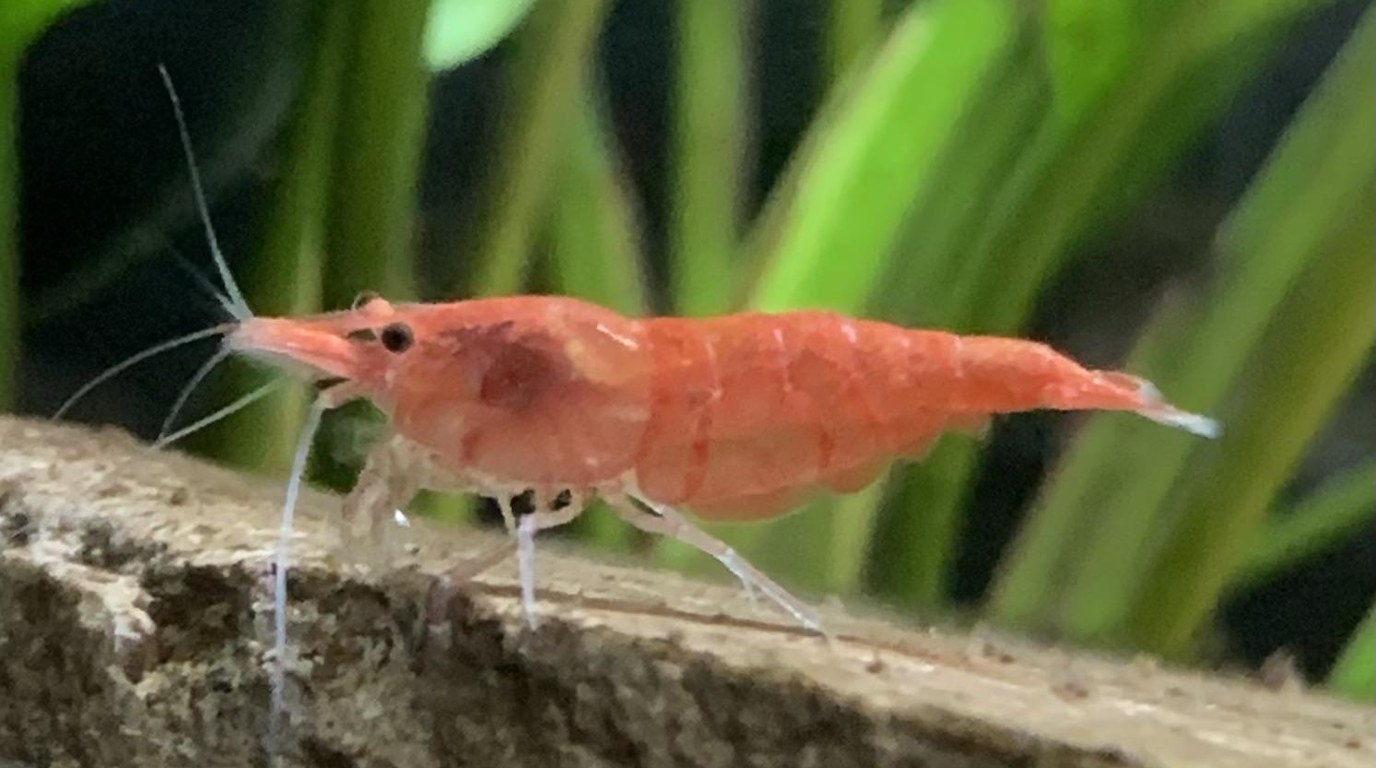
Researchers have measured that difference. In a lab study of cherry shrimp body shape, adult females had a longer, wider side plate on the second tail segment than males. Their carapace was more elongated, and their bodies were larger.1 That wider skirt is where a female holds her eggs once she’s berried.
Females also grow larger. The gap in how big Neocaridina shrimp get between the sexes is wide enough to notice once both are adults, though not in young shrimp.
A saddle, the yellowish patch just behind the head, marks a female and is one of the first things to watch for in Neocaridina shrimp breeding.
Color is the weakest clue. Males of regular-grade cherries tend to be paler than the females, some of them nearly clear. In high-grade lines such as Painted Fire Red or Bloody Mary, the males can be nearly as red. The authors of one rearing study describe the female of this species as larger and brighter.2 Even so, no published measurement has compared color between the sexes, so treat color as a hint and nothing more.
Keepers who sex their own shrimp lean on the signs in order: saddle and eggs first, then the curve of the underside and the body’s thickness, then size. Some also check the tail fan, which is narrower on males, when the other signs are too close to call.
| Sign | Female | Male |
|---|---|---|
| Eggs under the tail | Berried means female, the surest sign there is | No eggs, though a female without eggs looks the same |
| Saddle behind the head | Marks a female, a very reliable sign | No saddle, but a young female may not show one yet |
| Underside | Rounder, with the tail plates flaring into a skirt, a good sign on adults | Straighter, with narrower tail plates, a good sign on adults |
| Body size | Bigger and stockier when grown, a hint | Smaller and slimmer, a hint |
| Tail fan | Broader, a back-up sign | Narrower, a back-up sign |
| Color | Often deeper, a hint only | Paler in regular-grade cherries, nearly as red in high-grade lines, a hint only |
A few notes on this page come from how Shrimp Aquatics sorts the shrimp in its own breeding tanks. Shrimp Aquatics picks out females on four signs together: a rounder underside with the tail plates flaring like a skirt, a saddle, deeper color and a bigger, stockier body. Once the shrimp are big enough, that pick is almost always right for Shrimp Aquatics. The part worth copying in your own tank is the habit: weigh several signs at once, and never call a shrimp on color or size alone.
Which sign is surest when you sex cherry shrimp?
Eggs are the surest sign: a berried shrimp, carrying eggs under her tail, is female. A saddle comes next, and it marks a female too.
A male is harder to prove. By eye, a shrimp with no saddle and no eggs is a probable male at best, because a young female can look much the same. In the body-shape study, the male’s carapace was shaped like a juvenile female’s.1
Even careful observers get stuck. In one lab study of red cherry shrimp, which the authors call Neocaridina heteropoda, researchers judged each adult by its outward look on six separate occasions. A shrimp got a sex only when at least five of the six calls agreed, and 22 of the 53 were still left unsexed.3
What settles a male is seen under magnification. In the taxonomic description of the species, the inner branch of the male’s first pair of swimmerets is broad and pear-shaped. His second pair carries a small, bean-shaped extra lobe with strong spines, called the appendix masculina.4 Those are details taxonomists check under a microscope, not something you can judge through the glass.
So in your tank, call a slim shrimp without a saddle a probable male, and keep watching for a saddle as the group grows.
How big does a cherry shrimp need to be before you can sex it?
By eye, wait until the shrimp are nearly grown or until saddles start to show. Small juveniles are guesswork.
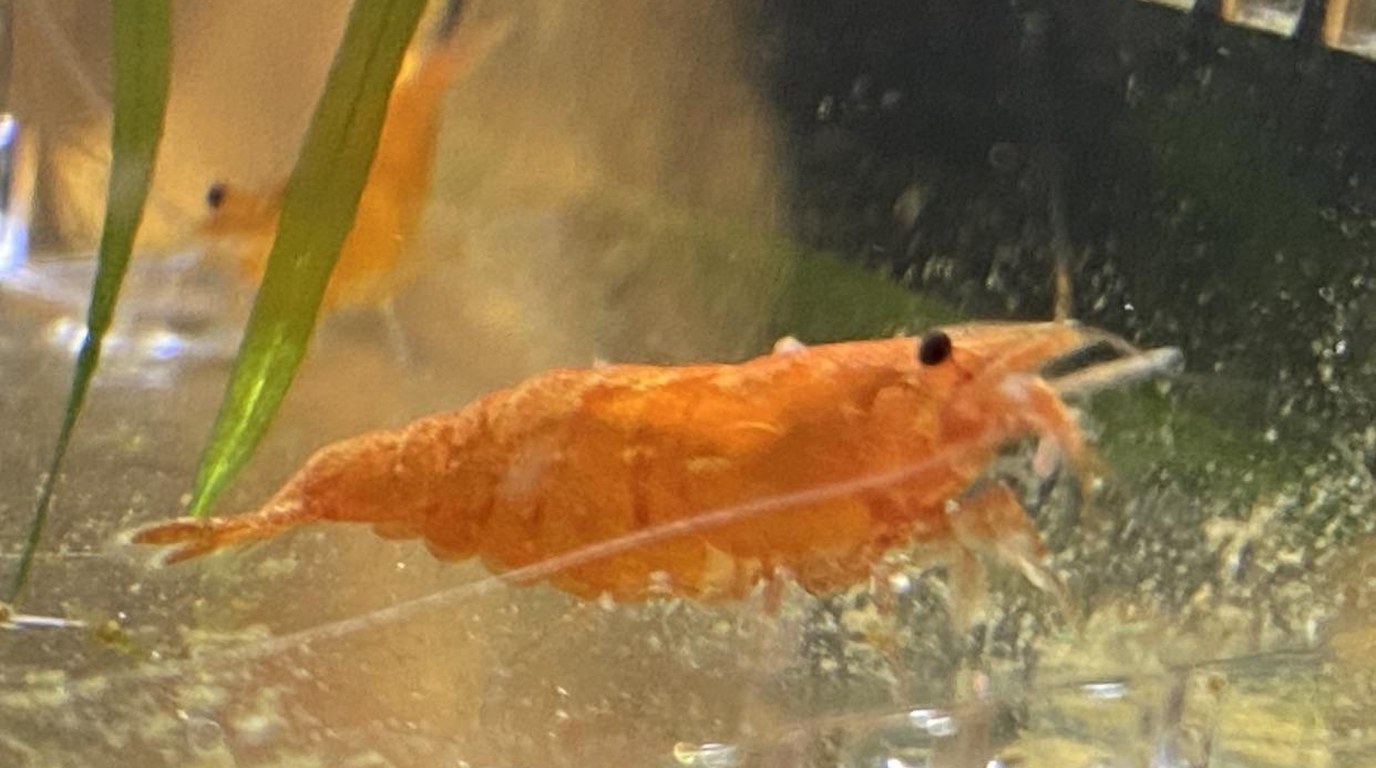
Labs can see it far earlier. In a study that followed young cherry shrimp stage by stage, sex could be told after the seventh juvenile stage, about two weeks after hatching.5 In another, 50-day-old juveniles were easy to sex under a stereomicroscope from the shape of their first two pairs of swimmerets.6
Through the glass it’s a different job. Keepers find juveniles of about 0.4-0.6 inch (1-1.5 cm) hard or impossible to sex by eye, and they tell newer keepers to wait until saddles show. Shrimp Aquatics tells its males and females apart by eye once the shrimp reach about 0.6 inch (1.5 cm), right at the top of that hard range.
If your group is still small juveniles, don’t sort it yet. Let them grow toward that size, or wait for the first saddles, and judge them then.
What do new keepers get wrong when sexing cherry shrimp?
The mix-ups beginners report come down to reading one sign the wrong way or trusting it on its own.
- Taking a saddle for illness. A pale band behind the head is a female’s saddle, and it’s been mistaken for sickness and answered with big water changes.
- Calling a shrimp male because it has no saddle yet. A shrimp taken for a male can molt and turn up with a saddle.
- Calling a saddle eggs. The saddle sits on her back, and the eggs of a berried female sit under her tail. Only the eggs mean she’s carrying.
- Sexing by color in a high-grade line. The males there can be nearly as red as the females, so a very red shrimp can be either sex.
- Comparing a young shrimp with an older one. A female that hasn’t finished growing can be smaller than a grown male, so size only works between adults.
Why are my male cherry shrimp swimming around like crazy?
It’s normal after a female molts. Males zoom around the tank, sometimes for days, and keepers read it as the males searching for her.
That fits the mating system researchers propose for this species from its body shape, in which small males keep searching for receptive females.1
What matters is who’s swimming. If it’s only the males and it follows a molt, leave them to it. If the whole tank is racing, females included, the few keepers who’ve seen that found a water or oxygen problem instead.
In that case, test the water right away: ammonia and nitrite should read 0, with the other Neocaridina shrimp water parameters inside their target range.
Outside that chase, behavior won’t sex a shrimp. In the lab study that tested shrimp one at a time for shy or bold behavior, the researchers found no evidence of a difference between males and females.3
How many male to female cherry shrimp do you need?
You need at least one of each to start a colony, but not a male for every female, and a breeding tank can carry more females than males.
Broods start out close to half and half. In a lab study, juveniles came out about half female on average, whether they were raised with adult males or adult females. Single broods varied a lot, though, some about two thirds female and some about one third.6 The same researchers describe cherry shrimp as having separate sexes.6 With broods that uneven, a handful of shrimp from one tank can lean one way.
Does warm water make more males? The evidence disagrees. One lab study reported mostly male offspring at 79°F (26°C), a couple of degrees above the 72-77°F (22-25°C) target range.7 Another, which raised juveniles at three temperatures, found no difference in the share of females.8 Either way, it’s no reason to run a tank warm, so keep it in the target range.
Small groups can come out lopsided. Keepers who bought about six shrimp often report four or five females, or a first batch that was all female. Then they wonder whether they have a male at all. Keepers start colonies with anywhere from six to 30 shrimp, about 10 in the middle.
A bigger group is the simplest way to get both sexes, and how many cherry shrimp per gallon your tank holds sets how big that group can be.
If you’re setting up a tank to breed from, we recommend moving some of the males to another tank once you can tell them apart, so that about seven or eight females share the tank with every two or three males.
Give those males a tank of their own, but never release shrimp, plants or tank water outdoors. Aquarium release is the most common way cherry shrimp reach waters outside their native range, and they’ve formed established populations on Oahu, Hawaii.9
References
9 Sources
- Sexual dimorphism in a freshwater atyid shrimp (Decapoda: Caridea) with direct development: a geometric morphometrics approach, Sganga, Piana and Lopez Greco, Zootaxa 4196(1), 2016.
- Density and gender segregation effects in the culture of the caridean ornamental red cherry shrimp Neocaridina davidi Bouvier, 1904 (Caridea: Atyidae), Vazquez et al., Journal of Crustacean Biology 37(4): 367-373, 2017.
- Among-individual behavioural variation in the ornamental red cherry shrimp, Neocaridina heteropoda, Rickward, Santostefano and Wilson, Ecology and Evolution 14(2): e11049, 2024.
- Two Asian fresh water shrimp species found in a thermally polluted stream system in North Rhine-Westphalia, Germany, Klotz, Miesen, Huellen and Herder, Aquatic Invasions 8(3): 333-339, 2013.
- Post-hatching development of the ornamental Red Cherry Shrimp Neocaridina davidi (Bouvier, 1904) (Crustacea, Caridea, Atyidae) under laboratorial conditions (accepted manuscript), Pantaleao, Gregati, da Costa, Lopez Greco and Negreiros-Fransozo, Aquaculture Research 48(2): 553-569, 2017.
- Effect of social environment on sexual differentiation in the highly gregarious red cherry shrimp (Neocaridina davidi) (accepted manuscript), Tropea and Lopez Greco, Canadian Journal of Zoology 97(9): 791-796, 2019.
- To what extent does temperature affect sex ratio in red cherry shrimp, Neocaridina davidi? The scenario global warming to offspring sex ratio (abstract), Serezli, Atalar, Hamzacebi, Kurtoglu and Yandi, Fresenius Environmental Bulletin 26(12): 7575-7579, 2017.
- Effect of Temperature on Biochemical Composition, Growth and Reproduction of the Ornamental Red Cherry Shrimp Neocaridina heteropoda heteropoda (Decapoda, Caridea), Tropea, Stumpf and Lopez Greco, PLOS ONE 10(3): e0119468, 2015 (the paper names the shrimp N. heteropoda heteropoda).
- Neocaridina davidi (Bouvier, 1904), cherry shrimp: species profile, U.S. Geological Survey Nonindigenous Aquatic Species program, updated 2026.
Ready to get started?
Shop our Neocaridina Shrimp collection
15 products available · Live Arrival Guarantee