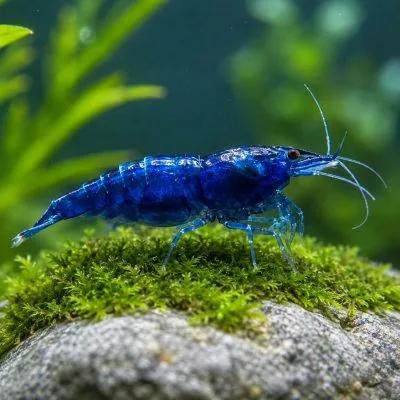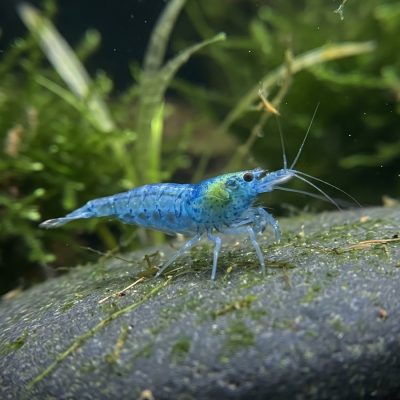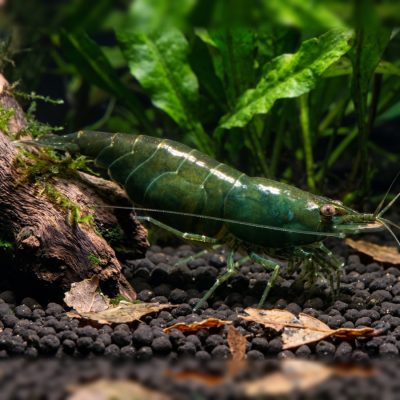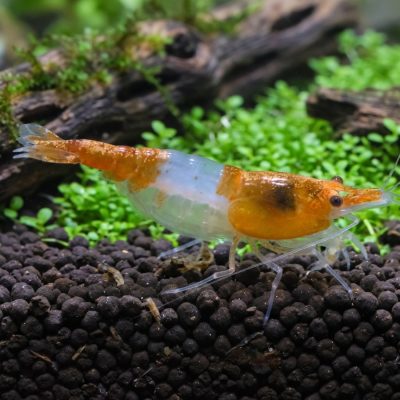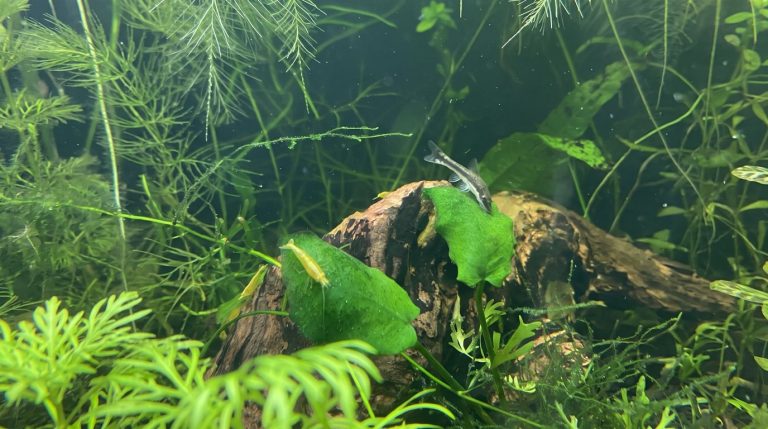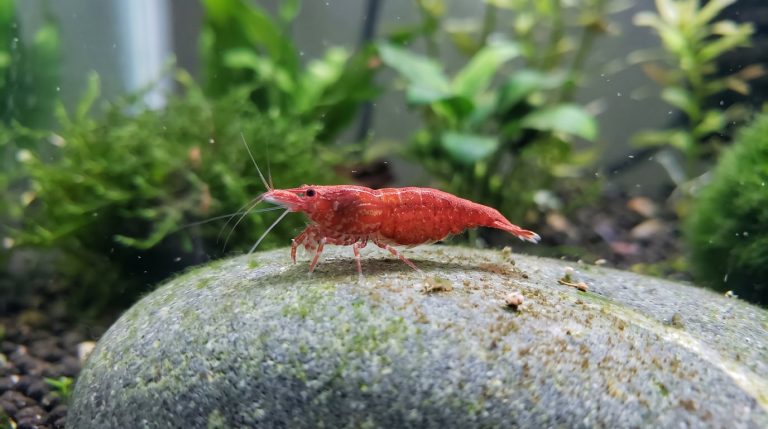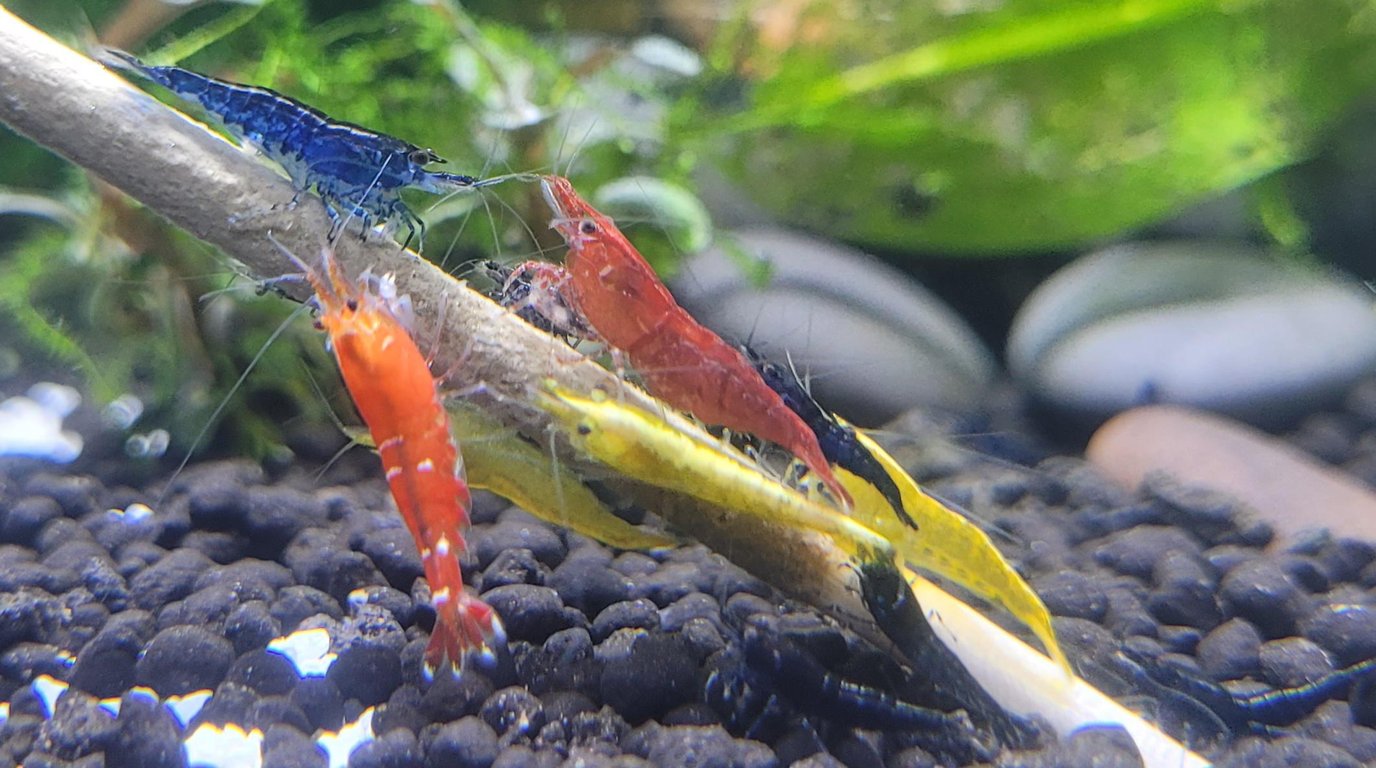
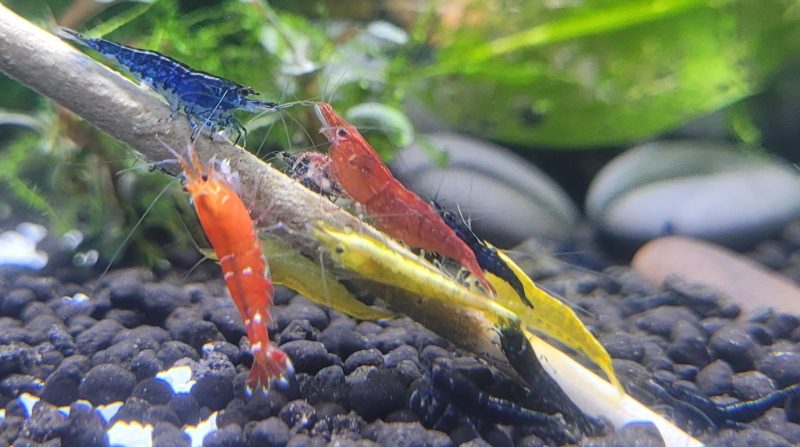
Yes, you can mix Neocaridina shrimp colors in one tank. Cherry shrimp (Neocaridina davidi) of different color lines live together peacefully, take the same water and breed with each other. The catch is the babies: young from mixed lines usually lose their parents’ colors and turn brown, clear or wild-looking. Mix them for a colorful display, and split the lines into separate tanks whenever holding a color matters to you.
Our tank-bred Neocaridina shrimp are sold one color line at a time, so the choice comes before you stock: one line per tank, or several together.
Water won’t make that choice for you. Every color line, Snowball included, is kept in the same range: 72-77°F (22-25°C), pH 6.8-7.6, GH 6-10 dGH and KH 2-5 dKH. Ammonia and nitrite stay at 0 in a cycled tank. The lines are peaceful with each other as well, so mixing them changes nothing else about Neocaridina shrimp care. What it changes is the next generation.
Why don’t Neocaridina colors blend like paint?
Neocaridina colors aren’t shades of one pigment, so mixing them isn’t like mixing paint. Among the types of Neocaridina shrimp, blue and red differ in which pigment systems do the work. A red shrimp and a blue shrimp aren’t two shades of one paint that could blend into a third.
That comes from a lab study of red, yellow and blue strains of cherry shrimp. The blue strain carried significantly more crustacyanin, a protein that binds the pigment astaxanthin. The red and yellow strains held more pteridines, a second family of pigments, and showed higher activity in the genes that make them. The authors conclude that these two pigment systems are the main source of the color differences, above all between blue and the red or yellow strains.1
The study compared the strains side by side and didn’t breed them together. It shows there’s no single paint to mix, but it doesn’t predict what the young of a cross look like. That part comes from keepers’ tanks.
What keepers find in mixed tanks is mostly young that look like wild Neocaridina. Researchers describe the wild-type cherry shrimp as transparent with scattered black spots.2 A study of farm-bred morphs describes the brown, wild-type form as see-through and faintly bluish, flecked with black-brown spots.3 Hobbyists call these shrimp “brownies” and say a line that throws them has reverted.
What happens if you mix red and blue cherry shrimp?
Don’t plan on purple. Keepers who mix unrelated lines, red and blue among them, mostly get babies that look brown or wild type. In one tank of red, blue and some orange shrimp, the babies ran from brown to rili patterns and some black, and none came out green.
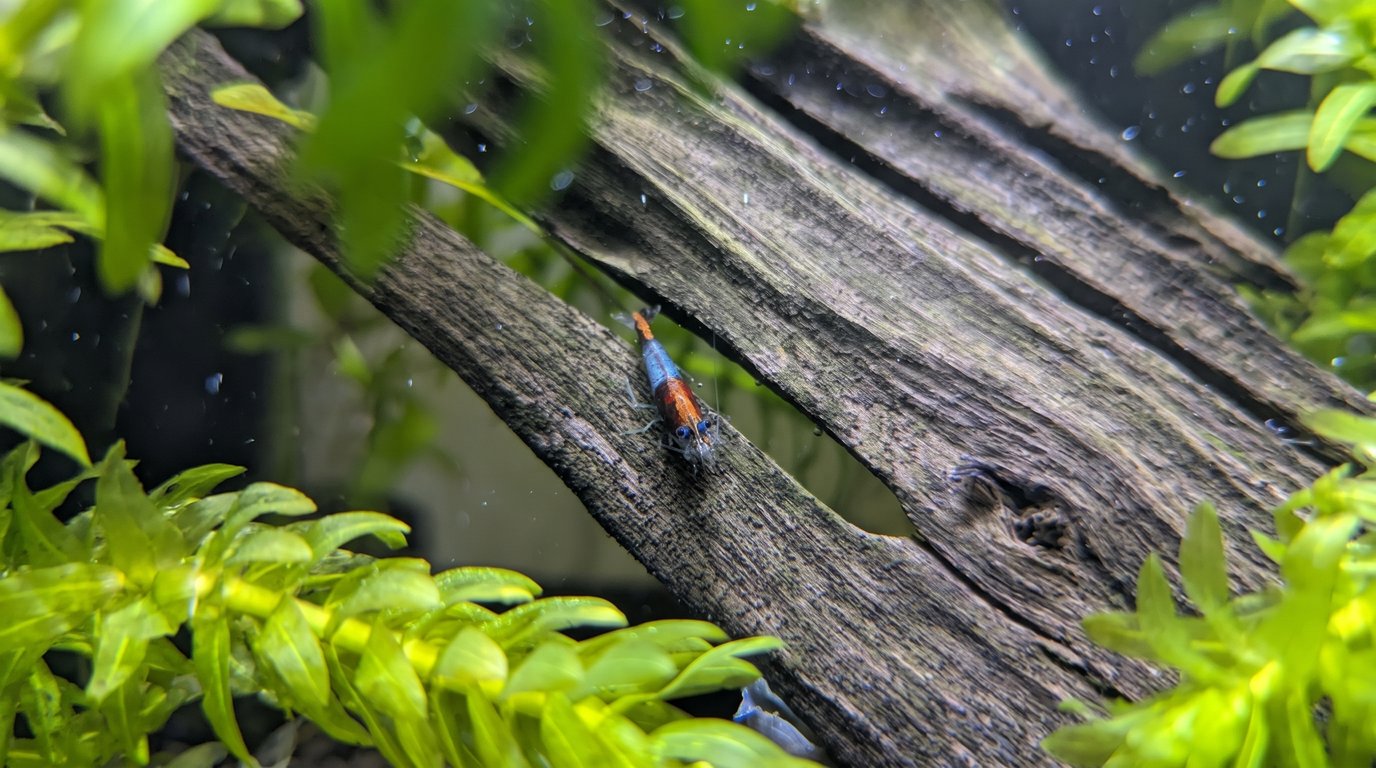
A mixed tank can still throw the odd bright shrimp, so treat any pairing as a gamble with the colors, never a recipe.
Can all Neocaridina shrimp breed together?
Yes, the cherry shrimp color lines can all breed with each other, because they’re one species. A University of Florida profile lists red cherry, orange and yellow sakura, green jade, blue dream, blue velvet, blue jelly and rili as forms of Neocaridina davidi. It says generations of selective breeding turned a transparent or greenish-brown wild shrimp into those colors and patterns.4 Neocaridina davidi is also the accepted name in the World Register of Marine Species, the taxonomic list that covers freshwater shrimp too.5
The scientific names are still argued over. One research group contends that N. davidi and three related names all belong to a single species.6 A commentary on wild Neocaridina in Japan treats crossing between Neocaridina lineages as a real concern, while researchers disagree over whether those two are separate species at all.7 None of that changes what happens in a hobby tank, where the color lines cross.
A couple of notes on this page come from the way Shrimp Aquatics runs its own breeding tanks, and a home tank can turn out differently. Snowball, the opaque white line Shrimp Aquatics sells as Neocaridina zhangjiajiensis, goes by a different species name. Put it in with red cherry or Blue Dream, though, and they cross, and the crossbred young lose their color. Adding Snowball to a colored tank puts both lines at stake.
How soon does a mixed Neocaridina tank lose its colors?
A mixed Neocaridina tank can start losing its colors with its very first broods. Keepers who mixed unrelated color lines report mostly brown or wild-type babies. In one tank every baby from the first brood was brown, and the generation after that was brown too. Another tank of several mixed lines had gone brown within about four months.
A few bright shrimp still turned up. Reds kept appearing for a couple of generations in one tank, and a green and some near-chocolate browns popped up in another. No published study has crossed hobby color lines and counted how many generations the color takes to fade, so the timing here comes from keepers.
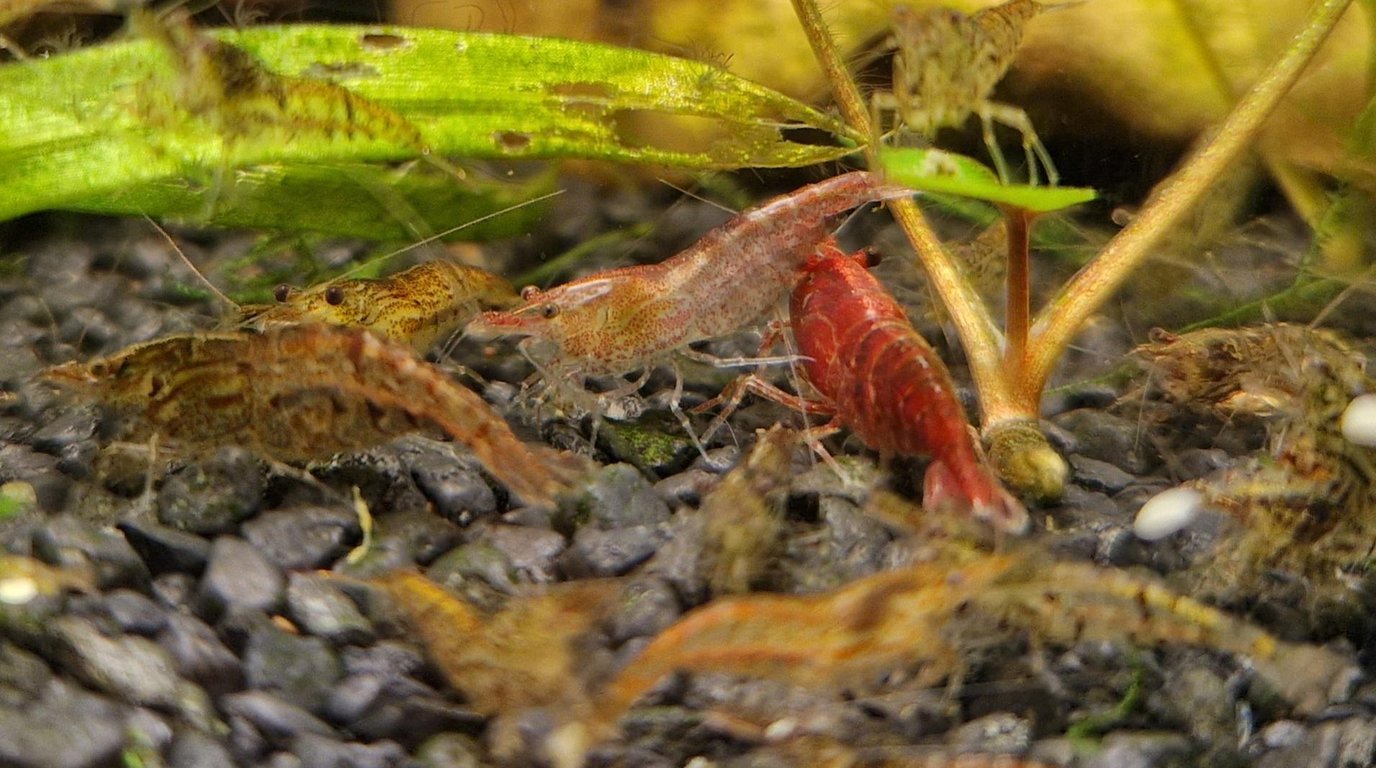
Keepers count it in months and broods because the change shows up in the young, so it moves at the pace of Neocaridina shrimp breeding in the tank.
Shrimp Aquatics keeps every color line in a separate tank. When its lines are kept together, the crossbred young lose their color and their bodies go clear. Other keepers describe the same young as brown or wild type. The words differ from tank to tank, but they all describe young that have lost the color their parents carried.
Why not mix them and see what you get? Because by the time the first broods show you the result, the crosses have already happened. If a line matters to you, make the call before the colors go in together.
Do off-color babies mean your Neocaridina line was mixed?
A brown or clear baby in a one-color Neocaridina tank doesn’t prove the line was mixed. Keepers see off-color young in tanks nobody mixed. One blue colony that never had another shrimp added produced almost all brown babies, and another threw striped brown ones, some of which later looked almost clear. A tank of red cherries from a single hobbyist threw a brown youngster.
Give a baby time before you judge it, too. Keepers find cherry shrimp babies clear for the first days, with color starting at about one to three weeks. A see-through shrimplet early in baby cherry shrimp care tells you nothing about the line yet.
Should you keep a mixed Neocaridina skittles tank?
Keep a mixed “skittles tank” if you want a colorful display and any young are welcome. If you want a color to carry on, or plan to pass shrimp on by line, keep one line per tank.
| Your goal | Mix or separate | Why |
|---|---|---|
| A colorful display, any young welcome | Mix | The lines take the same water and live together peacefully |
| Keeping one color going | One line per tank | Young from mixed lines can lose their parents’ color |
| Passing on or selling shrimp by color | One line per tank | Young from a mixed tank may not match the line you’d name them as |
In a skittles tank the color comes from the shrimp you put in. The young it raises tend to be mostly brown or wild-looking, with the odd bright one. That’s fine if you enjoy the tank for what it is.
Where should Neocaridina culls go?
Culling means taking the shrimp that don’t match out of a tank where you’re holding a color. Keepers who want a color to last do exactly that with their off-color young. In a mixed tank you can cull to keep the look you like, but don’t count on it to rebuild a single line.
Culled shrimp still need a home. Move them to a display tank of their own, or pass them to other keepers who enjoy a mixed tank. Never let shrimp, plants or tank water go into a pond or stream. Release from aquariums is the most common way cherry shrimp have reached waters outside their native range, and they’re established on Oahu, Hawaii.8
How do you get a single Neocaridina color line back?
Start a separate tank from one line that has been kept on its own, and keep the mixed tank going as a display. One line per tank is how a color is held, so a fresh single-line tank is the dependable route. It also leaves you with both: a display full of whatever the mix throws, and a line you can keep.
References
8 Sources
- Decoding color variation: genome-wide characterization and expression analysis of pigment pathways in Neocaridina denticulata, Bai et al., BMC Genomics 27: 535, 2026 (the paper names the shrimp N. denticulata).
- Functional Analysis of the NinaB-like Gene in Body Color Regulation of Neocaridina denticulata sinensis, BioTech 15(1): 15, 2026.
- All Shades of Shrimp: Preferences of Colour Morphs of a Freshwater Shrimp Neocaridina davidi (Decapoda, Atyidae) for Substrata of Different Colouration, Animals 11(4): 1071, 2021.
- EENY-751: Cherry Shrimp Neocaridina davidi (Bouvier 1904), Suen and Gillett-Kaufman, UF/IFAS Extension Featured Creatures, 2020.
- Neocaridina davidi (Bouvier, 1904), DecaNet, World Register of Marine Species, record modified 2024.
- Integrative Taxonomy Reveals New Insights into the Species Validity of the Neocaridina davidi-N. denticulata-N. heteropoda Complex and Mitogenomic Phylogeny of Caridean Shrimps, Current Issues in Molecular Biology 46(11): 12279-12298, 2024.
- Commentary: Integrative Taxonomy Reveals Freshwater Shrimp Diversity (Decapoda: Atyidae: Neocaridina) from Kyushu and Southern Honshu of Japan, with a Discussion on Introduced Species, Fuke, Zoological Studies 63: 53, 2024.
- Neocaridina davidi (Bouvier, 1904), cherry shrimp: species profile, U.S. Geological Survey Nonindigenous Aquatic Species program, updated 2026.
Ready to get started?
Shop our Neocaridina Shrimp collection
15 products available · Live Arrival Guarantee