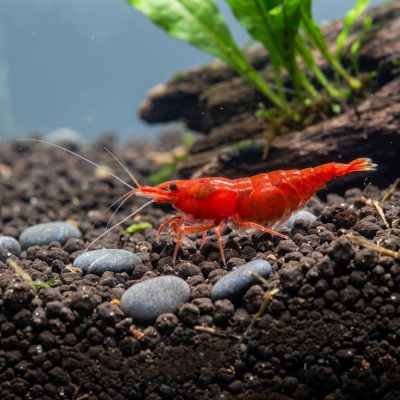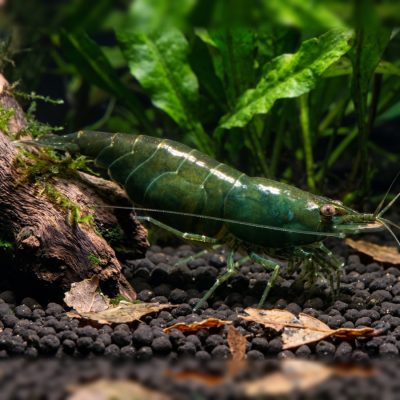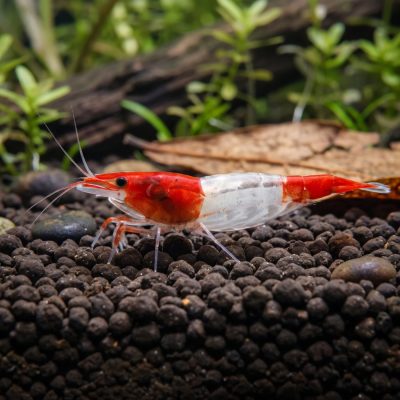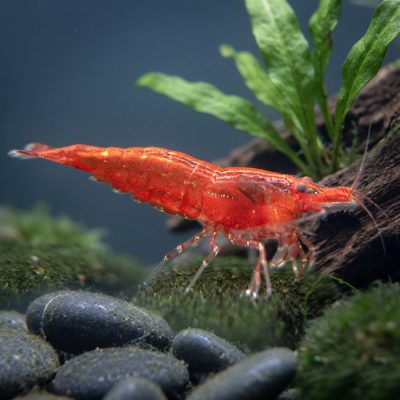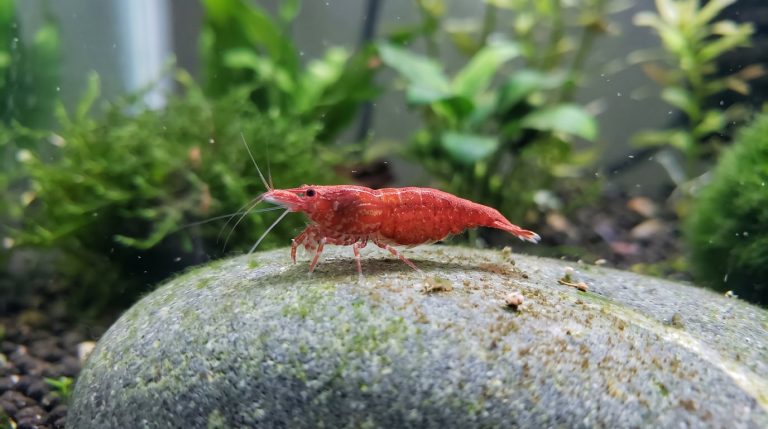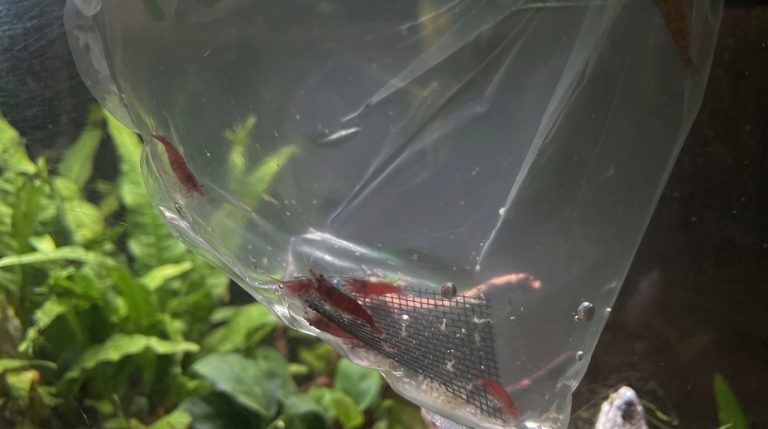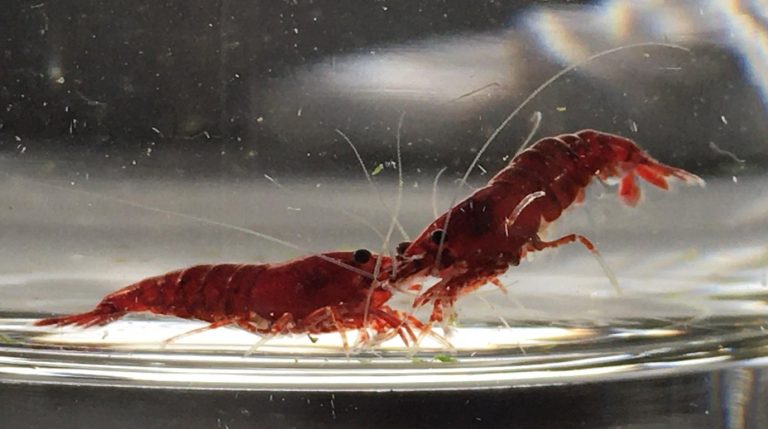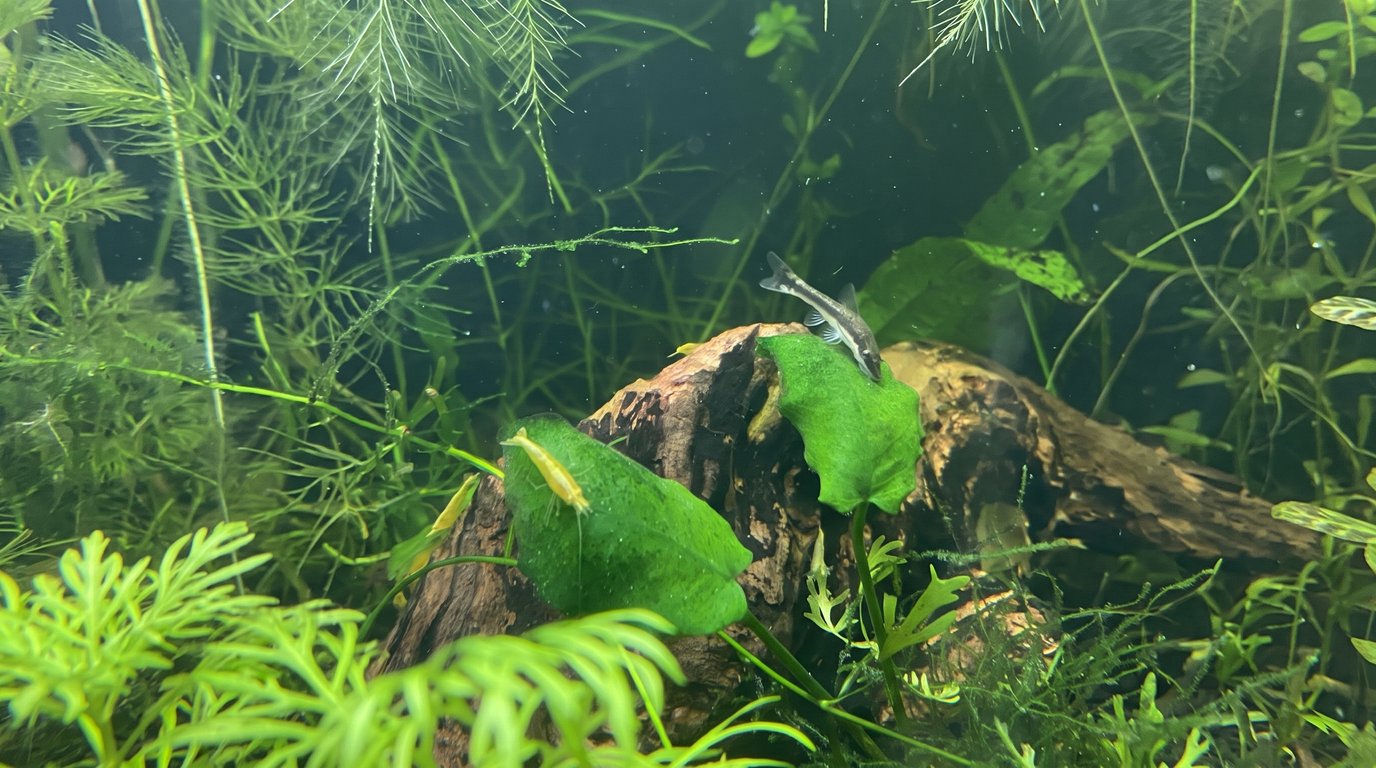
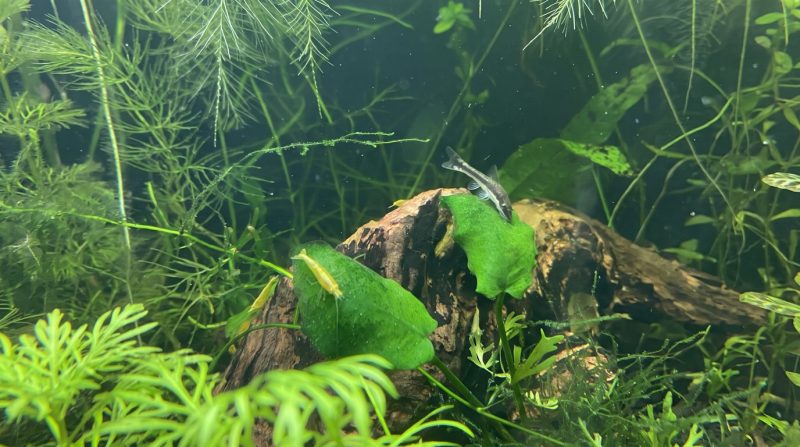
The lowest-risk tank mates for Neocaridina shrimp are snails and other peaceful invertebrates, plus a few very small fish such as otos. Almost any fish can take some of the babies, though, so a shared tank needs thick cover and a keeper who can live with losing a few. Bettas, cichlids and bigger fish put adult shrimp at risk too, and they don’t belong in a tank you’re building a colony in. If you want cherry shrimp (Neocaridina davidi) to multiply as fast as they can, give them a tank with no fish at all.
These choices hold whichever color line of our tank-bred Neocaridina shrimp you keep, from deep reds to blues.
Picking tank mates is one of the bigger calls in Neocaridina shrimp care. It’s far easier to make before the tank is stocked than after shrimp start going missing.
Why a fish in the tank costs a Neocaridina colony some of its babies
Fish eat what fits in their mouths, and a newborn cherry shrimp fits in the mouths of fish that would never manage an adult. So the real test of any fish is how many babies it takes, and whether the colony can stay ahead.
In a salt marsh study of wild marine shrimp, the smallest juveniles turned up in fish stomachs far more often than their share of the shrimp around them.1 Those were sea fish and a different kind of shrimp, but keepers describe the same pattern: the newest babies go first.
A hungry fish can also clear a small space fast. In fenced stream pools on Guam, no wild atyid shrimp could be seen a day or two after a jungle perch went in.2 That’s a big river fish, not a nano fish, but it shows how quickly shrimp disappear.
Adults have a weak moment of their own, right after a molt. In farmed giant river prawns, a much bigger freshwater animal, newly molted prawns are the ones at risk of being eaten by other prawns.3 The authors suggest giving molting animals places to get away. Cover may give a cherry shrimp the same kind of refuge in the soft stage after it sheds, and knowing how often cherry shrimp molt tells you how often an adult goes through that stage.
What this page says about the Shrimp Aquatics tanks comes from what Shrimp Aquatics sees with the shrimp it breeds, and another keeper’s tank can turn out differently. In the Shrimp Aquatics tanks where Neocaridina live with fish, the adult shrimp do fine, but many of the young get eaten.
Other keepers paint a wider picture. Some keep cherry shrimp with chili rasboras or celestial pearl danios and still see the colony grow or hold steady, while the fish pick off some newborns. Others have lost adult shrimp to tetras or a guppy. Either way, a shared tank trades some shrimplets for the fish, so decide which you want more. If it’s the colony, plan the cover now or give the shrimp their own tank.
What fish can you keep with cherry shrimp?
The lowest-risk fish for cherry shrimp are otos and the tiniest nano fish, such as chili rasboras and celestial pearl danios. They’re generally lower risk with adult shrimp, but not safe for shrimplets.
Check the water first. Neocaridina shrimp water parameters run 72-77°F (22-25°C), pH 6.8-7.6, GH 6-10 dGH and KH 2-5 dKH, and a fish has to be comfortable in that water too. Treat these numbers as a guide, not a pass-fail test. Neocaridina are easy shrimp, and a tank that sits a little outside one of them can still work, as long as it isn’t far off.
Keepers with otos and cherry shrimp report no attacks on adults or young, in colonies of about 50 to over 100 shrimp. The two do compete, because otos and shrimp go for the same food and sometimes push each other off it. Otos are also sensitive and do best in a mature tank with plenty to graze.
Chili rasboras and celestial pearl danios show the trade-off more plainly. Keepers who have cherry shrimp with them report the colony still breeding and growing or holding, with the fish taking some of the newest babies. They tie the babies’ survival to moss and plant cover.
| Fish | Listed temperature and adult size | What to expect with cherry shrimp |
|---|---|---|
| Otocinclus (Otocinclus vittatus, O. affinis) | 68-77°F (20-25°C), up to 3.3 cm4; 68-79°F (20-26°C), up to 5 cm5 | Keepers report no attacks on adults or young; they compete with the shrimp for food |
| Chili rasbora (Boraras brigittae) | 77-82°F (25-28°C), usually about 2 cm, up to 3.5 cm6 | Keepers report the colony still breeding, with some of the newest babies eaten |
| Spotted rasbora (Boraras maculatus) | 75-79°F (24-26°C), up to 2.5 cm7 | Often peaceful, but many small rasboras eat shrimplets |
| Exclamation point rasbora (Boraras urophthalmoides) | No range listed, up to 4 cm8 | Often peaceful, but many small rasboras eat shrimplets |
| Celestial pearl danio (Danio margaritatus) | Wild ponds recorded at 72-75°F (22-24°C) in January, adults about 2 cm9 | Keepers report the colony still breeding, with some of the newest babies eaten |
| Pygmy corydoras (Corydoras pygmaeus) | 72-79°F (22-26°C), up to 2.1 cm10 | May coexist in a larger, well-structured tank, but can eat shrimplets and compete for food |
| Dwarf corydoras (Corydoras hastatus) | 77-82°F (25-28°C), up to 2.4 cm11 | May coexist in a larger, well-structured tank, but can eat shrimplets and compete for food |
| Ember tetra (Hyphessobrycon amandae) | 75-82°F (24-28°C), up to 2 cm12 | Often peaceful, but many small tetras eat shrimplets |
| Medaka (Oryzias latipes) | 64-75°F (18-24°C), up to 4 cm13 | Treat it like a small tetra: often peaceful, but many eat shrimplets |
Read the temperatures before the names. FishBase lists chili rasboras at 77-82°F (25-28°C), so they only meet a cherry shrimp tank at its warm edge, 77°F (25°C).6 Dwarf corydoras sit at that edge or above it.11 Either one means running your shrimp at the top of their range.
So pick a fish whose listed range overlaps your shrimp’s water and whose adults are tiny, then still expect some young to go.
Tetras and guppies are a gamble even with adult cherry shrimp
Small tetras and guppies are a gamble, because some keepers lose adult shrimp to them while others keep the same fish with no adult losses at all. The fish named in those losses are rummy nose tetras, cardinal tetras, green neons, neons and a guppy.
Does that mean your neons will eat your shrimp? Not necessarily, and that’s the trouble: you won’t know which kind of tank you have until the fish are in it.
The signs were a shrimp held in a fish’s mouth, repeated bites, shrimp found in pieces and a shrinking colony. Even where tetras leave the adults alone, many small tetras eat shrimplets. Both are standard community tank fish, and FishBase lists the neon tetra at 68-79°F (20-26°C)14 and the guppy at 64-82°F (18-28°C).15 The water won’t rule them out; their appetite is what matters.
If you want them anyway, add them to a tank where the colony is already large and the cover is dense. Watch closely for the first few days, and be ready to move the fish or the shrimp out. Keepers report both orders, fish first and shrimp first, working and failing, so don’t count on the order to protect the shrimp.
Keep bettas, cichlids and larger fish away from a Neocaridina colony
Keep bettas, cichlids and larger fish out of a tank where you want Neocaridina to breed. They put adult shrimp at risk as well as the babies, and none of them is shrimp-safe. Goldfish, angelfish, gouramis and larger barbs count as larger fish here.
Bettas are the one people want to try, and keepers’ results run the whole range. Some report colonies that grew with a betta, one that held steady while the betta picked off babies, and others that shrank to a handful or vanished. The keepers whose colonies grew credit moss, plants and hiding places.
Which snails and other invertebrates can share a Neocaridina tank?
Snails are the lowest-risk companions for Neocaridina, apart from assassin snails, which hunt other snails. Other invertebrates each come with a catch of their own.
If you add nerite snails, don’t expect baby nerites, though that rests on related species. In a lab study, eggs of a related nerite, Clithon diadema, developed in fresh water but didn’t hatch without salt.16 The hobby expects the same of aquarium nerites, so you may see eggs on hard surfaces but no young. Ramshorn and Malaysian trumpet snails turn up in plenty of shrimp tanks too.
Mystery snails (Pomacea diffusa) are the one apple snail US federal rules let move between states without a permit, and APHIS describes them as mainly algae feeders.17 That’s a rules and diet note, not a promise about your shrimp. Other countries regulate apple snails differently, so check your own rules first.
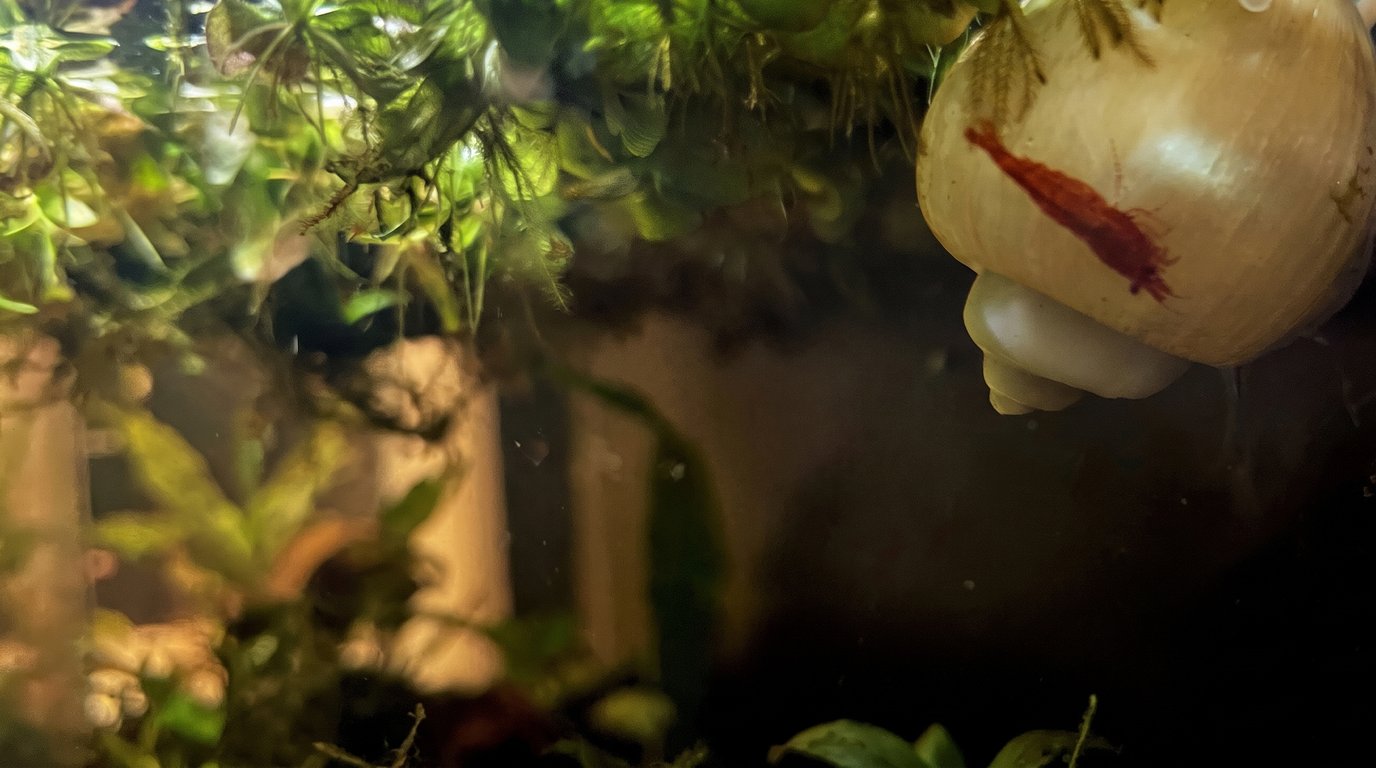
Assassin snails (Anentome helena) are snail predators. In a lab study they hunted and ate other snails, each snail tending to stick to favorite prey, and Malaysian trumpet snails were eaten least.18 Shrimp weren’t offered in that study, and keeper reports on live shrimp are mixed, so an assassin snail in a shrimp tank is a gamble.
Amano shrimp won’t breed in your tank. In a lab study, larvae of Caridina multidentata, the Amano shrimp, didn’t reach the juvenile stage at low salinity, because they need saline water to develop.19 They’re a different genus from Neocaridina, and their young never develop in a freshwater tank.
Vampire shrimp and bamboo shrimp need a different kind of tank. The vampire shrimp, Atya gabonensis, filter-feeds with fine setae on its claws and is adapted to fast-flowing water.20 Bamboo shrimp are sold as filter feeders of the same kind. Both need current and fine food in the water, and a cherry shrimp tank usually has gentle flow.
Dwarf crayfish are a gamble for the babies. The US Fish and Wildlife Service risk screening for the Cajun dwarf crayfish (Cambarellus shufeldtii) records no measured diet, only that it’s probably an opportunistic feeder on detritus.21 So treat it as an unmeasured risk to shrimplets.
Other Neocaridina color lines can crossbreed with yours. Mixing lines can produce wild-type, brown offspring, and that’s the risk to weigh before mixing Neocaridina shrimp colors in one tank.
Bee and Crystal shrimp don’t match a Neocaridina tank: they’re kept at 60-72°F (15.5-22°C), pH 5.8-6.8 and GH 4-6 dGH, cooler and softer water.
A few tank mates set the water themselves. A small group of Neocaridina lives and breeds in some Shrimp Aquatics Sulawesi tanks, in the same warm, alkaline, mineral-rich water as its rabbit snails. Shrimp Aquatics has seen Neocaridina live and breed there at up to 86°F (30°C). That’s the warmest it has seen them do well, not a target for a cherry shrimp tank, and at 90°F (32°C) breeding fails.
Keeping Sulawesi shrimp with Neocaridina works on the Sulawesi side’s terms. Their warm water sets the tank, and the Neocaridina stay a small group.
The same goes for rabbit snails with Neocaridina shrimp, where the snails’ hard, warm water comes first and the shrimp fit in around it.
Neocaridina also live and breed in the water section of the Shrimp Aquatics vampire crab paludariums, where the crabs rarely catch them. Where vampire crabs live with shrimp, the tank is built around the crabs, and the shrimp are a small group in the water part.
How to give Neocaridina shrimplets a chance in a shared tank
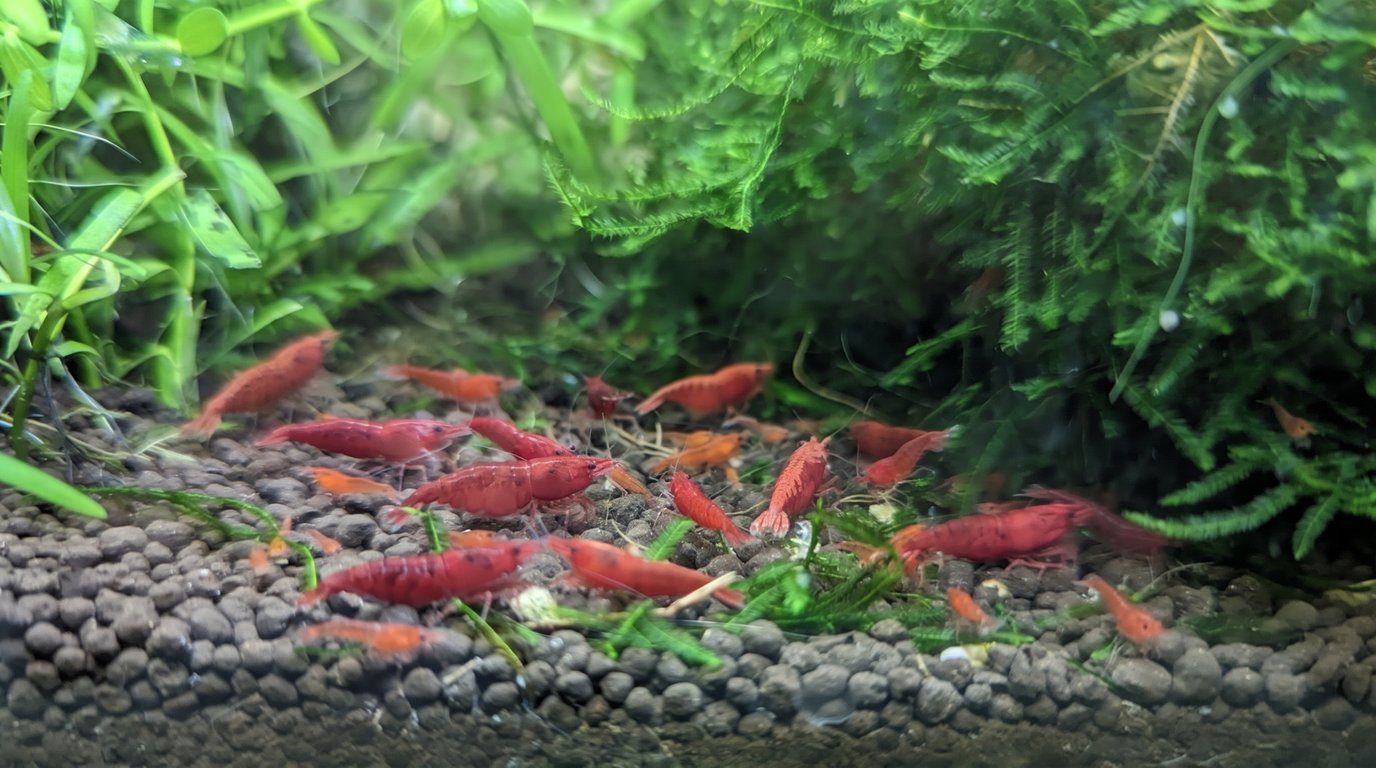
Give shrimplets thick, fine cover where a fish can’t easily follow them: dense moss, fine-leaved plants, leaf litter or wood. That’s what keepers with growing colonies credit.
In a lab study on an estuarine grass shrimp kept with killifish in sea water, about half the shrimp survived on bare gravel. Nearly all survived in the most branched, complex cover.22 That’s a different shrimp, fish and water, so it tells you cover helps, not how much moss you need.
No published study has tested which aquarium fish spare Neocaridina shrimplets, so plan on cover and on losing some young whatever fish you pick.
Fish aren’t the only thing eating babies. Some keepers report losing baby shrimp in tanks with planaria, with the baby count dropping as the planaria multiplied. None of them saw a planaria actually eat one. In lab dishes, Hydra and planarians preyed on water fleas, small crustaceans rather than shrimp.23 If babies keep vanishing in a tank with no fish, look on the glass and under the decor for these before you blame anything else.
If the colony matters more than the fish, give it a tank with no fish. A second tank works too: the colony grows there, and extras can move to the community tank. Without fish to dodge, baby cherry shrimp care comes down to steady water and enough to graze on.
Treat sick fish away from your Neocaridina shrimp
Treat a sick fish in a separate tank, and read every ingredient before anything goes into the tank with your shrimp. A “safe for invertebrates” line on a bottle doesn’t settle it. Whether a treatment harms shrimp depends on the exact active ingredient, how much goes in, the species and your water.
A 2026 review of the ornamental shrimp trade says copper-based treatments and dips are lethal to invertebrates and many fish treatments are toxic to them.24 That’s why shrimp care leans on quarantine and clean water. Look for copper by name. The US Environmental Protection Agency calls elevated copper toxic to aquatic invertebrates as well as fish, and hardness and pH change how toxic it is.25
That spare tank earns its place twice. If the colony comes first, it’s the shrimp’s home with no fish at all. If the community tank comes first, keep the fish tiny and the cover thick, and accept that some babies won’t make it.
References
25 Sources
- Fish Predation on Juvenile Penaeid Shrimp: Examining Relative Predator Impact and Size-Selective Predation (abstract), Estuaries and Coasts, Springer, 2018.
- Factors Affecting the Distribution of Atyid Shrimps in Two Tropical Insular Rivers, Leberer and Nelson, Pacific Science 55(4): 389-398, 2001.
- Angular Substrate Preference and Molting Behavior in the Giant River Prawn, Macrobrachium rosenbergii and its Implications for Cannibalism Management, McCallum, Weston and Tilahun, Proceedings of the Oklahoma Academy of Science 99: 7-11, 2019.
- Otocinclus vittatus summary page, FishBase (Froese and Pauly, eds.), accessed November 2026.
- Otocinclus affinis summary page, FishBase (Froese and Pauly, eds.), accessed November 2026.
- Boraras brigittae species summary, FishBase (Froese and Pauly, eds.), accessed October 2026.
- Boraras maculatus species summary, FishBase (Froese and Pauly, eds.), accessed October 2026.
- Boraras urophthalmoides summary page, FishBase (Froese and Pauly, eds.), accessed November 2026.
- The “Celestial Pearl Danio”, a new genus and species of colourful minute cyprinid fish from Myanmar (Pisces: Cypriniformes), Roberts, The Raffles Bulletin of Zoology 55(1): 131-140, 2007.
- Corydoras pygmaeus summary page, FishBase (Froese and Pauly, eds.), accessed November 2026.
- Corydoras hastatus summary page, FishBase (Froese and Pauly, eds.), accessed November 2026.
- Hyphessobrycon amandae species summary, FishBase (Froese and Pauly, eds.), accessed October 2026.
- Oryzias latipes summary page, FishBase (Froese and Pauly, eds.), accessed November 2026.
- Paracheirodon innesi, Neon tetra, species summary, FishBase (Froese and Pauly, eds.), accessed October 2026.
- Poecilia reticulata, Guppy, species summary, FishBase (Froese and Pauly, eds.), accessed October 2026.
- Development of an artificial propagation and breeding method for the beehorn snail (Clithon diadema), Huang, Lee, Lin, Hu and Nan, Aquaculture Reports 36: 102145, 2024.
- Snails and Slugs (import and interstate movement guidance), USDA Animal and Plant Health Inspection Service, current page, undated.
- Assassin snails (Anentome helena) as a biological model for exploring the effects of individual specialisation within generalist predators, Berkhout and Morozov, PLoS ONE, 2022.
- Larval performance of three amphidromous shrimp species in the genus Caridina (Decapoda: Caridea: Atyidae) under different temperature and salinity conditions, Kondo, Hamasaki and Dan, Crustacean Research 50: 41-54, 2021.
- High stability in filtration apparatus of African shrimp, PubMed Central PMC10432203, 2023.
- Cajun Dwarf Crayfish (Cambarellus shufeldtii) Ecological Risk Screening Summary, U.S. Fish and Wildlife Service, revised October 2016.
- The effect of macrophytic cover on survival of Palaemonetes pugio and P. vulgaris (grass shrimp) in the presence of predatory Fundulus heteroclitus (killifish), Merchant, Khan and Knowlton, Contributions to Zoology 70(2): 61-71, 2001.
- Who Ate Whom, Competition and Predation in a Freshwater Microcosm, Kovacevic et al., Water (MDPI), 2025.
- An ecophysiological approach to improving health outcomes of ornamental shrimp during aquarium trade and transportation, Conway Holroyd, Spicer, Ellis and Turner, Conservation Physiology 14: coag046, 2026.
- Supplementary Training Materials for Aquatic Life Criteria: Copper, Background, U.S. Environmental Protection Agency, Office of Water, updated May 2026.
Ready to get started?
Shop our Neocaridina Shrimp collection
15 products available · Live Arrival Guarantee