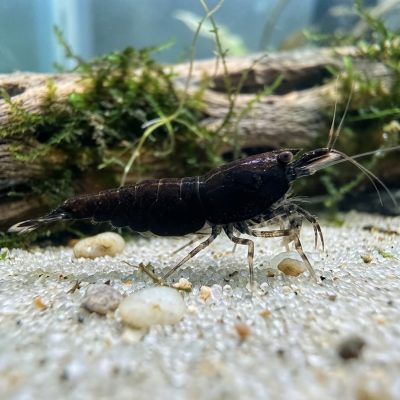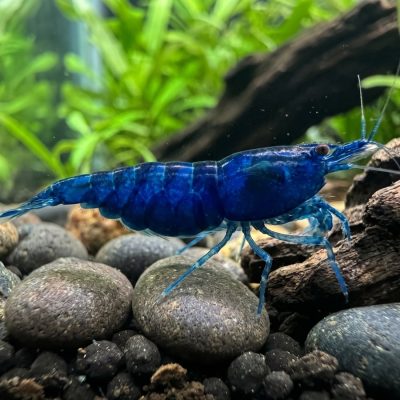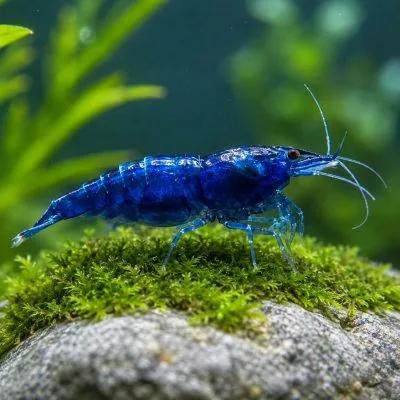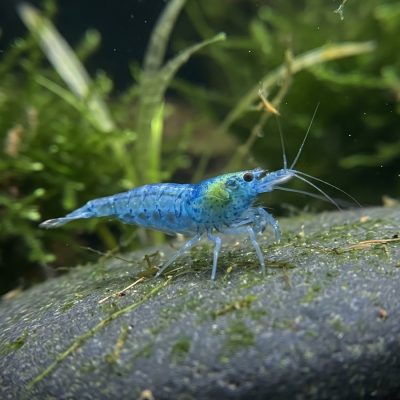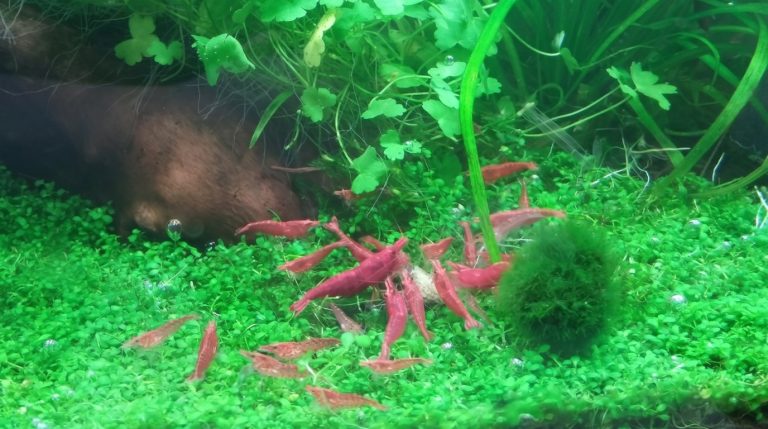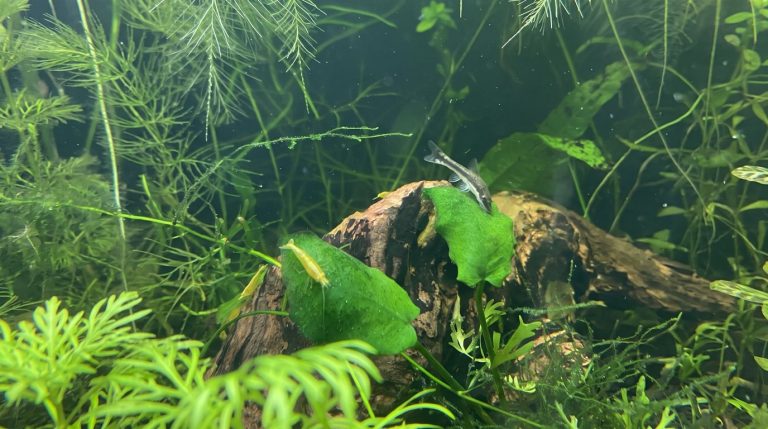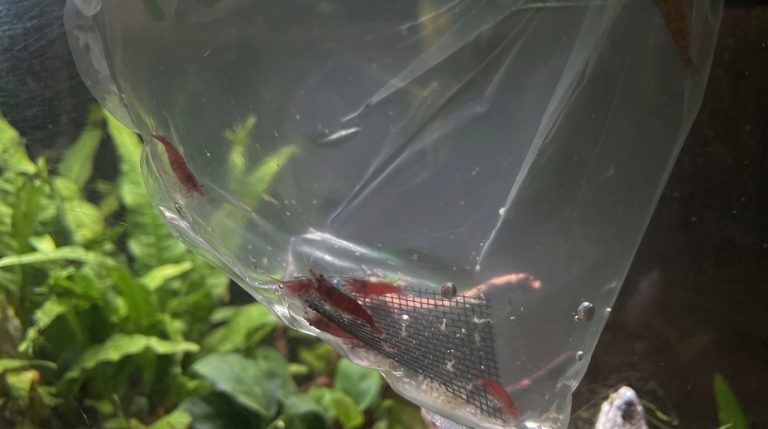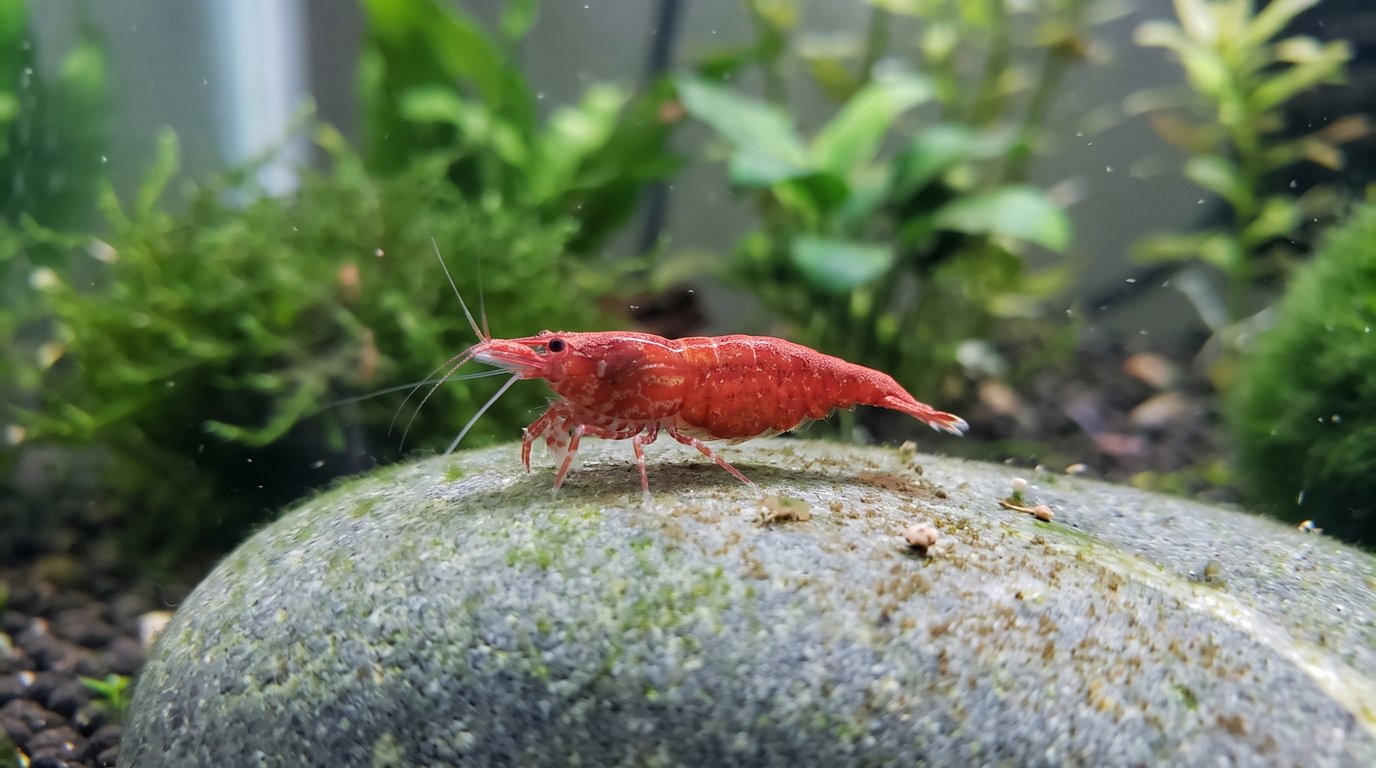
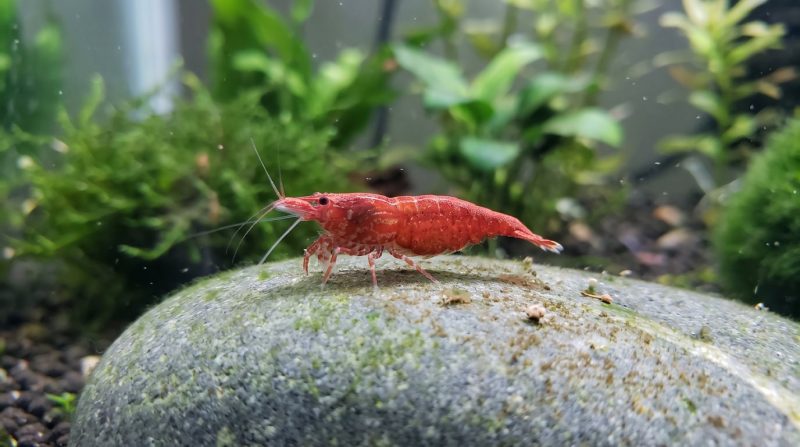
Yes, Neocaridina shrimp eat algae, mostly the soft kinds. Cherry shrimp (Neocaridina davidi) and their color lines spend the day picking biofilm, brown diatom film and soft green algae off glass, wood, stones and leaves. In keepers’ tanks they leave black beard and green spot algae, keepers are split on hair algae, and a colony keeps surfaces tidy between your own cleaning without clearing an outbreak.
That grazing is built into the species. The U.S. Geological Survey files the cherry shrimp as an opportunistic omnivore, with algae on its menu next to detritus and tiny bottom-dwelling animals.1 Researchers grew tape grass in outdoor tanks for 17 weeks. The film on its leaves came out close to half lower in the tanks stocked with Neocaridina, and the plants there grew faster. The authors attribute the drop to the shrimp eating the film.2
Every color line of our tank-bred Neocaridina shrimp grazes the same way, so the choice between them comes down to the color you want.
How much that grazing does for you depends on the algae you’ve got, the size of the colony and the rest of Neocaridina shrimp care in the tank.
Which algae do cherry shrimp eat, and which do they leave?
Cherry shrimp eat the soft films and leave the tough algae, with hair algae somewhere in between. Here’s what keepers and studies report.
| Algae or growth | What keepers and studies report | What to expect |
|---|---|---|
| Biofilm | Grazed on glass, wood, stones and leaves; the film on plant leaves fell by close to half with shrimp in an outdoor trial | Their everyday food |
| Brown diatom film | Eaten or picked at; keepers say not to wait for shrimp on a heavy coating | Help with a thin layer; wipe a thick one yourself |
| Soft green film on leaves and wood | Picked at by keepers’ shrimp, in small amounts | Light grazing where they feed every day |
| Hair, string or thread algae | Keepers split: soft, slimy strands eaten in some tanks, never in others; tough kinds left | Don’t stock shrimp to clear it |
| Green spot algae (GSA) | Left on the glass, or picked at without making a dent | Scrape it off yourself |
| Black beard algae (BBA) | Living tufts left alone | Trim it out by hand |
| Cyanobacteria (blue-green “algae”) | Not algae but bacteria; some kinds make toxins | Fix it as a tank problem, not as shrimp food |
Biofilm is the slick coat of microbes that forms on anything wet, and it’s what you’ll see them working over with their claws all day. On your plants, most keepers find the shrimp clean the film off healthy leaves and only eat into ones that are already melting or torn.
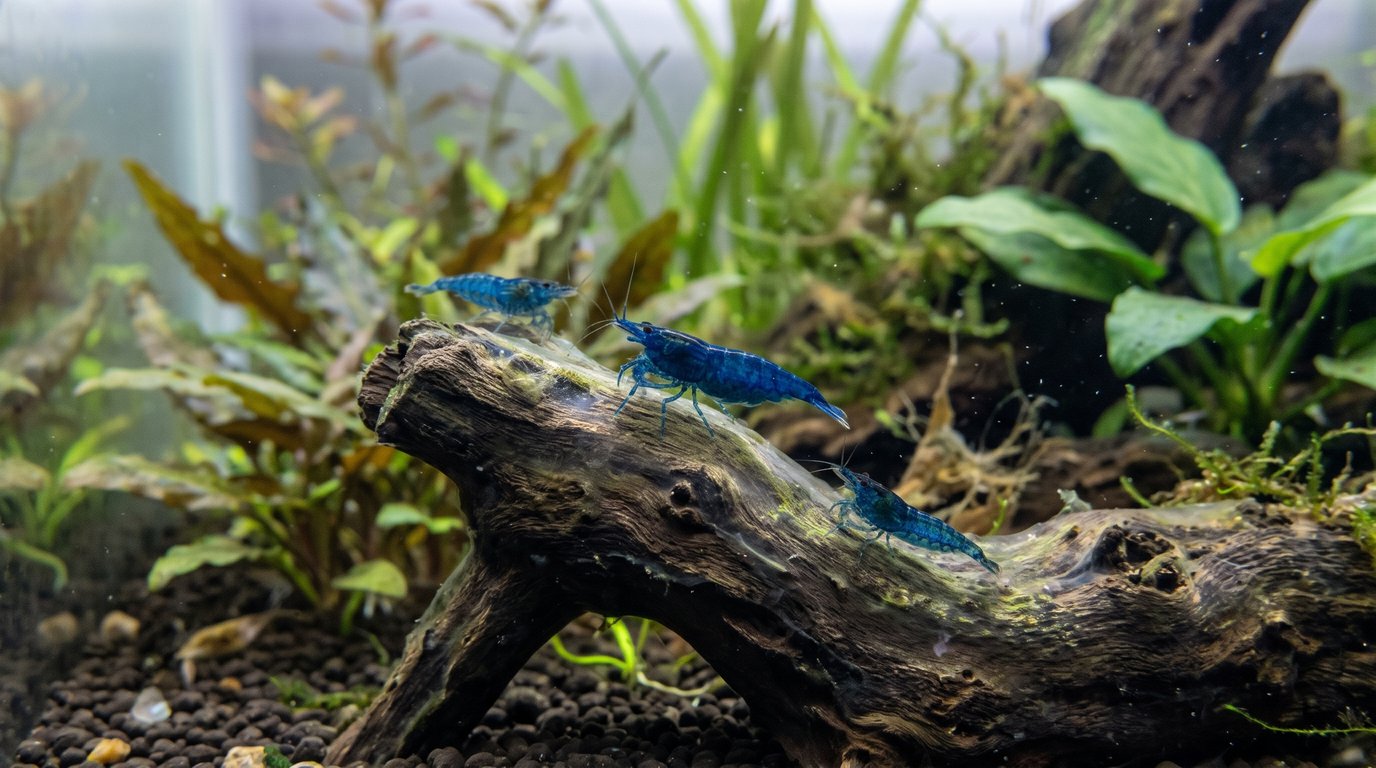
Brown diatom film, the dusty brown layer on glass and stones, gets eaten or picked at too. One keeper who tried it with their own red cherry shrimp found they cleaned it up pretty well. Others say to wipe a heavy coat off the glass yourself instead of waiting.
Hair algae is where keepers part ways. Some have seen their shrimp clean up the soft, slimy kind, and one of them found it only happened when the shrimp weren’t also being fed. Others have never seen cherry shrimp touch hair or thread algae. Keepers on both sides say the tougher kinds stay.
Green spot algae, the hard green dots on the glass, isn’t shrimp work. Keepers say theirs leave it or pick at it with no visible effect, and point to nerite snails for that job. Living black beard algae is left alone. In one tank the shrimp swarmed a clump within about half an hour, but only after it had been killed with a liquid carbon product. The algae was already dead by then, so don’t read it as a method to copy.
Cyano, the slimy blue-green sheet, isn’t algae at all. Cyanobacteria are photosynthetic bacteria, and only some of the hundreds of species are known to make toxins.3 EPA notes that those toxins can build up in aquatic invertebrates such as zooplankton and mussels.4 So don’t count on the shrimp for it: treat a blue-green film as a sign that something in the tank needs fixing, not as food for the colony.
A few notes on this page come from what Shrimp Aquatics sees in its own breeding tanks, and a home tank can behave differently. In those tanks the shrimp are seen eating the brown film and slime on glass and stones, soft green algae on leaves and wood, and hair algae as well. Keepers are split on hair algae, so take that as one more account on the side that sees it eaten. Soft growth is what to expect a colony to work on, and a hair algae problem still needs your hands.
Why are soft films easier for cherry shrimp than tough algae?
Related shrimp have feeding legs built for fine material, which fits a diet of soft film. In two Caridina species from the same family as Neocaridina, the first two pairs of legs carry dense setae for brushing up fine particles and scraping film off surfaces.5 In two more Caridina species, the claws carry modified spines and setae that gather fine food and pass it to the mouth.6 Neither study tested which algae the shrimp eat, so picture tiny brush-tipped claws built for a film. What cherry shrimp do with tough algae comes from the keeper reports above.
How much algae will a Neocaridina colony clean up?
A Neocaridina colony keeps the surfaces it grazes tidy between your own cleaning, but don’t expect it to clear an outbreak or remove what feeds the algae. Think of it as daily upkeep, the way wiping a counter after dinner is different from clearing out a flooded kitchen.
The same outdoor trial shows the limit. Tanks with shrimp ended up with more total phosphorus and nitrogen in the water, and more algae floating in it, than tanks without them.2 The shrimp cleaned the leaves, but they didn’t take nutrients out of a closed tank. In yours, that’s the job of plants and water changes.
So should you add more shrimp? A bigger, established colony works over more surface than a few new arrivals, but don’t count on extra shrimp to fix an outbreak. Size the group by how many cherry shrimp per gallon your tank can carry, not by how much algae you can see.
Do Amano shrimp eat more algae than cherry shrimp?
Most keepers who have kept both say an Amano shrimp does more algae work than a cherry shrimp, though they’re not unanimous. In one tank the Amanos ate hair algae the Neocaridina left alone. In another, the Amanos waited around for fish food, and the cherry colony did more by sheer numbers once it had filled the tank. One comparison lists black beard, staghorn, green spot and several kinds of hair algae as left by either shrimp.
There’s a catch with Amanos. The species sold as Amano shrimp, Caridina multidentata, is amphidromous, and researchers who reared its larvae state that larvae of such shrimp need saline water to develop. In their trial, none reached the juvenile stage at the lowest salinity they tested.7 So Amanos don’t build a breeding colony in a freshwater tank the way cherry shrimp do; the ones you add are the ones you have.
Can cherry shrimp survive on algae alone?
A small group in a mature, planted tank can get a lot of its food from algae and biofilm. Don’t plan on algae alone for a new tank or a growing colony, though. One test used an aquaculture system built to grow biofilm on nets and sheets. With that film as their only food, Neocaridina grew, and females matured and carried eggs.8 A home aquarium isn’t built that way.
The diet that keeps a colony going is the film and algae plus food you add, and pellets don’t replace the grazing. A new tank has little film yet, and a growing colony has more mouths for it. Both need a top-up beyond what Neocaridina shrimp eat off the surfaces.
What should you do when algae outgrows your cherry shrimp?
Start with whatever is feeding the algae, then take out what you can by hand and let the shrimp keep up with the rest. Extension guidance for ponds says most filamentous algae prefer still, warm, nutrient-rich water, and that an overgrowth is a symptom of too many nutrients.9 In ponds and lakes, blooms of cyanobacteria follow more sunlight, warmer water and an excess of nutrients, phosphates and nitrates in particular.3 Those are ponds, not tanks, but the levers are the same kind: what goes in, what comes out and what competes for it.
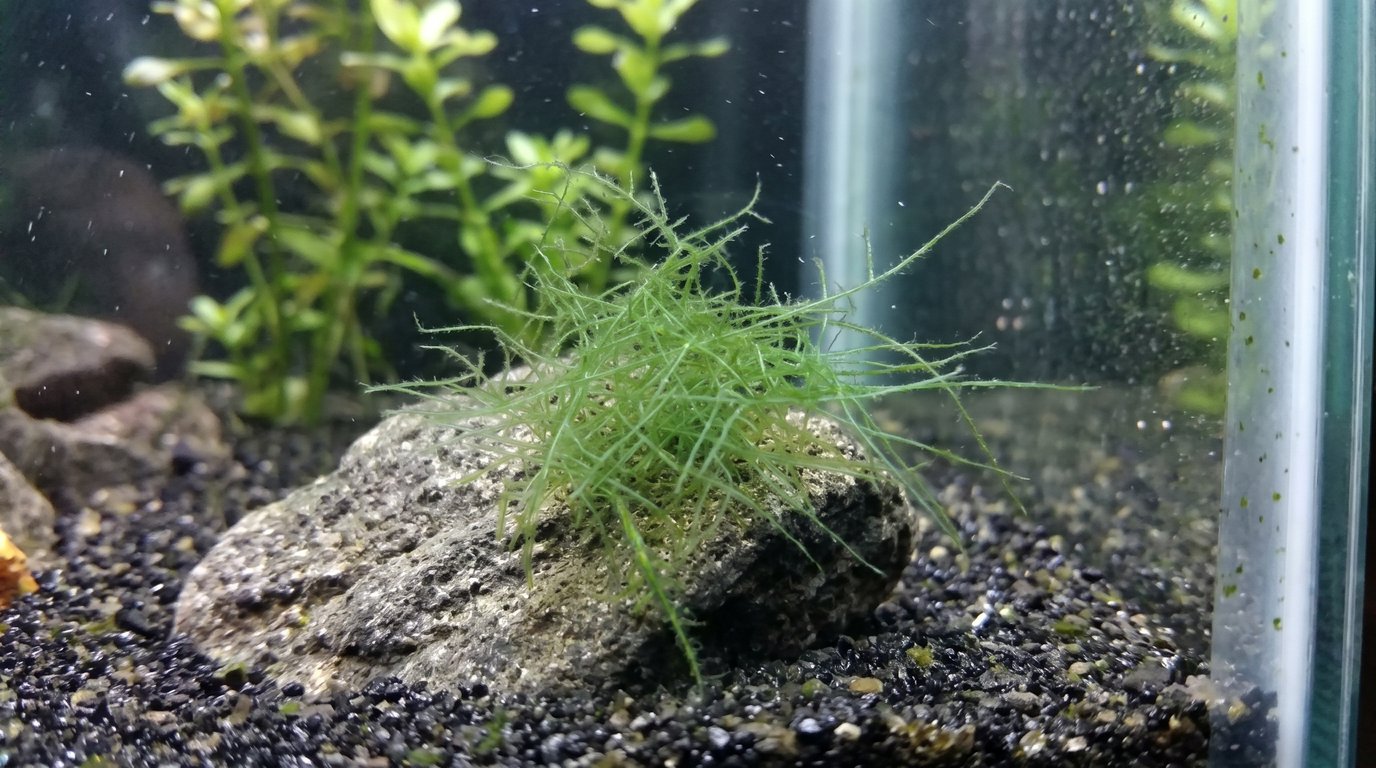
- Take out what you can by hand: twist strands of hair algae out, wipe the glass and trim the worst leaves.
- Keep up your regular water changes, so nutrients leave the tank instead of building up.
- Let healthy plants compete with the algae for what’s in the water.
- Clear a big outbreak in stages, and watch the shrimp after each round.
The stages matter. Penn State’s pond guidance warns that killing all the algae at once can deplete the oxygen as that mass decays.9 EPA also notes that blooms of cyanobacteria and green algae can contribute to oxygen loss.4
When one of its tanks grows a lot of algae, Shrimp Aquatics feeds less so the shrimp graze more of it. That means smaller portions, not skipped days, and it’s no reason to cut back in a new tank or one full of shrimplets. Less food also leaves less to break down; in fish systems, uneaten feed is one source of ammonia, and overfeeding is a major cause of high levels.10 Shrimp Aquatics never uses algae killers in tanks that hold shrimp. In your tank too, cut the food before you reach for a bottle.
Which algae treatments put cherry shrimp at risk?
Keep copper algaecides out of a cherry shrimp tank, and treat glutaraldehyde and hydrogen peroxide as risks, not routine cleaners.
Copper first. EPA’s copper guidance says elevated copper is toxic to aquatic invertebrates, and that water chemistry such as pH, hardness and organic carbon changes how toxic a given amount is.11 In a lab study, 48 hours in copper-laced water changed the activity of more than 200 genes in Neocaridina, mostly ones tied to immunity and molting.12 In a much larger freshwater prawn, a week of waterborne copper damaged the gills and the hepatopancreas, and the damage grew with the dose.13 Pond guidance adds that copper sulfate algaecide can kill fish and release toxins from the algal cells it bursts.3
Glutaraldehyde-based treatments carry their own risk. EPA rates glutaraldehyde as highly to slightly toxic to freshwater invertebrates and slightly to moderately toxic to shrimp in acute tests. The shrimp it tested was a marine mysid, not a freshwater species like yours.14 Hydrogen peroxide was tested for 24 hours on freshwater life in the lab. A small mysid shrimp was the most sensitive of the larger invertebrates, some water fleas were more sensitive still, and cyanobacteria reacted at lower levels than green algae.15 Neither study tested a decapod, the group true shrimp like Neocaridina belong to, so there’s no safe dose for a shrimp tank to give you.
After any treatment or a large die-off, test the water. Ammonia and nitrite should both read 0 in a cycled shrimp tank, the baseline under the rest of the Neocaridina shrimp water parameters.
Fix the cause first, and let the shrimp work on the film while you do. Whatever you pull out goes in the trash. Never tip algae, plants, tank water or shrimp into a pond or stream, because aquarium release is the most common way cherry shrimp have reached waters outside their native range.1
References
15 Sources
- Neocaridina davidi (Bouvier, 1904), cherry shrimp: species profile, U.S. Geological Survey Nonindigenous Aquatic Species program, updated 2026.
- Omnivorous shrimp Neocaridina denticulata sinensis enhances the growth of submerged macrophyte Vallisneria denseserrulata, Ye et al., Knowledge and Management of Aquatic Ecosystems 420: 32, 2019.
- Cyanobacteria (Blue-green Algae) in Our Waters (Guide W-106), Sallenave, New Mexico State University Cooperative Extension, revised 2021.
- Learn about Harmful Algae, Cyanobacteria and Cyanotoxins, U.S. Environmental Protection Agency, updated 2026.
- Functional morphology of the feeding and associated appendages of the detritivore-collector atyid shrimps, Caridina cantonensis and Caridina trifasciata (abstract), Yam, Crustaceana 89(3): 359-368, 2016.
- The Feeding Mechanism of Some Atyid Prawns of the Genus Caridina (abstract), Fryer, Transactions of the Royal Society of Edinburgh 64: 217-244, 1960.
- Larval performance of three amphidromous shrimp species in the genus Caridina (Decapoda: Caridea: Atyidae) under different temperature and salinity conditions, Kondo, Hamasaki and Dan, Crustacean Research 50: 41-54, 2021.
- Breeding and life cycle of the ornamental freshwater shrimp Neocaridina davidi in a biofilm-based culture system (abstract), Viau et al., Aquaculture Research 51(9): 3847-3864, 2020.
- Filamentous Algae, Swistock, Penn State Extension, updated 2025.
- Ammonia in Aquatic Systems (FA031), Francis-Floyd et al., UF/IFAS Extension, 2022.
- Supplementary Training Materials for Aquatic Life Criteria, Copper, Background, U.S. Environmental Protection Agency, updated 2026.
- Transcriptome analysis of Neocaridina denticulate sinensis under copper exposure, Xing et al., Gene 764: 145098, 2021.
- Impact of waterborne copper on the structure of gills and hepatopancreas and its impact on the content of metallothionein in juvenile giant freshwater prawn Macrobrachium rosenbergii (abstract), Li, Zhao and Yang, Archives of Environmental Contamination and Toxicology 52(1): 73-79, 2007.
- Reregistration Eligibility Decision for Glutaraldehyde (EPA 739-R-07-006), U.S. Environmental Protection Agency, 2007.
- Sensitivity of phytoplankton, zooplankton and macroinvertebrates to hydrogen peroxide treatments of cyanobacterial blooms, Weenink et al., Water Research 225: 119169, 2022.
Ready to get started?
Shop our Neocaridina Shrimp collection
15 products available · Live Arrival Guarantee