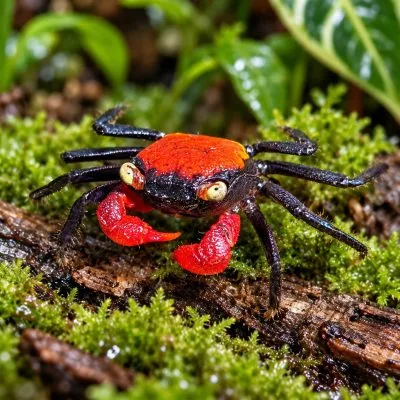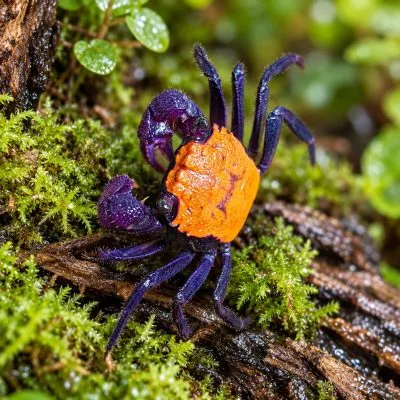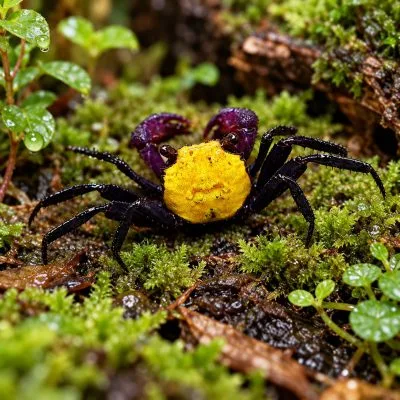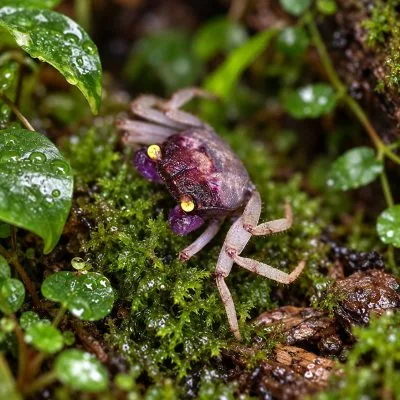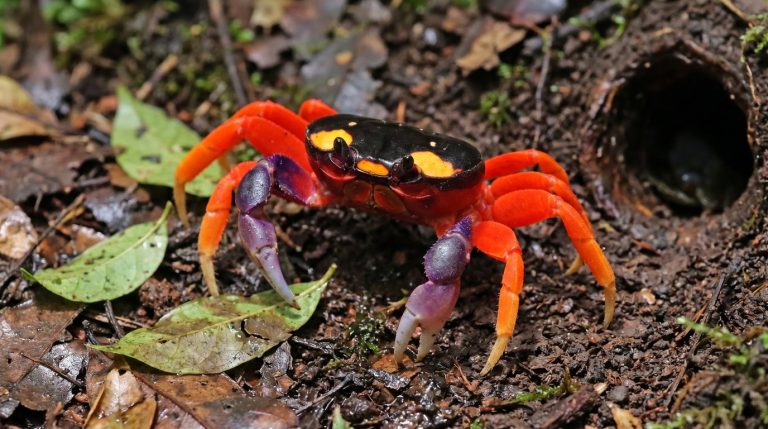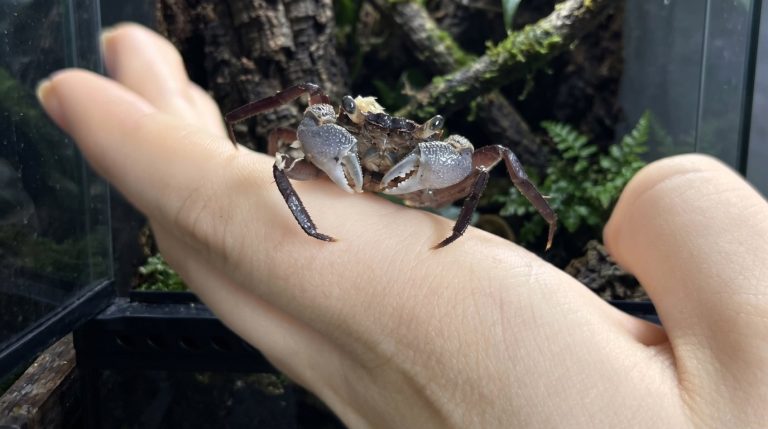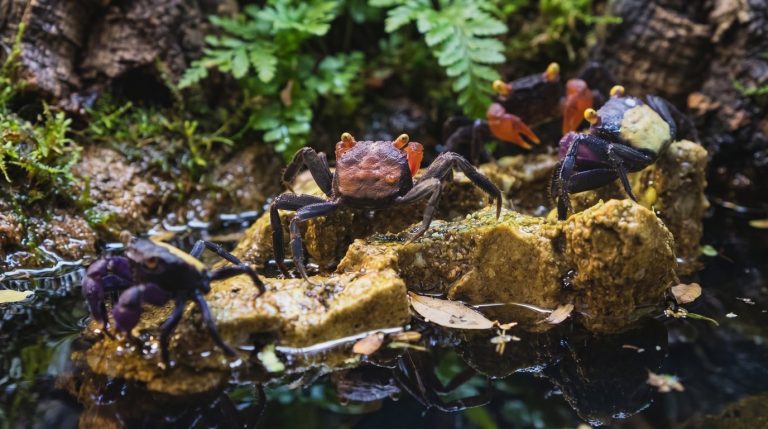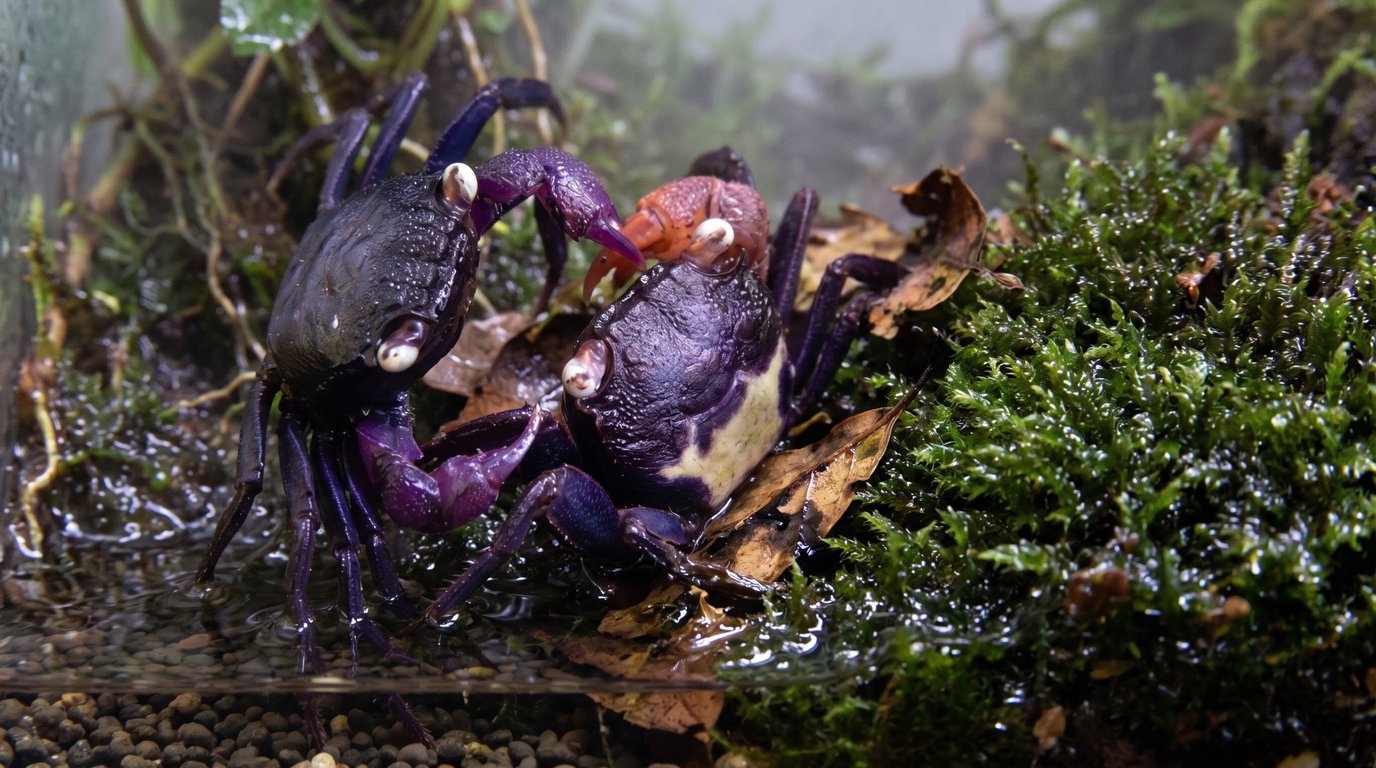
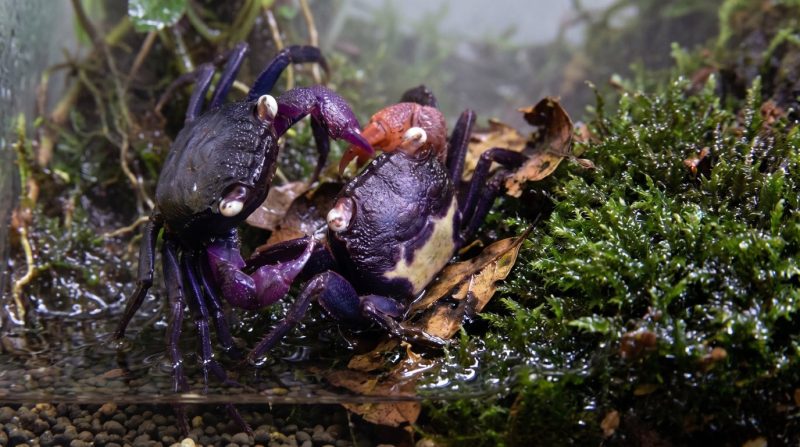
As long as the air stays humid and there’s water to climb into, a vampire crab can stay out of water nearly all the time. These are land crabs. In a lidded paludarium they live on damp soil and moss and go down into the water now and then, and no clock is running while they’re out. Being out of water isn’t the danger. Drying out is, and a crab loose in your room starts drying out at once.
How do vampire crabs breathe out of water?
Vampire crabs breathe air with their gills, and that’s what lets them live on land. Crabs in their family, the Sesarmidae, hold water inside their gill chambers and keep moving it over the gills, which keeps oxygen coming in while they’re active out of the water.1 That’s described for the family as a whole, but it fits what you see in a vampire crab tank.
In our paludariums, the crabs spend their time on land and climb down into the water from time to time to feed and to molt.
So a crab that’s been sitting on the land all evening isn’t stranded. It’s home. What it can’t do is leave water behind for good. Even among the most land-living crabs, no known crab is completely independent of water through its whole life cycle,2 which is why vampire crab care always keeps a water section within reach.
How often does a vampire crab need to get into the water?
Whenever it wants to. Your crab goes in when it needs to, with no schedule for you to keep, so your job is to have water there every hour of the day, in a section every crab can climb into, get fully under and climb back out of.
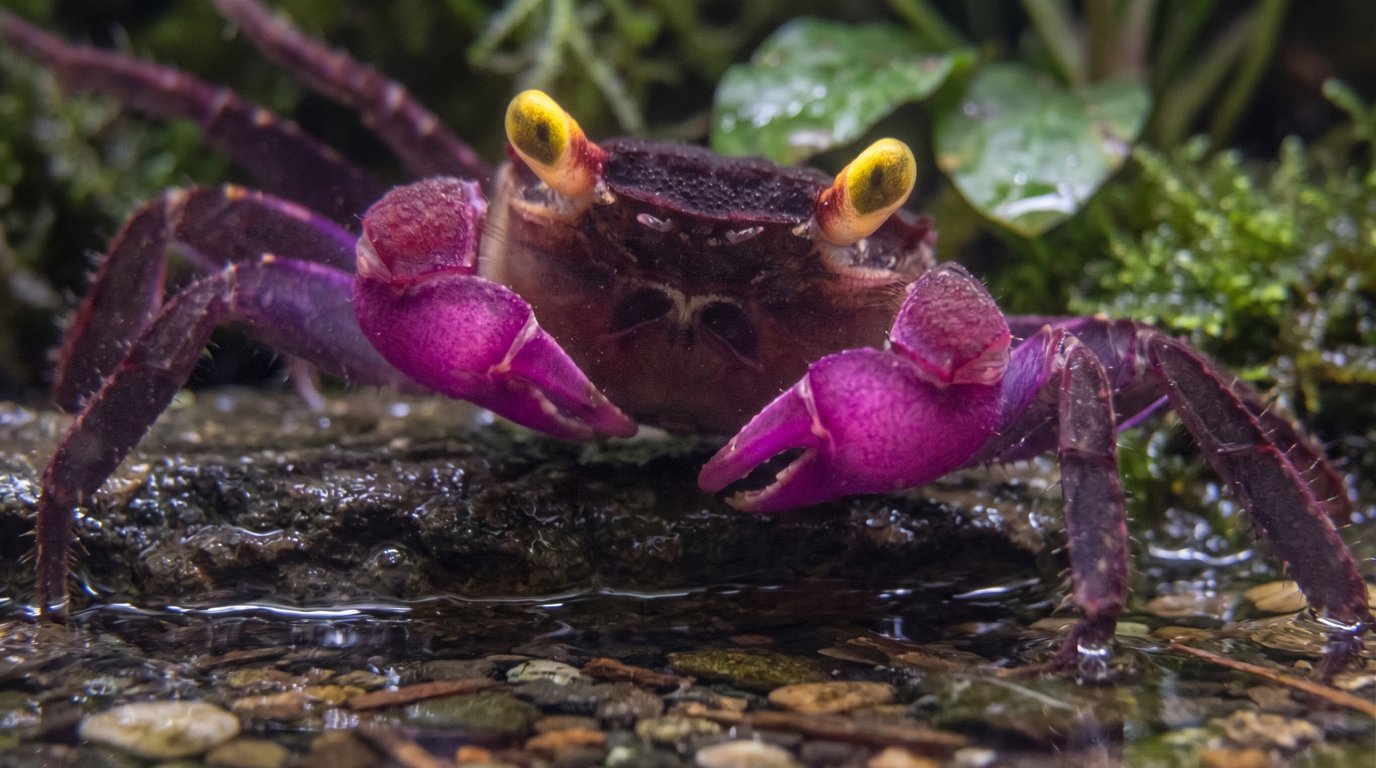
Why fully under? Molting is the time a crab needs that water most. A vampire crab goes into the water to molt, which is why vampire crab molting goes wrong in a tank where the only water is a damp sponge or a dish too shallow to cover the crab.
Land crabs also need to drink. In land crabs generally, a crab that goes without drinking loses blood volume and its body fluids get more concentrated, so the whole body dehydrates.3 A water dish that has dried up is something to fix today, not next weekend.
How big the water section should be depends on your largest crab, and how much water vampire crabs need walks through the sizing.
If you’re still planning a tank for your first tank-bred vampire crabs, build the water section in on day one. Adding it later means digging up land the crabs have already made their own.
What dries a vampire crab out inside its own tank?
Dry air does, along with a dry floor, and letting a tank dry out is one of the most common vampire crab mistakes. Land crabs lose most of their water through the shell and the gills, and when a crab dries out, its fine gill surfaces collapse and take in less oxygen.3 A crab stuck in dry air ends up short of both.
Look for these before anything else:
- A lid left open, or cut away for cables, so the humid air escapes.
- A heat mat or a strong light over bare substrate that dries the top layer.
- Moss and soil that look pale and dry between mistings.
- A water dish that has dried up or dropped below what a crab can get under.
A closed tank usually needs misting about once a day, more while new plants and moss are settling in, and the moss tells you when it’s due. The routine for how to keep a vampire crab tank humid comes down to the lid, damp moss and that misting.
How long can a vampire crab survive outside the tank?
Not long enough to wait and see. A vampire crab loose in the room starts drying out at once, so treat it as urgent. Nobody has timed how long it lasts, and the hour counts you’ll find in care sheets don’t trace back to a measured crab.
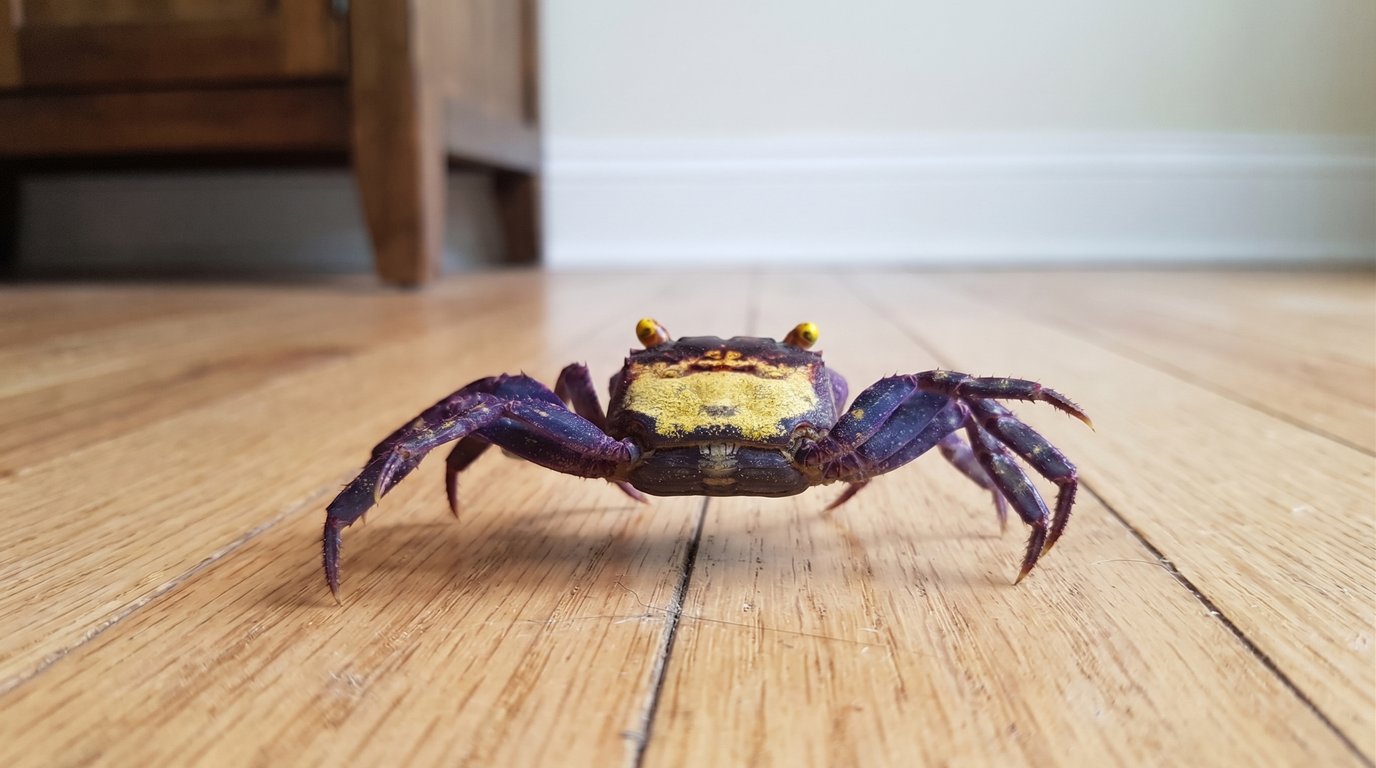
In ordinary room air, a crab keeps losing water through its shell and gills with nothing to put it back.3 Red claw crabs, a different sesarmid crab kept by hobbyists, show where that ends: escaped ones turn up dried out and dead behind furniture or in other rooms, in one case after only a day or two out of the tank.
Before you search the house, make sure the crab is really gone. A missing vampire crab may well be dug in, hiding or molting inside the tank.
Then look for the way out. A crab can only leave a closed tank through a gap, and the gaps that let vampire crabs escape from an open-top enclosure are the same ones around cables, tubing and sliding doors. Search low and close to the tank first: under the stand, behind furniture, along the walls and anywhere damp. Vampire crabs are mostly active after dark, so check again with a flashlight at night.
What to do when you find your vampire crab out of the tank
Get it back onto damp land beside the water and let it choose. Go gently, because a crab that has been drying out has less left to give.
- Slide a cup over the crab and a piece of card under it, so you lift it without grabbing a leg.
- Set it on damp moss or soil at the edge of the water section, not straight into the water. A land crab that can’t get out of the water can drown,4 and a weak crab may not manage the climb, which is why vampire crabs can’t live in water full time.
- Mist the land around it, close the lid and keep the lights low for the rest of the day.
- Find the gap it used and close it before dark.
- Count your crabs over the next few nights. If one found a way out, another may have too.
Then leave it alone. A tight lid and damp land mean you’ll rarely need these steps. You choose Male or Female for each crab on the product page when you order, and everything in our catalog is bred or propagated in our own tanks.
References
4 Sources
- Species-specific gill’s microbiome of eight crab species with different breathing adaptations, Scientific Reports 13, 2023.
- Wolfe et al., Convergent Adaptation of True Crabs (Decapoda: Brachyura) to a Gradient of Terrestrial Environments, Systematic Biology 73(2), 2024.
- Lucu and Turner, Ionic regulatory strategies of crabs: the transition from water to land, Frontiers in Physiology 15, 2024.
- O’Mahoney and Full, Respiration of crabs in air and water (hosted copy on a University of California, Berkeley lab site), Comparative Biochemistry and Physiology Part A 79(2), 1984.
Ready to get started?
Shop our Vampire Crab collection
8 products available · Live Arrival Guarantee