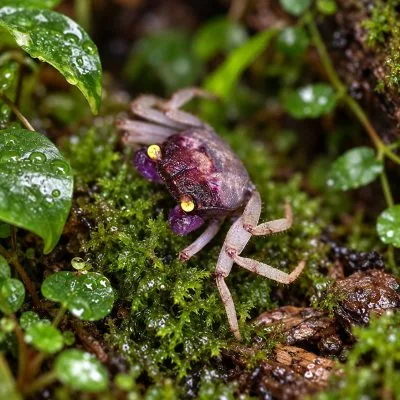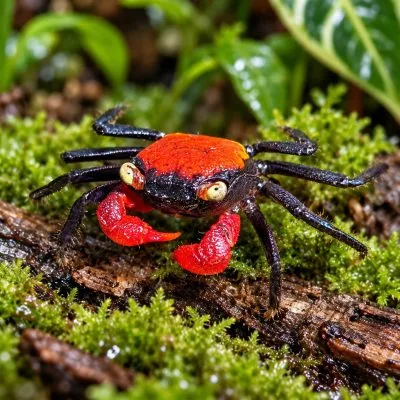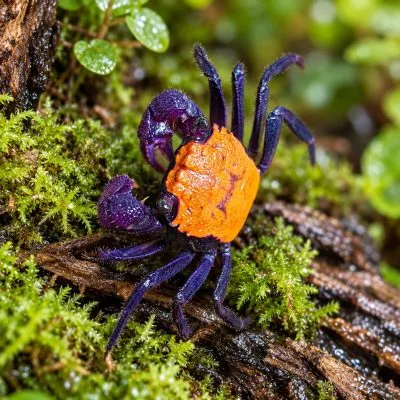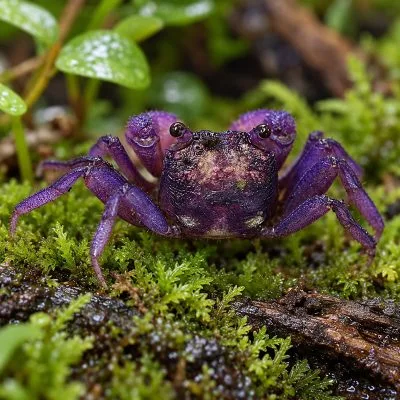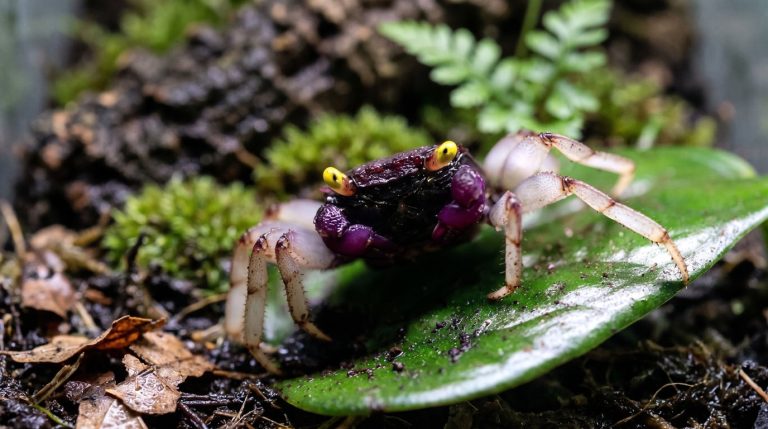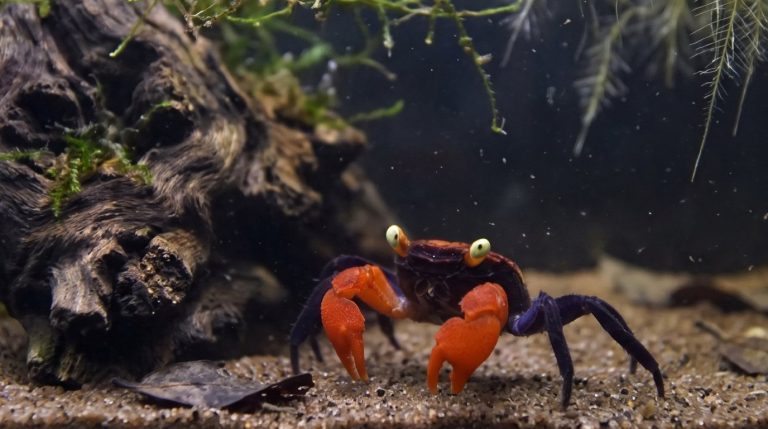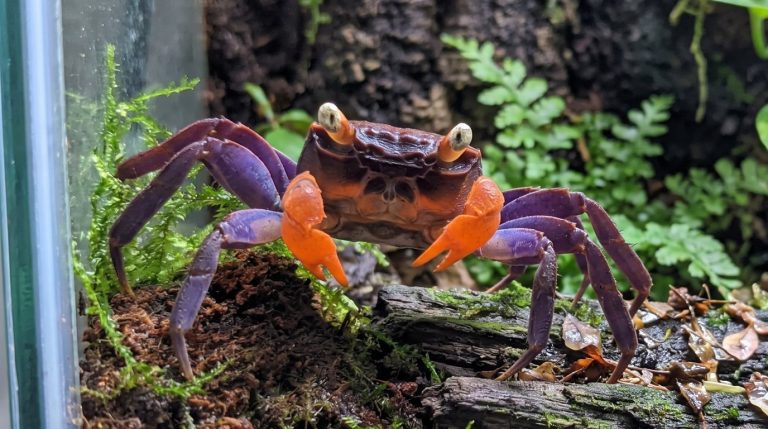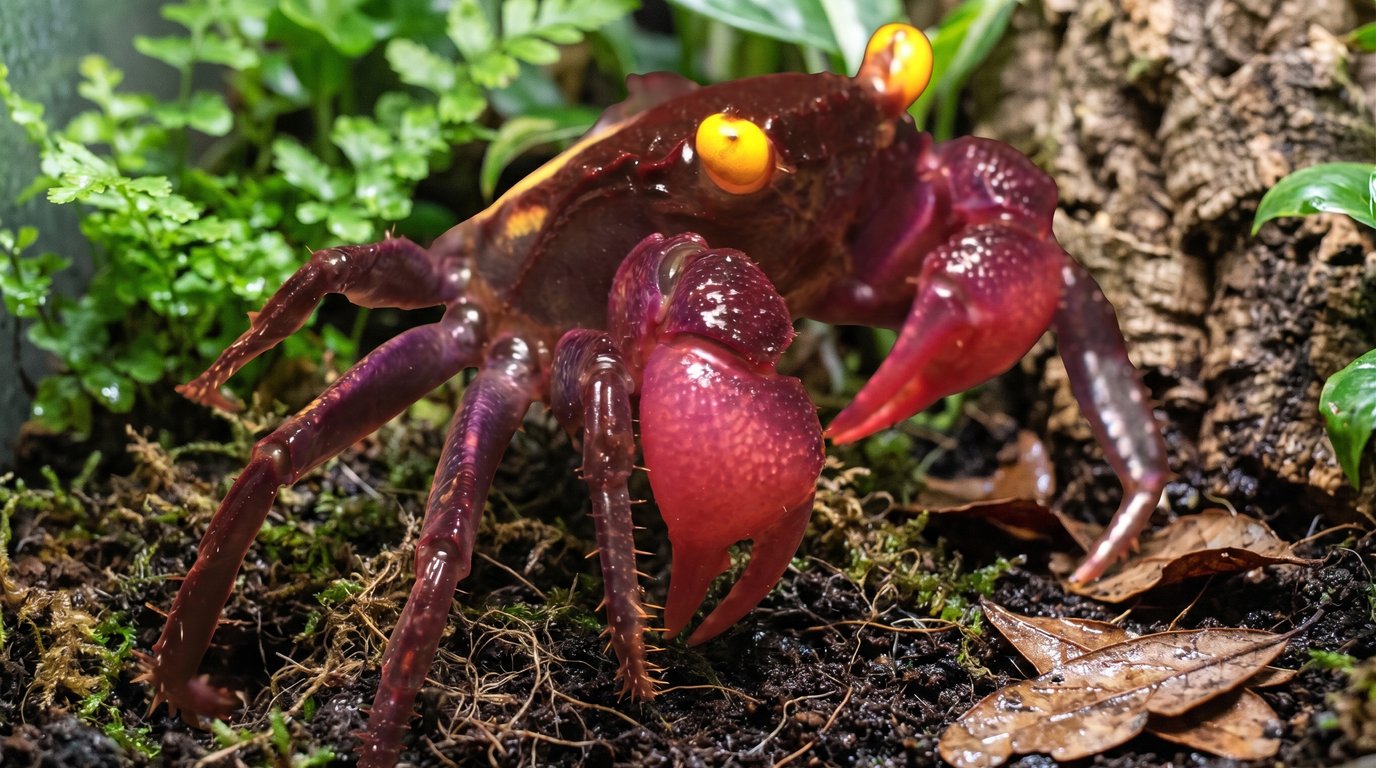
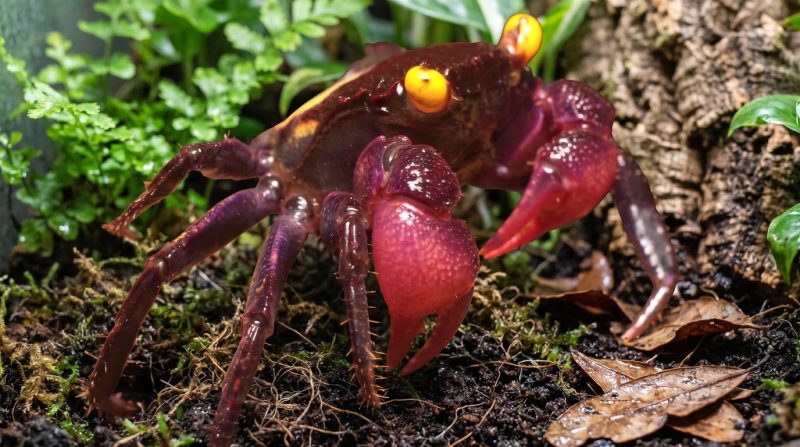
Vampire crabs need most of the tank floor as land, with the water section taking the smaller share. They’re land crabs that spend their days on damp soil and moss, so the land is where they actually live. The useful way to measure it isn’t square inches. It’s hides: enough damp, broken-up land that every crab can be out of sight at the same moment, with some hiding spots still empty.
Why do vampire crabs need more land than water?
Because the land is where they live. Vampire crabs are land crabs, and two Java species long sold under that name, Geosesarma dennerle and Geosesarma hagen, show what that means in the wild: they hide under rocks and dense plants, dig burrows near the water’s edge, and adult G. hagen are seldom found in the water at all.1
In our paludariums, the crabs spend their time on land and climb down into the water from time to time to feed and to molt.
So think of the land as the house and the water as a place they visit. That split runs through all of vampire crab care, from where you put the food to where you look for a crab you haven’t seen in days.
What land-to-water ratio should a vampire crab tank have?
Most of the floor as land. The exact split matters less than care guides make it sound. You’ll see 80/20, 75/25 and 70/30 quoted for vampire crabs, and they’re rules of thumb passed between care sheets. Any of them is a fine place to start.
We’d check two things instead of the percentage. First, every crab can get fully under the water somewhere, which comes down to depth and an easy way out, as how much water vampire crabs need explains. Second, the land that’s left holds enough hides for your group.
Tempted to give them a bigger pool just in case? Don’t. Every inch of extra water is floor they can’t hide on, and a tank that’s mostly water is the wrong home for a land crab. In a vampire crab tank setup, the land rises from the waterline toward the back, so most of the floor ends up above the water without any measuring.
How much land does each vampire crab need?
Enough for a hide of its own, plus spares. Nobody has tested a land area per vampire crab, and the per-crab figures on care sheets don’t trace back to a counted group, so count hides instead.
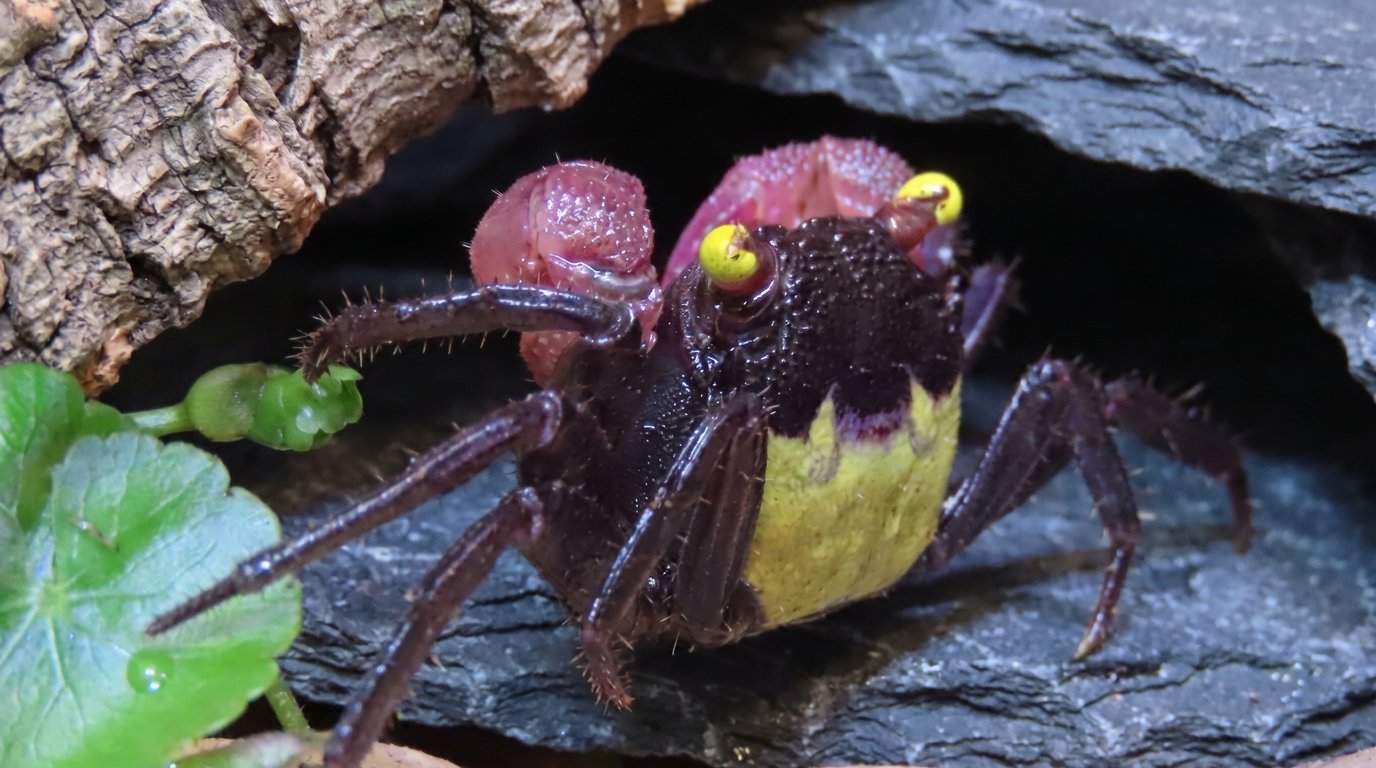
The crabs themselves are small. The type specimens of G. dennerle and G. hagen measure 14.4 mm and 13.9 mm across the shell, a little over half an inch.1 A crab that size doesn’t need much room to walk. What it needs is cover. By day, vampire crabs sit hidden in burrows they dig, in caves and crevices, under stones, cork or leaves, or among dense plants, and you can go days without seeing one.
So build the land, put in the hides, and add crabs only while every crab can be out of sight at once and some hides stay empty. That count, not the tank’s gallons, is what sets how many vampire crabs can live together on the land you’ve built.
Plan the land and the hides before you order your tank-bred vampire crabs. You choose Male or Female for each crab on the product page, so you can match the group to the hides you already have.
Why cover matters more once a male moves in
In a group, a dominant male can chase the others, and crabs lose legs and claws in those fights, sometimes several at once. Open floor doesn’t help a crab that’s being chased. Rocks, cork and plants that break up the line of sight across the land do, because a chased crab needs somewhere to get out of view.
Is one male still going after everyone, hides or not? Then more land won’t fix it, and it’s time to separate an aggressive male vampire crab.
What makes land usable for vampire crabs?
Damp ground with things to get under. A flat sheet of open substrate counts for less than its size suggests, because a crab has nowhere to go on it. Before you count your land as land, run through these:
- The soil and moss stay damp to the touch between mistings.
- No part of the land sits in standing water or stays soggy.
- Stones, cork, leaf litter or dense plants cover a good part of the surface.
- Cover runs right down to the water’s edge, not just at the back.
- Something to climb, such as cork, branches or plants growing up the back.
Dry land is land the crabs won’t use, and dry air is a common way a vampire crab tank goes wrong. A closed lid, damp moss and misting about once a day keep it right, and that routine is most of how to keep a vampire crab tank humid. Soggy land fails the other way. Moss dies back where the ground stays waterlogged, so aim for damp, not wet.
The water’s edge deserves cover too. In the wild, young G. dennerle and G. hagen are found closer to the waterline than the adults,1 so moss and plants along the edge give smaller crabs somewhere to be.
How deep should the land be for vampire crabs?
Deep enough, in at least one spot, for a crab to dig in until it’s out of sight. Keepers lay about 2-10 inches (5-25 cm) of soil, from the shallow end to the deepest point. Judge it by the crabs: if they dig burrows and disappear into them, the soil is deep enough.
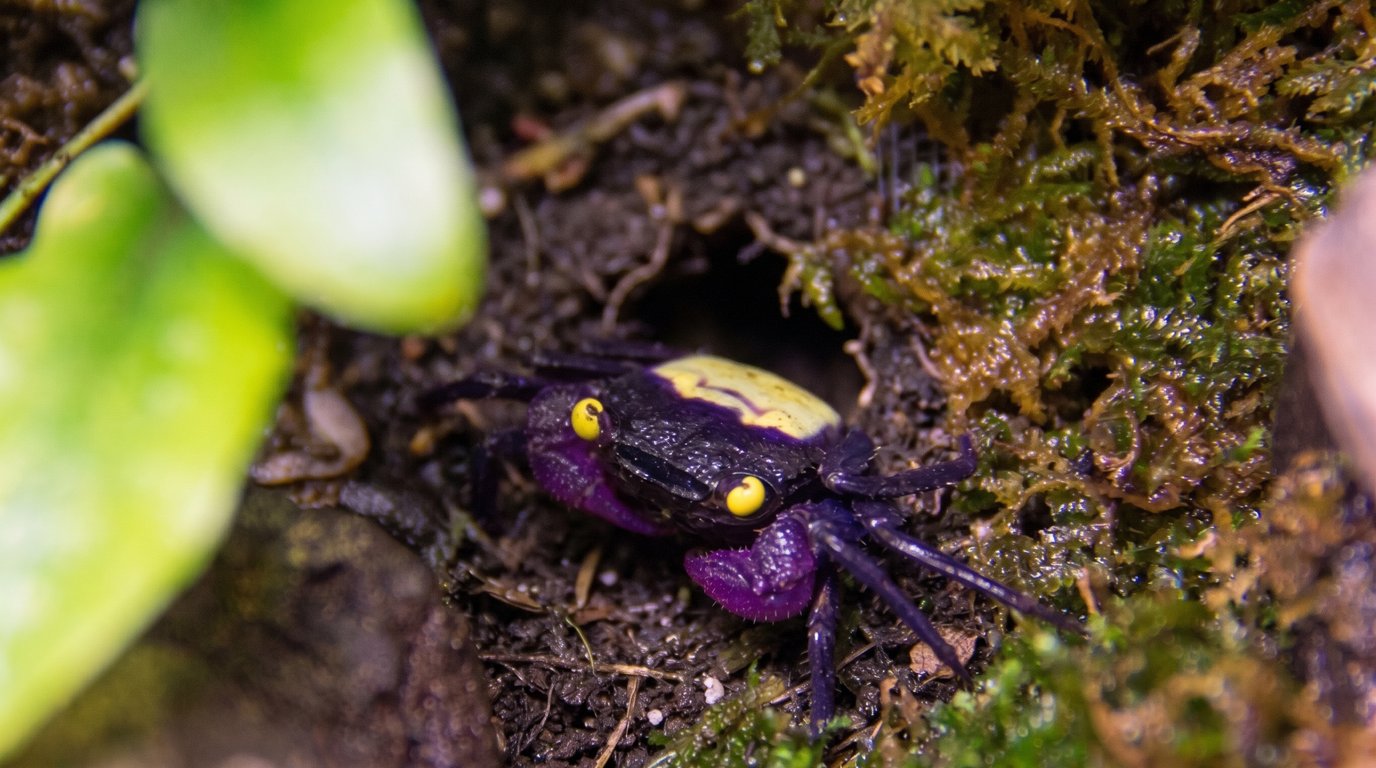
The whole floor doesn’t have to be deep. Mound the substrate higher toward the back, so one end gives the crabs deep soil to tunnel in and the front slopes down to the water. Loose, damp soil that holds a tunnel works better here than bare gravel, which won’t hold a tunnel. A damp soil mix with nothing added is the best substrate for vampire crabs for that deep end.
That deep spot matters most for a berried female. She spends most of her brooding time hidden, often dug in or in a burrow, and she’s rarely seen until the crablets appear. If you’re planning on vampire crab breeding, build up that soil before a female needs it, because digging up the land later disturbs the very crab you’re trying to leave alone.
Once the land is built and the hides outnumber the crabs, you’re ready to stock. Everything in our catalog is bred or propagated in our own tanks.
References
1 Source
- New species of “vampire crabs” (Geosesarma De Man, 1892) from central Java, Indonesia, and the identity of Sesarma (Geosesarma) nodulifera De Man, 1892, Ng P.K.L., Schubart C.D. and Lukhaup C., Raffles Bulletin of Zoology 63: 3-13, 2015.
Ready to get started?
Shop our Vampire Crab collection
8 products available · Live Arrival Guarantee