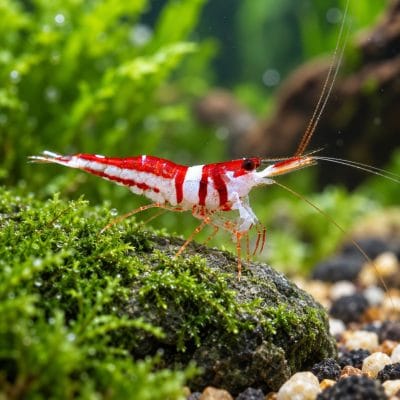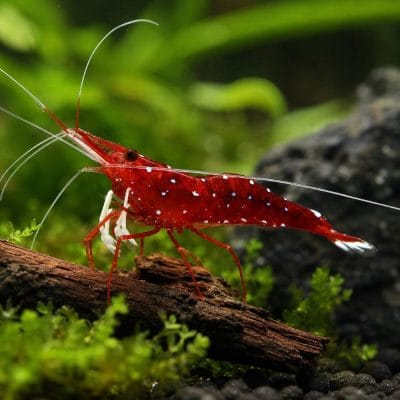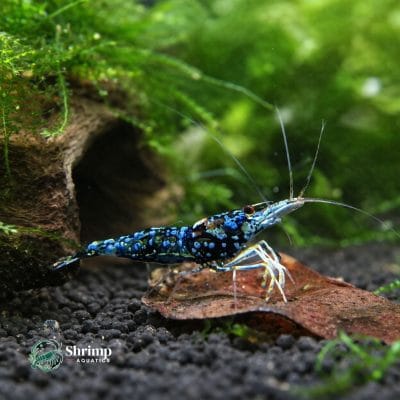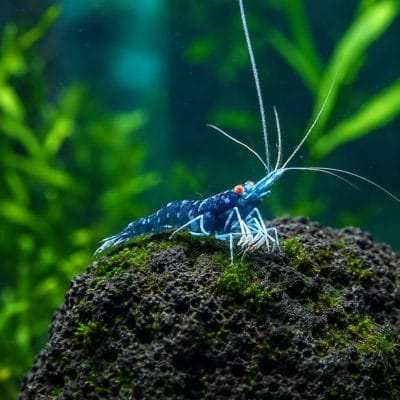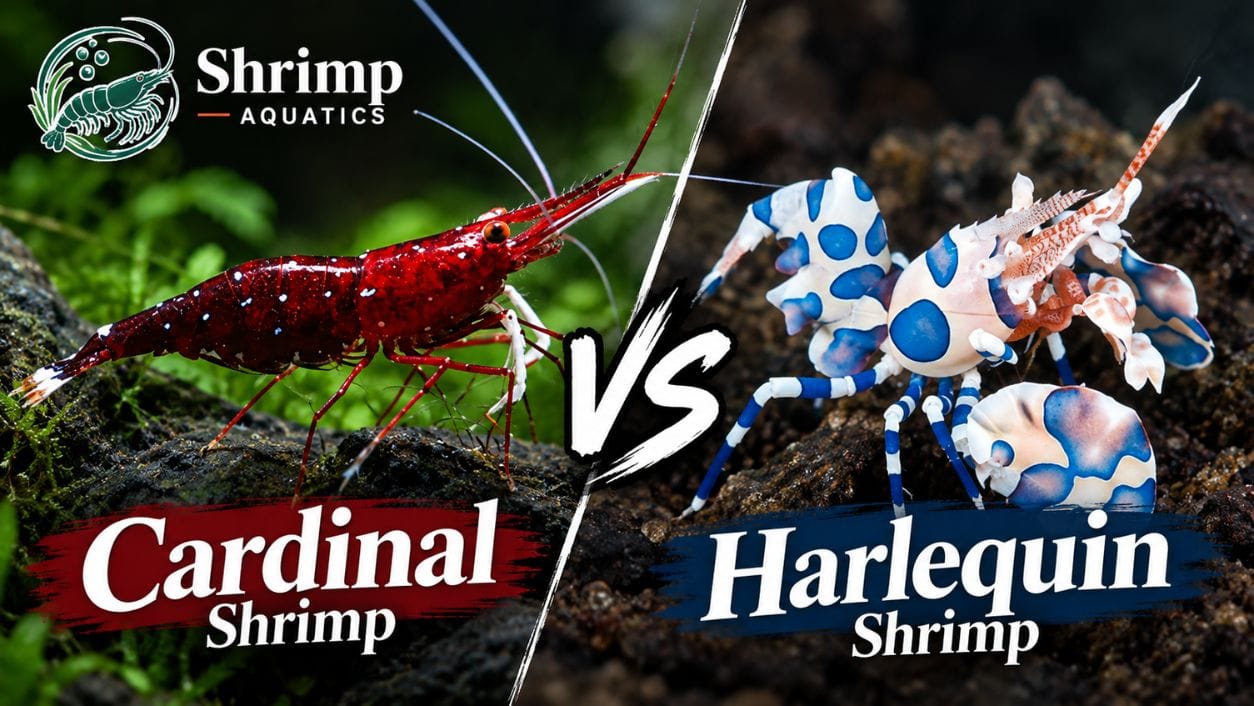
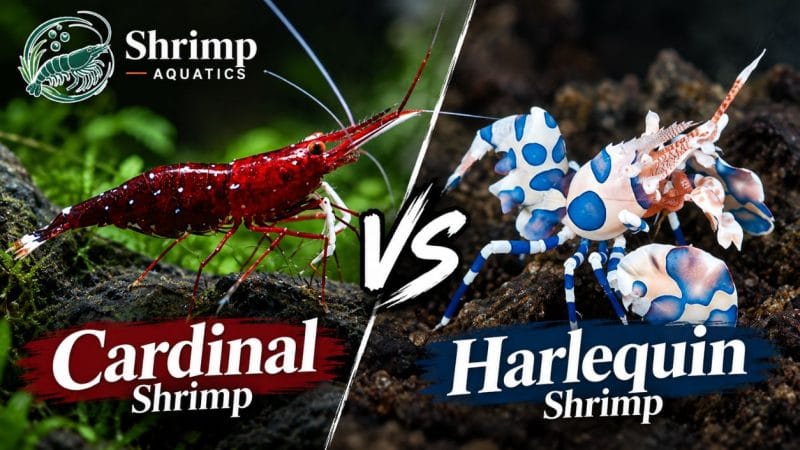
Two names, three animals, and one of them isn’t even freshwater. Cardinal shrimp and Sulawesi harlequin shrimp are both Caridina from the ancient lakes of Sulawesi, and they want the same warm, alkaline water. The harlequin shrimp a reef store sells is a different animal altogether.
Is the harlequin shrimp in front of you freshwater or marine?
Ask what water it came out of before you look at the pattern. Two unrelated animals are sold as harlequin shrimp, and only one of them belongs anywhere near a Sulawesi tank.
The saltwater one is what most reef keepers mean by the name. The World Register of Marine Species lists Hymenocera picta Dana, 1852 as an accepted marine species in the family Palaemonidae, and treats Hymenocera elegans Heller, 1861 as a synonym of it.1 That shrimp eats starfish and effectively nothing else. A published account of one feeding on a blue star has it holding the star upended for 30-60 minutes, starting on the tube feet and gonad tissue. The same paper names that starfish-only diet as the real problem for hobbyists who want the species in a reef tank.2 None of it transfers to fresh water, and no acclimation gets it there.
The freshwater one is the shrimp a Sulawesi seller means. That is Caridina woltereckae, an atyid shrimp endemic to Lake Towuti.3 It sits in the same genus as the cardinal shrimp you’re weighing it against. From here on, harlequin means that one.
| Cardinal shrimp | Sulawesi harlequin | Marine harlequin | |
|---|---|---|---|
| Species | Caridina dennerli | Caridina woltereckae | Hymenocera picta |
| Water | Fresh, warm and alkaline | Fresh, warm and alkaline | Salt water only |
| Wild home | Lake Matano, Sulawesi | Lake Towuti, Sulawesi | Marine, no freshwater range |
| What it eats in a tank | Biofilm and algae off rock | Biofilm and algae off rock | Live sea stars |
How to tell a cardinal shrimp from a Sulawesi harlequin
Spots against stripes, and you can do it from a photo. The 2009 revision of the Sulawesi Caridina describes C. dennerli as dark red to purple, with several conspicuous white spots and one distinct white dot on the upper rear of the abdomen. The claws and carpus of the first and second pairs of legs are bright white, and the species is endemic to Lake Matano.3 Those white front legs are where the other trade name, Sulawesi White Sock shrimp, comes from.
C. woltereckae is the banded one. The same revision describes it as a large bodied Lake Towuti species that carries the harlequin pattern and lives on rock.3 Bold dark and pale bands, no field of white dots. If the listing photo shows banding, you’re not looking at a cardinal, whatever the seller typed above it.
Names drift faster than shrimp do. Several Sulawesi shrimp types on sale today trace back to one species with a color line selected on top, so the scientific name on the listing is worth more to you than the common one.
Do cardinal and harlequin shrimp need different water?
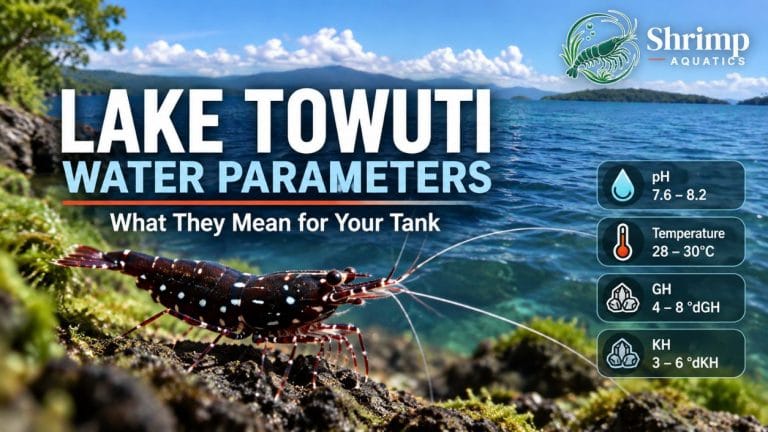
No. Neither one gets a different target from us, and there’s no clever middle setting to find. Both sit in the range we hold every Sulawesi lake species to.
| Temperature | 79-86°F (26-30°C) |
|---|---|
| pH | 7.5-8.5 |
| GH | 4-8 dGH |
| KH | 3-6 dKH |
| TDS | 150-250 ppm |
| Nitrate | Keep it under 10 ppm |
| Substrate | Inert rock and sand, never a pH lowering soil |
| Difficulty | Advanced to expert |
Holding Sulawesi shrimp water parameters steady is most of the work in either tank, and it’s the same work for both. That’s good news, really. Choosing between these two is a choice about the animal, not about the equipment bill.
Which raises the obvious question. If the water is identical, why not keep both?
In our Sulawesi shrimp tanks we have not seen routine crossing among unrelated Sulawesi species, but we treat White Sock, Blue Ghost, Yellow Ghost and Oiran as lines that may cross when kept together. Our advice is still one species per tank.
Want both under one lid anyway? Read what keepers have documented about Sulawesi shrimp crossbreeding first. A hybrid shrimplet isn’t something you can reliably spot months later.
What picking cardinal over harlequin changes in your tank
Mostly it changes what you look at. Nothing in the published record ranks one of them as easier to keep than the other.
On brood size, the 2009 revision counted eggs on wild females at the moment of collection: 8-14 eggs on seven C. dennerli females, and 19-29 on two C. woltereckae females.3 Read those numbers carefully. They come from a handful of wild animals, two of them in the harlequin’s case. They say what a female was carrying in the lake, not what your tank will produce, and we wouldn’t plan a colony around the gap between them.
On size, the same paper measured 53 C. dennerli at a carapace length of 1.5-3.4 mm, and calls C. woltereckae the larger bodied of the two.3 Carapace length is a museum measurement, not the body length a care sheet quotes for how big Sulawesi shrimp get. The tidy “about an inch” figure repeated across the hobby has no measurement behind it. Take this much from it: the harlequin is the bigger shrimp, and neither is big.
The last difference isn’t biology at all. It’s what you can actually buy. Cardinal is sold under its own name and under a shelf of color line names, so the trade name alone won’t tell you which species is in the bag. We stock both: several of our lines are color forms of C. dennerli, and our Sulawesi Harlequin is tank-bred C. woltereckae. Wherever you buy, ask for the species name in writing before you settle on one, because the banded pattern and the price are easier to copy than the animal.
The third striped Towuti shrimp you should not be sold
There’s a second banded Lake Towuti shrimp species, and it gets called harlequin too. Caridina spongicola was described in 2006 from the outlet bay on the lake’s west shore. It lives on a freshwater sponge, or inside the sponge’s openings, at depths of 2-5 m. It’s tiny, with a carapace of 1.8-2.8 mm, dark bands across the body, pale front legs and a white stripe along the abdomen, and it is endemic to that one lake.4
You can see the problem. An animal whose home is a living sponge in one bay is not one you can feed from a jar, and we wouldn’t buy one at any price. If a listing uses the harlequin name and mentions sponges, ask the seller for the species name in writing before you pay.
Check these on the listing before you order either one
Both species are in trouble in the wild, and that shapes what you should ask. The IUCN Red List assessed C. dennerli on 20 August 2018 as Critically Endangered, tagged Possibly Extinct in the Wild under criterion A2e, with a decreasing population trend.5 C. woltereckae is listed there under the name Harlequin Shrimp Sulawesi. It was assessed on 6 December 2018 as Critically Endangered under criterion A3e, from a single known location. The assessment also records international trade in the species.6
So the questions worth asking are short ones.
- Which species is it, written as a scientific name, not a trade name?
- Is the stock tank-bred, and how long has the seller been breeding it?
- What pH, GH, KH, TDS and temperature is it being kept in right now?
- Does the photo show banding or spots, and does that match the name on the listing?
- Don’t order because the price dropped. A cheap Critically Endangered shrimp is a question, not a bargain.
Every shrimp we sell is bred by Shrimp Aquatics rather than collected from the wild. Our tank-bred Sulawesi shrimp lines are cardinal and its color morphs. A listing that says Sulawesi White Sock and one that says cardinal shrimp are the same species here.
Here’s the honest bottom line. If your tank holds 79-86°F (26-30°C) and pH 7.5-8.5 steadily, and the rock is already grazed over, either species is a fair choice. Buy the one you like looking at. If it doesn’t, neither is, and the harlequin’s rarity makes it the worse animal to learn on.
References
6 Sources
- Hymenocera picta Dana, 1852, taxon record, World Register of Marine Species, accessed 12 September 2026.
- Feeding behavior of Harlequin Shrimp Hymenocera picta Dana, 1852 (Hymenoceridae) on Sea Star Linckia laevigata (Ophidiasteridae), Journal of Threatened Taxa 5(13): 4819-4821, 2013.
- Radiation of endemic species flocks in ancient lakes: systematic revision of the freshwater shrimp Caridina from the ancient lakes of Sulawesi, Indonesia, with the description of eight new species, Raffles Bulletin of Zoology 57(2): 343-452, 2009.
- Caridina spongicola, new species, a freshwater shrimp (Crustacea: Decapoda: Atyidae) from the ancient Malili lake system of Sulawesi, Indonesia, Raffles Bulletin of Zoology 54(2): 271-276, 2006.
- Caridina dennerli, IUCN Red List assessment, IUCN Red List of Threatened Species, assessed 20 August 2018.
- Caridina woltereckae, IUCN Red List assessment, IUCN Red List of Threatened Species, assessed 6 December 2018.
Ready to get started?
Shop our Sulawesi Shrimp collection
27 products available · Live Arrival Guarantee